Global ADHD Network — One of the most highly reviewed ADHD CPD and CME training providers in ADHD diagnosis and neurodiversity training.Global ADHD Network — One of the most highly reviewed ADHD CPD and CME training providers in ADHD diagnosis and neurodiversity training.Global ADHD Network — One of the most highly reviewed ADHD CPD and CME training providers in ADHD diagnosis and neurodiversity training.
Documenting Criterion E: How to Write Up “Not Better Explained by Another Disorder”
Criterion E asks which conditions you considered and why each was set aside. Listing eight names satisfies nobody. The three discriminators that do most of the work, condition-by-condition wording, and what to write when the alternatives cannot be cleanly separated.
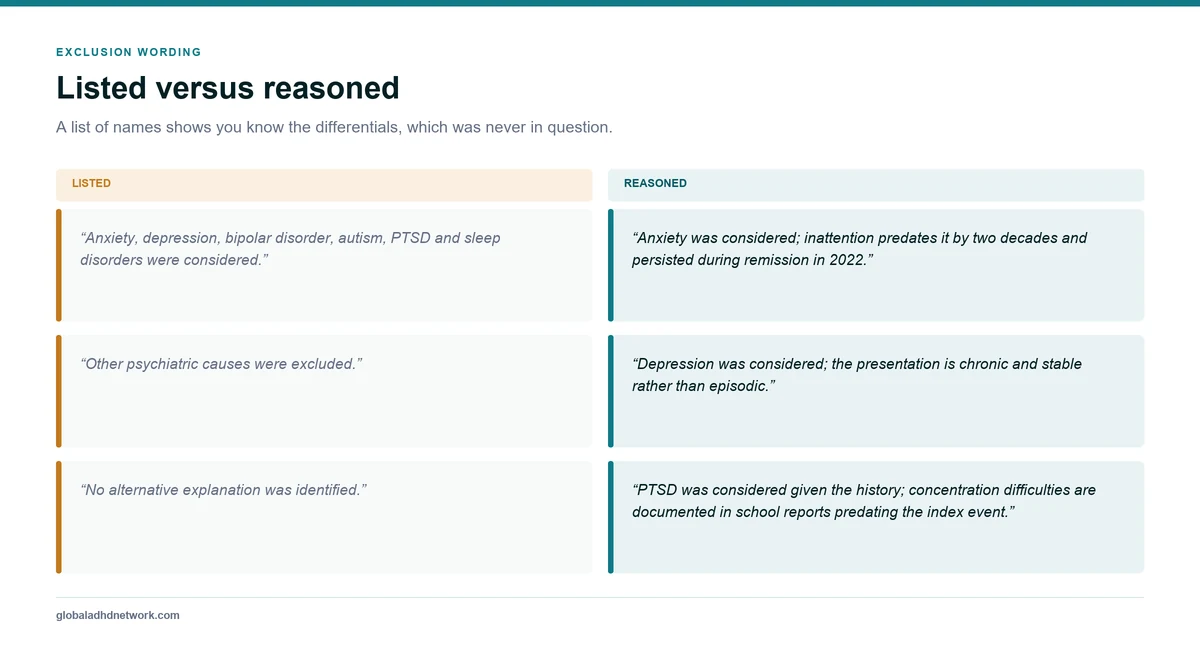
Criterion E is the shortest of the five and the one most often treated as a formality. It asks whether the symptoms are better explained by another mental disorder. Many reports answer it with a list of eight condition names and no verbs.
That list satisfies nobody. It demonstrates that the clinician knows what the differentials are, which was never in question, and says nothing about why any of them was set aside.
This article is about the documentation, not the differential diagnosis itself. The clinical work of distinguishing ADHD from its mimics is covered in depth in DIVA-5 with complex presentations. What follows is how to get that reasoning onto the page.
Who this is for
Consultant psychiatrists and clinical psychologists writing the exclusion paragraph
ADHD nurse specialists documenting a differential agreed in supervision
GPs with an extended role, assessing whether a report has addressed alternatives
Trainees, who tend to over-list and under-reason
Exclusion is not the same question as co-occurrence
Two questions get merged constantly, and separating them fixes most Criterion E writing.
Is this ADHD or something else? That is Criterion E, and it is an exclusion question.
Is this ADHD and something else? That is co-occurrence, and the answer is usually yes.
Anxiety, depression, sleep disruption and substance use co-occur with adult ADHD at rates high enough that their absence is more remarkable than their presence. Finding one does not close the ADHD question. It belongs in the report as a co-occurring diagnosis, not as a reason the assessment stopped.
Say which you are doing. A report that lists anxiety under Criterion E and then diagnoses anxiety in the same document without explaining the distinction reads as confused even when the clinician was not.
Three discriminators that do most of the work
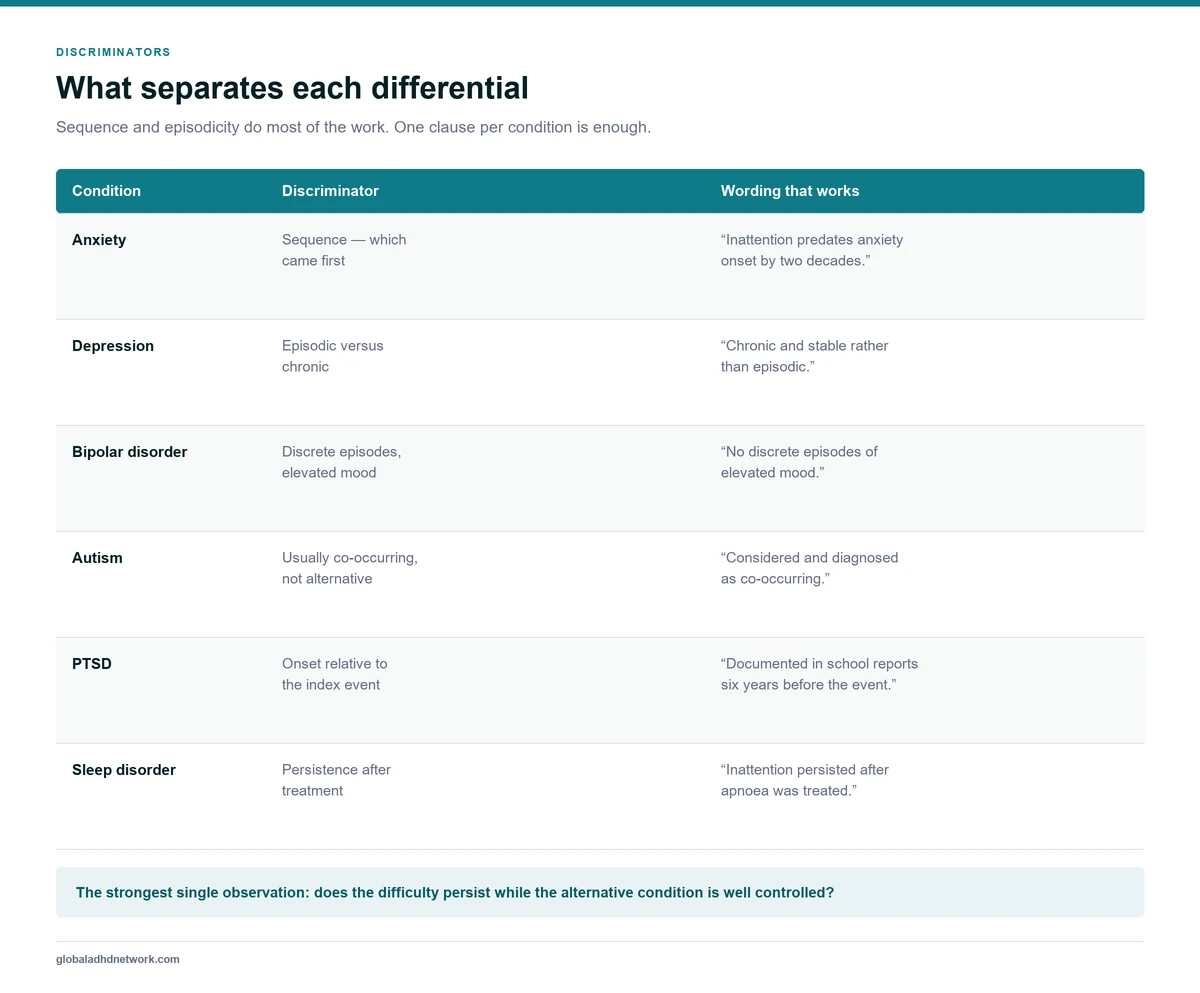
Sequence
Which came first. This is the workhorse. Inattention that predates an anxiety disorder by two decades is not caused by it. Ask for the timeline and record the years.
Episodicity
ADHD is chronic and trait-like. Depression and bipolar disorder are episodic by nature. A difficulty that has been continuously present since primary school is not a mood episode.
Persistence during remission
The most powerful single observation available to you: does the attentional difficulty persist during periods when the alternative condition is well controlled? If someone remains inattentive when their anxiety is treated and their sleep is good, that is close to decisive.
The conditions worth addressing explicitly
You do not need to address everything. Address what a reader would reasonably wonder about, given this patient.
Anxiety disorders — impair concentration directly. Sequence usually separates them. See ADHD and anxiety.
Depression — episodic, and typically accompanied by anhedonia and diurnal variation that ADHD lacks.
Bipolar affective disorder — distinguished by discrete episodes and elevated mood, not merely elevated activity.
Autism — usually co-occurring rather than alternative. See AuDHD assessment.
Trauma and PTSD — hypervigilance and dissociation both resemble inattention. Onset relative to the index event is the discriminator.
Sleep disorders — screen properly; untreated apnoea imitates inattentive ADHD convincingly. See ADHD and sleep.
Substance use — both a differential and a common consequence. See ADHD and addiction.
Physical causes — thyroid function, iron studies, head injury history.
Wording, condition by condition
One clause each. These are the patterns that work:
Anxiety was considered. The attentional difficulties predate the onset of anxiety symptoms by approximately two decades and persisted during a period of remission in 2022 while she was not working.
Depression was considered. The presentation is chronic and stable rather than episodic, and there is no history of anhedonia or diurnal mood variation.
Post-traumatic stress disorder was considered given the history disclosed. The concentration difficulties were documented in school reports predating the index event by six years.
Note what each of those does: it names the condition, gives one discriminating fact, and stops. Three sentences cover three conditions and take a minute to write.
When you cannot fully exclude something
Sometimes the honest position is uncertainty — a patient with a significant trauma history and no childhood documentation, where the two explanations cannot be cleanly separated.
Say so. "The relative contribution of ADHD and post-traumatic symptoms cannot be fully disentangled on current evidence; the ADHD diagnosis is made on the basis of X and should be reviewed if Y" is a legitimate and defensible clinical position. An acknowledged uncertainty is far stronger than a confident sentence a reader can pick apart.
Related guides in this cluster
This article is part of GAN's assessment workflow cluster. The pillar covers the whole pathway; each supporting guide takes one criterion and goes deeper.
Criterion E is written last and should be thought about throughout. Trying to reconstruct the exclusion reasoning at the point of writing is what produces the bare list.
A workable sequence: screen for the obvious alternatives at referral, take the timeline during the history so that sequence is captured naturally, and note the discriminator at the point you notice it rather than at the end. By the time you write the paragraph, you are transcribing rather than reasoning.
The single most useful habit is to record dates during the history. “Anxiety since her mid-twenties, concentration difficulties since primary school” is a Criterion E paragraph already written, captured in passing during Criterion A.
The trap of the tidy exclusion
There is a risk in the opposite direction, and it is worth naming.
A confident exclusion paragraph can conceal a diagnostic error. Anxiety is the most common casualty: it is genuinely true that inattention often predates anxiety, and it is also true that severe anxiety produces attentional symptoms indistinguishable from ADHD in the room. A clinician who has learned the sequence argument can apply it reflexively and stop thinking.
The safeguard is to ask what would change your mind. If the answer is nothing, the exclusion is not reasoning. Where you have genuinely weighed an alternative and rejected it, you can usually say what evidence would have pointed the other way — and a report that includes that sentence reads as considered rather than formulaic.
Substance use sits on both sides
Worth handling separately because it is the differential most often mishandled.
Stimulant use, alcohol and cannabis all produce attentional and executive symptoms, so substance use is a genuine differential. It is also a common consequence of untreated ADHD, and a frequent form of self-medication. Treating it purely as an exclusion criterion delays diagnosis for a group who need it particularly badly.
The practical position is to establish the timeline — did the attentional difficulties predate substance use, which they usually do — and to document current use and its likely contribution rather than requiring abstinence before assessment. Where use is heavy enough to make assessment unreliable, say that explicitly and set out what would need to change. Our guide to ADHD and addiction covers the relationship in more depth.
Reviewing the exclusion later
Criterion E is a judgement made on the evidence available on the day, and evidence changes.
A patient whose apnoea is subsequently treated, whose trauma becomes disclosable, or who turns out to have a family history nobody mentioned, may warrant a revisited formulation. Building that expectation into the report — a sentence specifying what would prompt review — costs nothing and makes the document more robust, not less.
It also protects the patient. A diagnosis framed as provisional-pending-X is easier to revise than one framed as settled, and revision without loss of face is better for everyone than a second opinion sought elsewhere.
Learning disability, cognitive ability and the exclusion nobody documents
One differential goes unaddressed more often than any other, and it is the one most likely to matter medico-legally.
DSM-5 asks whether the symptoms are consistent with the person's developmental level. Where general cognitive ability is significantly below average, inattention and disorganisation may reflect that rather than a separate attentional disorder — or, more commonly, both may be present and the ADHD may be genuinely additional.
You do not need formal cognitive testing in every assessment. You do need to have thought about it, and to say so where there are indicators: a history of significant educational support, difficulty with the assessment process itself, or an informant account describing global rather than selective difficulty.
A single sentence covers it. "There was no history of significant global developmental difficulty; educational attainment was age-appropriate until secondary school, and the difficulties described were selective rather than generalised." Where you do suspect a learning disability, say what you are recommending rather than diagnosing around it.
Writing Criterion E when co-occurrence is the answer
Most of the time the honest conclusion is not that the alternatives were excluded but that ADHD sits alongside them, and the paragraph should say so plainly.
Generalised anxiety disorder is also present and is considered co-occurring rather than alternative. The attentional difficulties predate anxiety onset by approximately two decades and persisted during a documented period of remission. Both diagnoses are made, and the treatment plan addresses sequencing.
That paragraph does three things at once: it satisfies Criterion E, it records the second diagnosis, and it signals that the clinician has thought about the interaction rather than treating the conditions as unrelated. It is also considerably more useful to the GP who has to act on it than a bare exclusion list would be.
Frequently Asked Questions
What does DSM-5 Criterion E require for ADHD?
That the symptoms are not better explained by another mental disorder. It is an exclusion criterion, and it should be documented with the conditions considered and the reason each was set aside.
Is Criterion E the same as differential diagnosis?
Closely related but not identical. Differential diagnosis is the clinical reasoning; Criterion E is the requirement that the reasoning appears in the record with a stated conclusion.
Can ADHD be diagnosed alongside anxiety or depression?
Yes. Co-occurrence is common. Criterion E asks whether another condition better explains the presentation, not whether another condition is present.
How many conditions should a Criterion E paragraph address?
Those a reader would reasonably expect given the presentation — typically three to six. One clause of reasoning each is enough.
What if ADHD and another condition cannot be separated?
State the uncertainty explicitly, give the basis on which the diagnosis was made, and specify what would prompt review. An acknowledged limitation is more defensible than false confidence.
%20(1).webp)