Global ADHD Network — One of the most highly reviewed ADHD CPD and CME training providers in ADHD diagnosis and neurodiversity training.Global ADHD Network — One of the most highly reviewed ADHD CPD and CME training providers in ADHD diagnosis and neurodiversity training.Global ADHD Network — One of the most highly reviewed ADHD CPD and CME training providers in ADHD diagnosis and neurodiversity training.
The Complete Adult ADHD Assessment Checklist: A Clinician's Step-by-Step Guide to DSM-5 and NICE NG87
The whole adult ADHD pathway in one guide: what to gather before the appointment, how to evidence DSM-5 Criteria A to E, the five functional impairment domains, differential diagnosis, and the report that has to carry all of it. Written for the clinicians who sign it off.
The assessment went fine. Ninety minutes, a full symptom history, an informant on the phone, a patient who left the room looking like someone had finally explained their own life to them. Then the report came back from the ICB with a query against Criterion B, and you realised that everything you knew about that patient's childhood was in your head rather than on the page.
That is where most adult ADHD assessments come unstuck. Not the clinical judgement — the evidence trail behind it.
This is a working guide to the whole pathway, from what you gather before the appointment to what you write at the end. It follows the structure of the checklist we use in our own training, and it is built around the two frameworks a UK assessment has to satisfy at once: the DSM-5 diagnostic criteria, and NICE guideline NG87.
Who this guide is for
This is written for the people who carry out and sign off adult ADHD assessments:
Consultant and specialty psychiatrists running adult ADHD clinics in NHS or private settings.
Clinical psychologists undertaking neurodevelopmental assessment, particularly where autism is also in question.
ADHD nurse specialists and nurse prescribers, who under NICE NG87 may diagnose where they hold the relevant training and expertise.
GPs with an extended role in ADHD, whose involvement is expanding as assessment moves closer to primary care — our guide for GPs and primary care clinicians covers the wider pathway.
Trainees and clinicians moving into neurodevelopmental work from general psychiatry, CAMHS or liaison, who know the criteria but not yet the evidential habits.
If you are a patient or a family member looking for information about assessment, our guide to how long an ADHD diagnosis takes in the UK will be more useful than this one.
Preparing for an adult ADHD assessment: what to gather first
A first appointment that starts with information-gathering is a first appointment that will overrun. Most of the preparation is administrative, and most of it can be done by someone who is not you.
Before the patient arrives, you want:
The referral reason and presenting concerns reviewed, not skimmed
A self-report screening tool completed — usually the ASRS v1.1
An informant invited, ideally someone who knew the patient before age 12
School reports and previous records requested where they exist
Interpreter or reasonable adjustments arranged, booked early rather than on the day
Enough time in the diary — 60 to 90 minutes for a full structured interview
Why the screening tool matters less than you think
Have the referral reason and presenting concerns reviewed rather than skimmed. A screening tool completed in advance — the ASRS v1.1 is the usual choice — tells you nothing diagnostic on its own, but it gives you a starting shape and it saves fifteen minutes of the appointment.
The informant invitation is the highest-value five minutes
The single most useful thing you can do before the patient arrives is ask them to invite an informant. Someone who knew them as a child: a parent, an older sibling, an aunt. Patients often need this explained, because it sounds like you are checking up on them rather than gathering evidence. Say it plainly. DSM-5 asks for evidence that this started before you were twelve, and none of us remembers being nine very accurately.
Request school reports where they exist. Arrange an interpreter or reasonable adjustments if they are needed, and do it early — adjustments booked on the day are usually adjustments that do not happen.
And allocate the time honestly. A full DIVA-5 interview takes sixty to ninety minutes. Booking it into a forty-minute new-patient slot is a decision about the quality of the assessment, whether or not it is framed that way.
ADHD screening tools are not diagnostic instruments
Worth settling early, because it shapes the whole appointment. A completed ASRS is a prompt, not a finding. It tells you which symptoms to probe and it gives the patient a vocabulary. It does not contribute to the criteria, and it should not appear in the report as though it does.
This matters more than it used to. A significant proportion of adults now arrive having already completed three or four online screeners, sometimes with printouts. They have often been told by an app that they score in the "highly likely" range, and they are expecting confirmation rather than assessment. Naming the distinction in the first ten minutes — this tells us where to look, the interview is what decides it — prevents a difficult conversation ninety minutes later, and it protects the assessment from becoming a negotiation.
The same applies to computerised attention tasks. A QbTest or similar can add supporting information about activity and attentional performance. It cannot diagnose ADHD, it cannot rule it out, and a normal result in a well-compensated adult means very little. Use it as one input among several or not at all, but do not let it carry a criterion.
DSM-5 Criterion A: the adult ADHD symptom threshold
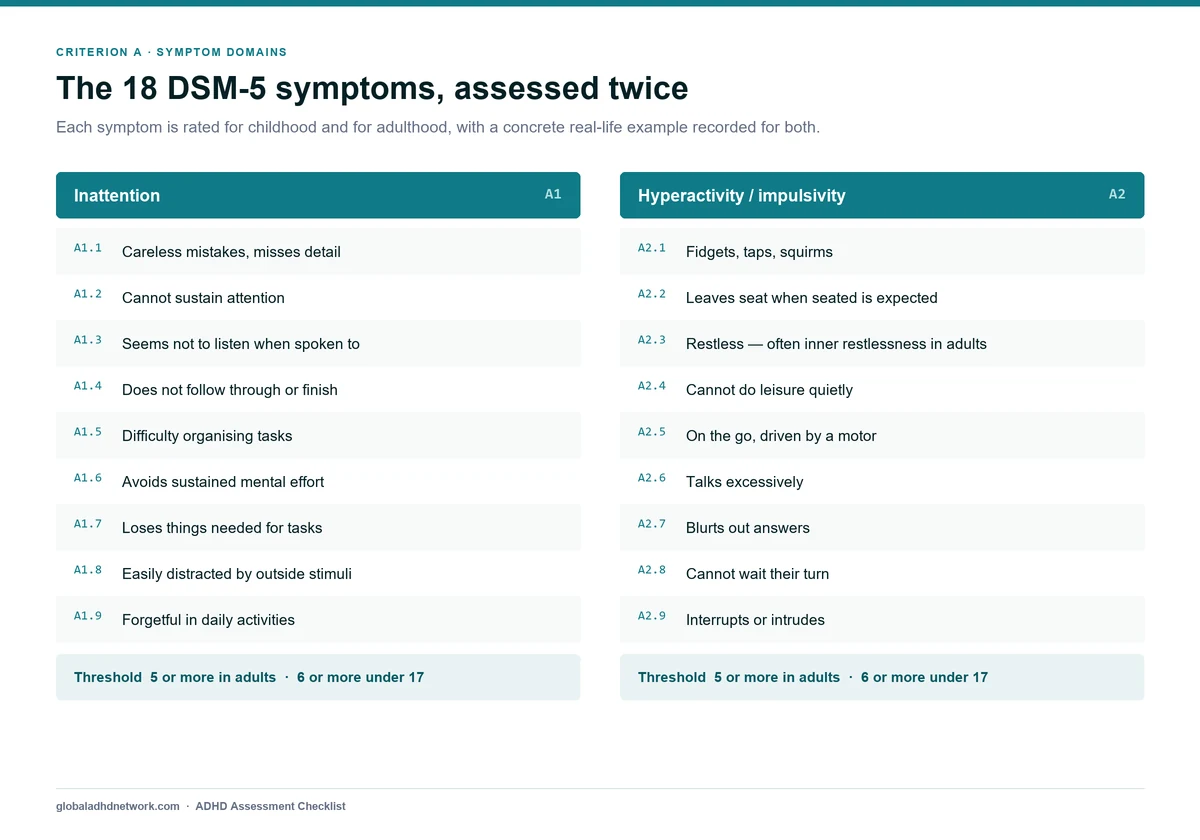
DSM-5 sets out eighteen symptoms across two domains. Adults need five or more in at least one domain; under-17s need six. Both domains are assessed for childhood and for adulthood, because a diagnosis in adulthood is a diagnosis of a condition that started in childhood.
The nine DSM-5 inattention symptoms
Careless mistakes and missed detail. Difficulty sustaining attention. Not seeming to listen when spoken to directly. Not following through, not finishing. Difficulty organising. Avoidance of tasks needing sustained mental effort. Losing things. Distractibility. Forgetfulness in daily life.
Nine items, and every one of them describes something most people do sometimes. That is the trap. The question is never does this happen — it is does this happen at a frequency and severity that is out of step with the person's developmental level, and does it cost them something.
The nine DSM-5 hyperactivity and impulsivity symptoms
Fidgeting and squirming. Leaving the seat. Restlessness — which in adults is usually reported as an internal state rather than an observable one, and is frequently missed for that reason. An inability to do leisure quietly. Being on the go, driven by a motor. Talking excessively. Blurting out answers. Difficulty waiting. Interrupting and intruding.
Masking, compensation and the well-adapted adult
Adults have often spent thirty years building a life that hides these. Someone who cannot sit through a meeting has, by forty, usually found a job with no meetings. The absence of a symptom is not always the absence of a symptom; sometimes it is a very expensive accommodation. Ask what it costs them to sit still, not whether they can.
Questions that surface compensation rather than symptoms:
What happens on the days your systems fail — when the alarms are off, or your partner is away?
How many reminders, lists or apps are you running to stay on top of ordinary admin?
What have you stopped doing, or never applied for, because you knew you could not sustain it?
Who else absorbs the work — a partner managing the calendar, a colleague checking your emails?
This matters most in the presentations that get missed. Inattentive presentations produce no disruption and therefore attract no attention, which is why they surface late — see inattentive ADHD and why it goes unrecognised, and inattentive ADHD in women for the compensatory patterns that most often mislead assessors.
Record a concrete example for each endorsed symptom. Not a rating — an example. "Loses things" is a checkbox. "Has replaced the same house key four times this year and now keeps a spare with a neighbour" is evidence.
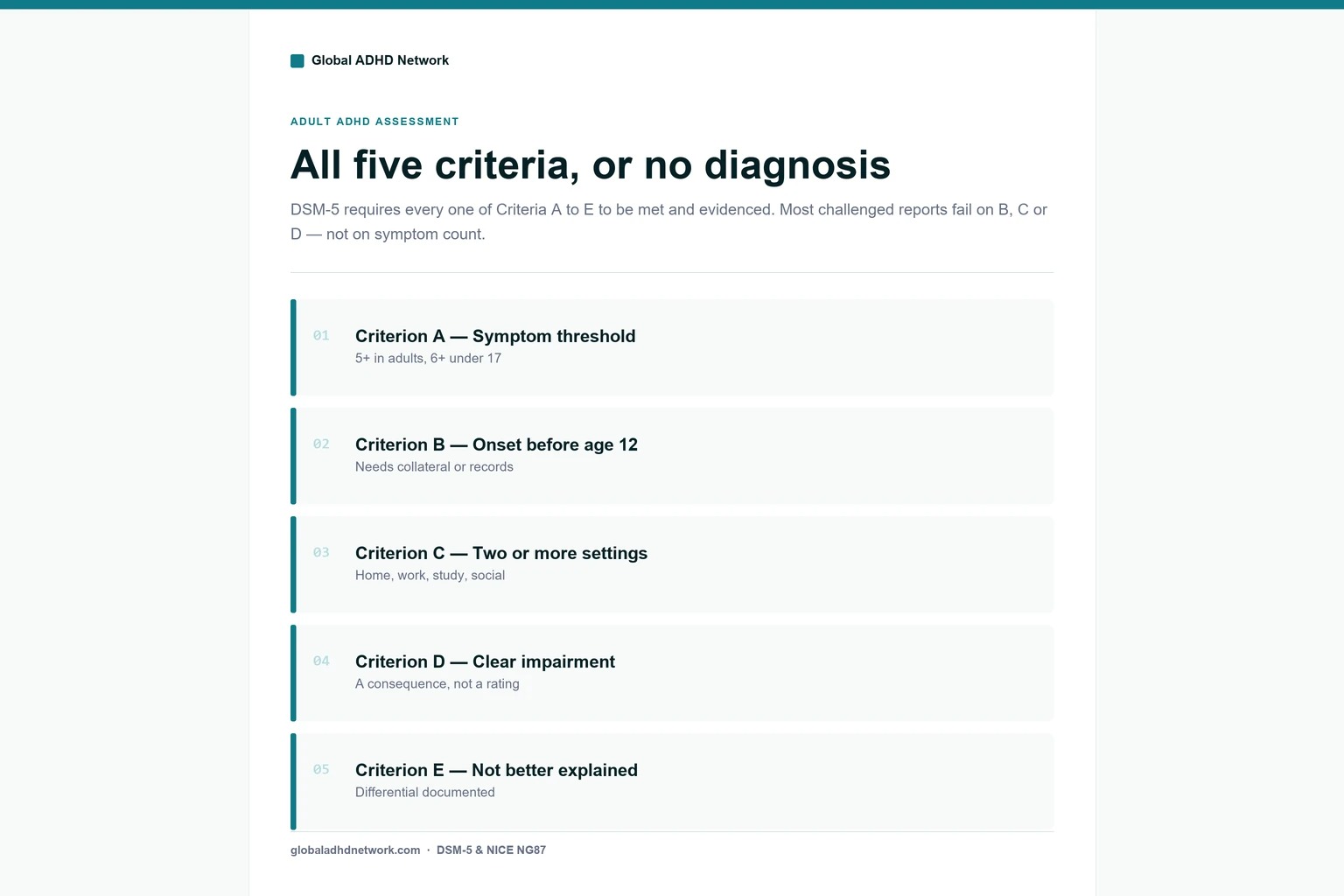
DSM-5 Criterion B: evidencing ADHD symptom onset before age 12
This is where more reports are challenged than anywhere else, and it is almost never because the clinician did not consider it. It is because the consideration did not make it into writing.
Adults are unreliable witnesses to their own childhoods. That is not a criticism of patients; it is how memory works. Retrospective recall of specific behaviours from twenty-five or forty years ago is thin, and it is shaped by everything that has happened since — including, often, having recently read a great deal about ADHD.
So you need corroboration. In descending order of strength:
An informant who knew them before age 12 — parent, older sibling, close relative
Contemporaneous school reports — written at the time, by someone with no stake in the outcome
Childhood medical, educational or social care records — often thin on ADHD specifically, but can evidence concern
Detailed, probed self-report anchored to checkable landmarks — sets, streaming, school moves, being kept behind
An informant who knew them before twelve is the strongest source. Contemporaneous school reports come a close second, and have the advantage of being written by someone with no stake in the outcome. Where neither exists, you can still meet the criterion — but you must say so, say what you relied on instead, and say what the limitation is.
A report that asserts "symptoms have been present since childhood" without naming a source is an assertion. A report that says "his mother described end-of-year reports from age seven onward noting that he was bright but never finished anything" is evidence. The clinical work is identical. Only the writing differs.
DSM-5 Criterion C: ADHD impairment in two or more settings
Symptoms have to show up in more than one place. Home and work. Work and study. Study and social life. The point of the criterion is to distinguish a pervasive difficulty from a situational one — the person who cannot concentrate in a job they hate is describing the job, not ADHD.
Settings worth probing when the obvious two are not available:
Health management — appointments, prescriptions, screening invitations
Money — direct debits, overdrafts, unopened post, late fees
Study, training or professional revalidation
Any remaining social or family context, however small
In practice this criterion has become harder to evidence, not easier. A patient who lives alone and works remotely has, functionally, one setting. You will need to work a little to find the second: how do they manage money, appointments, correspondence, their tenancy, their health? Household administration is a setting. So is the part of life that involves other people, however small it currently is.
Name both settings in the report, and give a distinct consequence in each. Two named settings with one shared example is one setting described twice.
The criterion also asks you to look backwards, not only across. Childhood is where cross-setting evidence is usually cleanest, because children have less control over their environments — a child who was disorganised at school and disorganised at home could not opt out of either. If an informant can tell you that teachers and parents were describing the same difficulties independently of one another, that is Criterion C evidence as well as Criterion B evidence, and it is worth recording under both.
DSM-5 Criterion D: functional impairment in adult ADHD
Criterion D asks for clear evidence that the symptoms interfere with, or reduce the quality of, functioning. This is the criterion most often satisfied clinically and least often evidenced on paper, usually because it gets summarised into a severity rating. "Moderate impairment" tells a reader nothing they can picture.
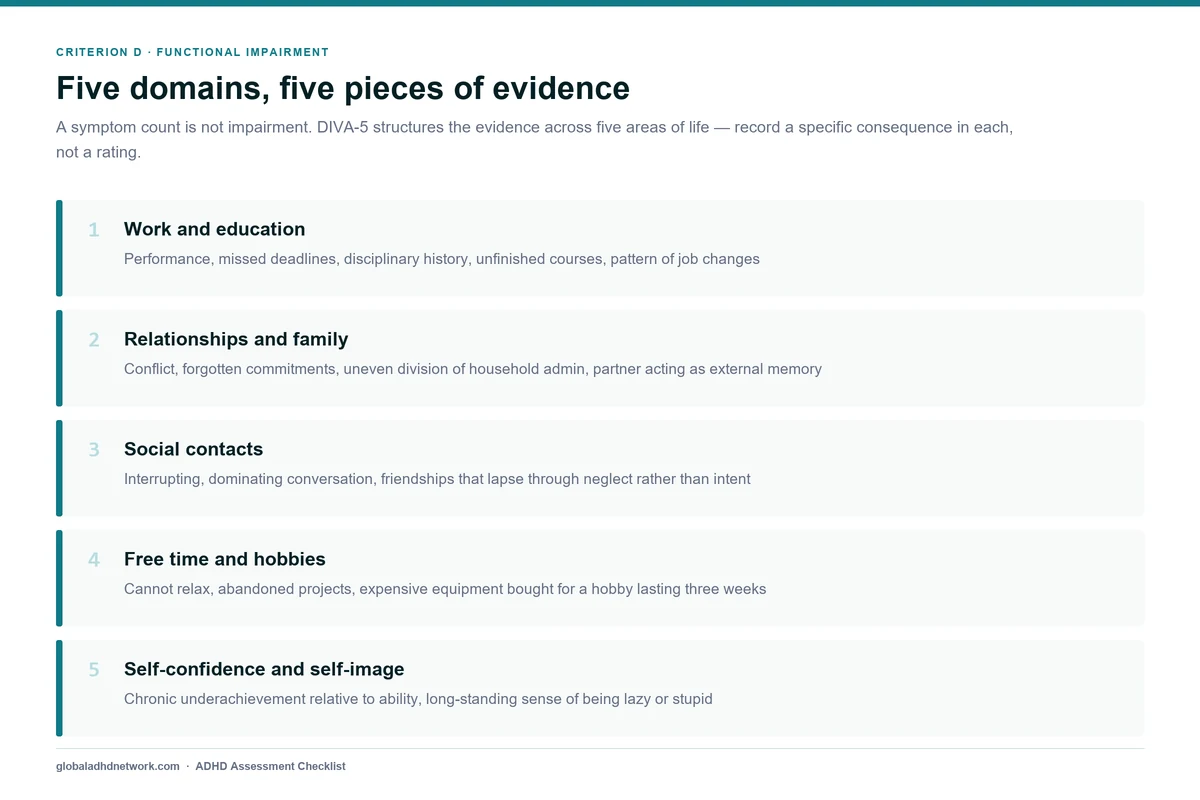
DIVA-5 structures this across five domains, and they are worth using as a checklist even if you are not running a DIVA.
Work and education — performance, deadlines, disciplinary history, unfinished courses, pattern of job changes
Relationships and family life — conflict, forgotten commitments, a partner acting as external memory
Social contacts — interrupting, dominating conversation, friendships lapsing through neglect rather than intent
Free time and hobbies — cannot relax, abandoned projects, equipment bought for a hobby that lasted three weeks
Self-confidence and self-image — chronic underachievement, a long-standing belief that they are lazy or stupid
That last domain gets skipped more than the others, and it is often where the most striking evidence sits. Chronic underachievement relative to apparent ability. A forty-year-old with a first-class degree and a work history that reads like someone else's. A lifetime of being told they were lazy, and believing it.
What you are looking for in each domain is a consequence, not a feeling. Two courses abandoned despite predicted grades in the top decile. Three formal warnings for lateness. A relationship that ended over unpaid bills. These are the sentences a reader can weigh.
DSM-5 Criterion E: ADHD differential diagnosis and exclusion
The last criterion is an exclusion, and it is the one people most often treat as a formality. Listing five conditions in a row does not satisfy it. You need to say which conditions you considered and why they do not account for the presentation.
The usual candidates:
Anxiety disorders. Anxiety impairs concentration. The discriminating question is usually sequence — did the inattention predate the anxiety, or arrive with it? See ADHD and anxiety.
Depression and mood disorders. Episodic by nature. ADHD is not.
Bipolar affective disorder. Distinguished by episodicity and by the presence of elevated mood, not just elevated activity.
Trauma and PTSD. Hypervigilance and dissociation both look like inattention from the outside.
Sleep disorders. Screen properly — untreated sleep apnoea produces a convincing imitation of inattentive ADHD, and sleep problems co-occur with ADHD often enough to muddy both directions.
Substance use. Both a differential and a common consequence — see ADHD and addiction.
Physical and neurological causes. Thyroid function, iron studies, head injury history.
One sentence per condition considered is enough. "Anxiety was considered; the attentional difficulties predate the anxiety by two decades and persist during periods of low anxiety" does more work than a list of eight names.
Co-occurring conditions in adult ADHD assessment
It is worth separating two questions that often get merged. Is this ADHD or something else? is Criterion E. Is this ADHD and something else? is a different question, and the answer is usually yes.
Anxiety, depression, sleep disruption and substance use co-occur with adult ADHD at rates high enough that their absence is more noteworthy than their presence. Finding one does not close the ADHD question. It changes the treatment plan and the sequencing, and it belongs in the report as a co-occurring diagnosis rather than as a reason to stop.
Communicating an adult ADHD diagnosis
Naming the presentation
Determine the presentation — predominantly inattentive, predominantly hyperactive-impulsive, or combined — and say which, with the evidence for it.
Then deliver it properly. A diagnosis given in the last ninety seconds of an overrunning appointment is a diagnosis the patient will spend the next month misremembering. Most adults arriving at this point have waited a long time, have often paid for the privilege, and have usually constructed an entire theory of themselves around not having an explanation. Give them the reasoning, not just the verdict.
Delivering a negative or uncertain outcome
A negative outcome deserves the same care, and more of it. "You do not meet criteria" without an account of what you found instead is the single most common reason people seek a second, third and fourth opinion.
Writing the adult ADHD assessment report
Everything above only exists insofar as it is written down. The report is not a record of the assessment; for every reader who was not in the room, it is the assessment.
Work through the criteria explicitly, with the evidence for each stated. Name your sources — who the informant was, what their relationship is, what period they can speak to, that consent was obtained. State the limitations where evidence was thin. A report that admits an evidential gap is more credible than one that papers over it, and it is considerably easier to defend.
The sections that carry the weight:
Referral reason and presenting concerns
Every source of information, named — including the informant's relationship and consent
Criterion-by-criterion evidence, worked through explicitly
Differential and co-occurring conditions, with reasoning rather than a list
Diagnosis, presentation, recommendations and any limitations
Then set out treatment options and next steps, and arrange shared care or onward referral where appropriate. We have covered the structure in detail in the report writing guide.
Frequently Asked Questions
How long should an adult ADHD assessment take?
A structured diagnostic interview such as DIVA-5 takes sixty to ninety minutes on its own, before informant contact, records review and report writing. Services running full assessments in under an hour are usually not completing the childhood history.
Can ADHD be diagnosed without an informant?
Yes, but the evidence for Criterion B has to come from somewhere else — school reports, childhood records, or a documented account of why corroboration was unavailable and what you relied on instead. The limitation should appear in the report.
Who can diagnose ADHD in adults under NICE NG87?
NG87 restricts diagnosis to a specialist psychiatrist, a specialist nurse prescriber, or another appropriately qualified healthcare professional with training and expertise in diagnosing ADHD. It is expertise-based rather than profession-based.
How many symptoms are needed for an adult ADHD diagnosis?
Five or more in either the inattention or the hyperactivity-impulsivity domain for those aged 17 and over. Six or more for under-17s. The threshold applies to one domain — it does not need to be met in both.
What is the difference between DSM-5 and ICD criteria for ADHD?
DSM-5 requires onset before age 12; ICD-10 required onset by age 7 and used a more restrictive combined presentation. Most UK adult services now work to DSM-5, which is what NG87 anticipates.
%20(1).webp)