Global ADHD Network — One of the most highly reviewed ADHD CPD and CME training providers in ADHD diagnosis and neurodiversity training.Global ADHD Network — One of the most highly reviewed ADHD CPD and CME training providers in ADHD diagnosis and neurodiversity training.Global ADHD Network — One of the most highly reviewed ADHD CPD and CME training providers in ADHD diagnosis and neurodiversity training.
Writing the ADHD Report: Evidencing Every Criterion in a Document That Holds Up
For every reader who was not in the room, the report is the assessment. The five sections that carry the weight, criterion-by-criterion wording that holds up, six documentation errors that get reports challenged, and why writing the limitations in makes the document stronger.
Every assessing clinician has written a report they were confident in and then had it come back with a question they could answer in one sentence — a sentence that was in their head throughout the assessment and never made it onto the page.
That gap is what this article is about. Almost nothing that gets an ADHD report queried is a clinical error. The reasoning happened. It just was not written down in a form a second reader could follow.
A diagnostic report is not a record of what you did. For everyone who was not in the room — a GP deciding on shared care, an ICB reviewing a private diagnosis, an occupational health adviser, a university disability service, sometimes a tribunal — the report is the assessment. It has to carry the argument on its own.
Who this guide is for
Report writing is the part of assessment least often taught and most often audited. This is written for:
Consultant psychiatrists and clinical psychologists who sign reports and carry the medico-legal exposure.
ADHD nurse specialists and nurse prescribers producing reports that will be read by GPs deciding on shared care.
GPs with an extended role, who are usually on the receiving end and know exactly which reports are unusable — see what a GP can and cannot act on.
Trainees writing their first independent reports, where the gap between good assessment and good documentation is widest.
Who reads an adult ADHD diagnostic report
Worth being concrete, because the audience shapes the register.
The patient — often several times, sometimes quoting it back years later
A GP — realistically the first page and the recommendations
An ICB or insurer — adversarially, looking for the criterion you skipped
Occupational health — usually extracts rather than the whole document
A university disability service — to award exam adjustments
A solicitor — in a minority of cases, line by line
Write for the sceptical reader, in language the patient can understand. Those two goals conflict less often than people expect. Precision and plain English are the same discipline.
ADHD report structure: the five sections that carry the weight
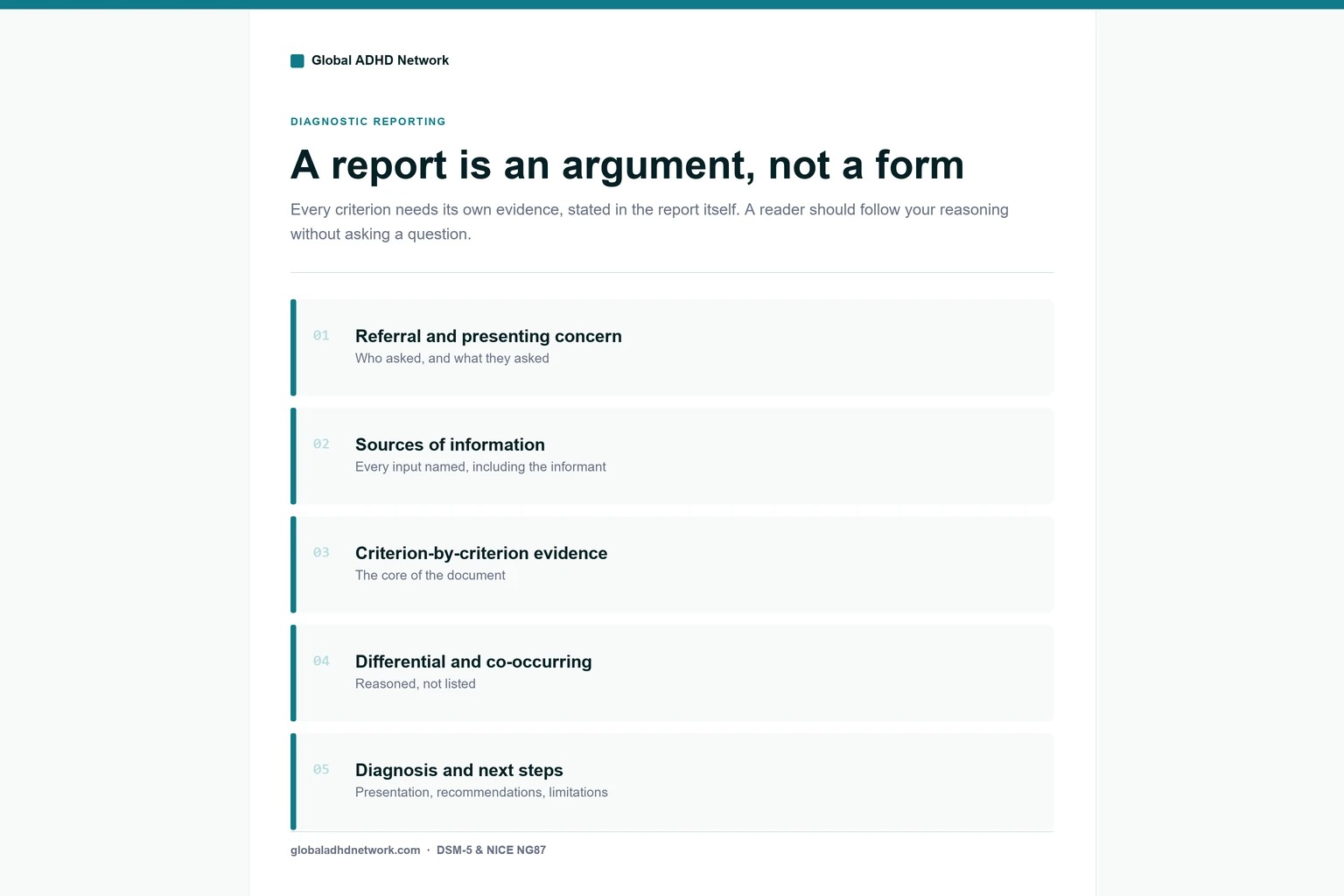
Five sections carry the weight. Everything else is administrative.
Referral and presenting concerns — who referred, what question you were asked, what the patient came for in their own words.
Sources of information — every input, named.
Criterion-by-criterion evidence — the core of the document.
Differential and co-occurring conditions — what you considered and what you concluded.
Diagnosis, presentation and next steps — the outcome, and what happens now.
Use headed sections rather than continuous prose. A reader looking for Criterion B should be able to find Criterion B.
Naming every source of information in the ADHD report
This section takes five lines and prevents more queries than any other part of the report.
What belongs in the sources list
List the clinical interview and its duration. Name the structured instrument used — DIVA-5, ACE+, CAADID — and note that it was administered in full. List any rating scales, with the caveat that they are screening rather than diagnostic. List records reviewed, and say which ones you asked for and did not get.
Recording the informant properly
Then the informant: relationship to the patient, the period of childhood they can speak to, the method of contact, and the fact that consent was obtained. "Collateral history was obtained from the patient's mother, who lived with him throughout his childhood, by telephone on 14 August with the patient's written consent" does a great deal of work for one sentence.
An unattributed informant account reads as hearsay, however good the account was.
Evidencing each DSM-5 criterion in the ADHD report
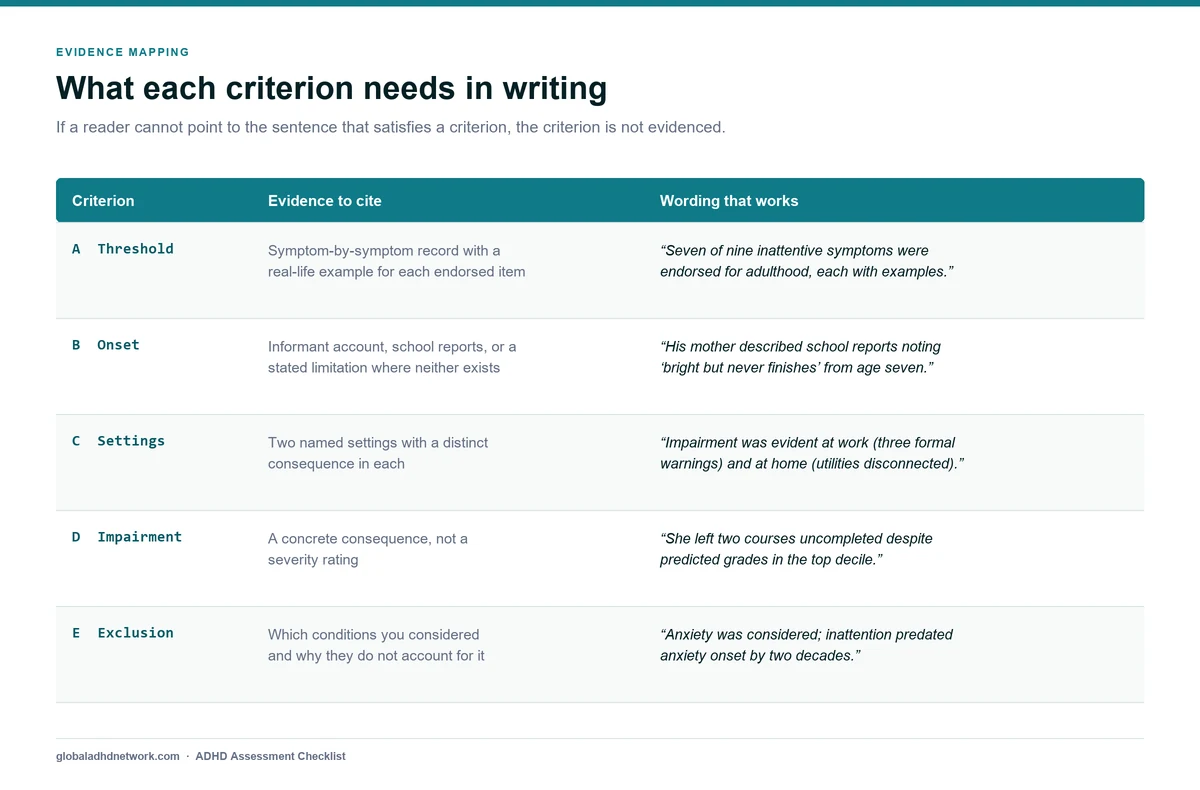
The test is simple. For each of the five criteria, can a reader point to the sentence that satisfies it? If not, the criterion is not evidenced, whatever you concluded.
Criterion A — evidencing the ADHD symptom threshold
State how many symptoms were endorsed, in which domain, for which period. Then give examples. Not all nine — three or four vivid ones carry more weight than a full list of paraphrased criteria.
Seven of the nine inattentive symptoms were endorsed for adulthood and eight for childhood, each supported by a specific example. He described replacing his house keys four times in the past year and now leaving a spare with a neighbour.
Criterion B — evidencing childhood onset before age 12
Name the source. If the source is an informant, say who. If it is records, say which. If neither exists, say that, and say what you relied on instead. Detail on this is in the collateral history guide.
His mother described end-of-year school reports from age seven onward that repeatedly noted he was "bright but never finishes anything". Two of these reports were provided and are consistent with her account.
Criterion C — evidencing impairment in two settings
Name two settings and give a distinct consequence in each. Two settings sharing one example is one setting described twice.
Impairment was evident at work, where he has received three formal warnings for missed deadlines in two years, and at home, where utilities have twice been disconnected for non-payment despite sufficient funds being available.
Criterion D — evidencing functional impairment
A consequence, not a severity rating. "Moderate impairment" gives the reader nothing to weigh.
She left two undergraduate courses uncompleted despite predicted grades in the top decile, and described a persistent sense of underachievement that predates any mood symptoms.
Criterion E — documenting the differential diagnosis
Say which conditions you considered and why they do not better account for the presentation. One clause per condition is enough. A list of names with no reasoning satisfies nobody.
Anxiety was considered; the attentional difficulties predate anxiety onset by approximately two decades and persist during periods of low anxiety. Depression was considered; the presentation is chronic rather than episodic.
How to report ADHD rating scale and QbTest scores
Scores get misused in reports more often than any other input, in both directions.
The first error is treating a screening score as evidence toward a criterion. An ASRS result does not contribute to Criterion A. Reporting it as though it does invites a reader to conclude that the diagnosis rests on a self-completed questionnaire, which is the opposite of the impression you want.
The second error is omitting scores entirely because they are not diagnostic. They are still worth reporting — as context, and as a baseline you can measure treatment response against later.
The wording that works keeps the role explicit:
ASRS v1.1 was completed prior to assessment and indicated a high symptom load. This was used to direct the clinical interview and does not itself contribute to the diagnostic criteria.
The same applies to computerised attention tasks. If a QbTest or similar was used, report what it showed, state that it is supportive rather than diagnostic, and — importantly — say what a normal result would and would not mean. A well-compensated adult can perform normally on a fifteen-minute task and still meet criteria comfortably. If the report does not say so, a reader who sees a normal score may draw their own conclusion.
Language and tone in an ADHD diagnostic report
The patient will read this document, probably more than once, and possibly at a difficult moment. That is not a reason to soften the clinical content. It is a reason to be careful about the words carrying it.
Deficit-only language does real damage without adding precision. "Fails to", "refuses to", "poor" and "deficient" are describing a person rather than a presentation, and none of them makes the report more defensible. "Difficulty sustaining attention on unstimulating tasks" says exactly what "poor attention span" says, and says it more accurately.
Attribute reported material to whoever reported it. "His mother described him as disruptive" is a record. "He was a disruptive child" is the clinician adopting someone else's judgement as fact.
Keep strengths in where they are clinically relevant, and resist the urge to add them where they are not. A line noting that someone completed a demanding degree while unmedicated is evidence about compensation and capacity, which matters for the recommendations. A generic paragraph about ADHD superpowers is not evidence about anything, and it reads as filler to a sceptical reader.
GAN's guide to neurodiversity-affirming assessment covers the broader stance. In the report specifically, the working rule is narrow: describe behaviour and consequence, attribute opinion, and let the reader draw the conclusion you have already evidenced.
Six documentation errors that get ADHD reports challenged
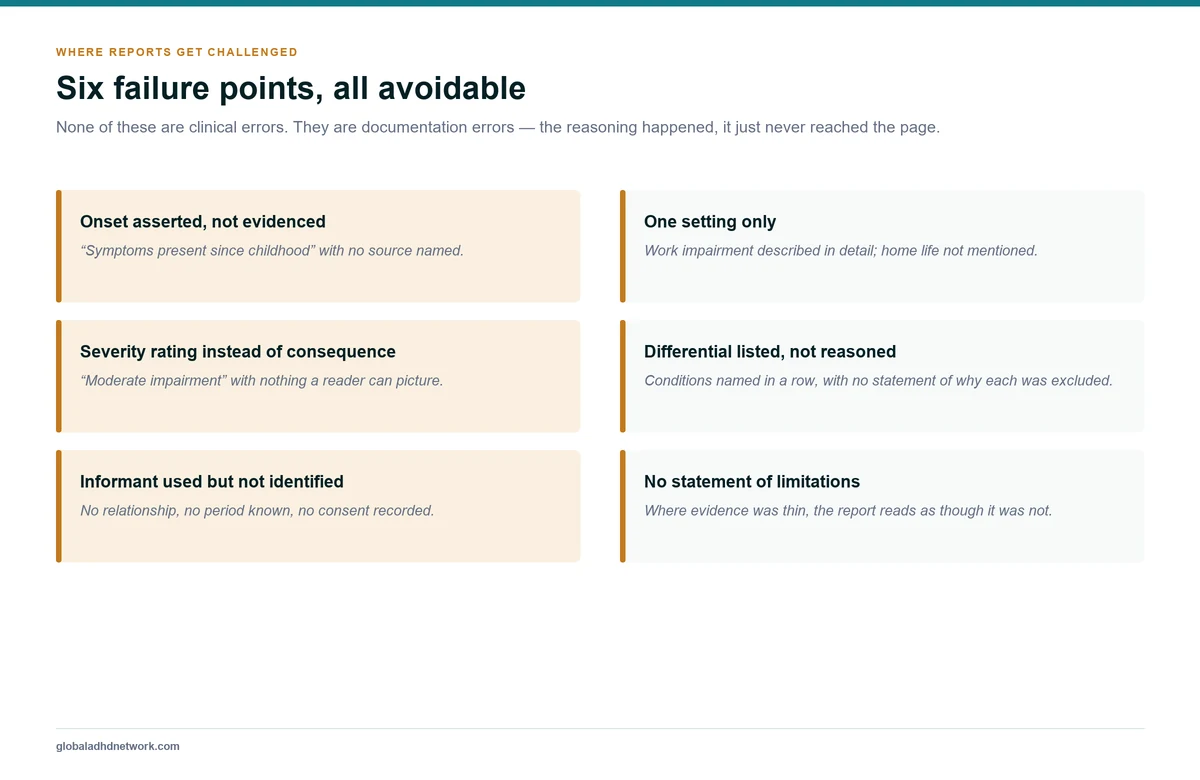
These come up repeatedly, and all six are documentation failures rather than clinical ones.
Onset asserted rather than evidenced. "Symptoms have been present since childhood" with no source named. This is the most common single reason for a query.
One setting described in detail, the other not mentioned. Usually because work impairment is easy to describe and home life feels intrusive to ask about.
A severity rating instead of a consequence. "Significant functional impairment" is a conclusion presented as evidence.
A differential listed but not reasoned. Eight conditions in a row with no statement of why each was set aside.
An informant used but not identified. No relationship, no period, no consent recorded.
No statement of limitations. Where the evidence was thin, the report reads as though it was not — which is the version that damages credibility when someone notices.
Writing limitations into the ADHD report
Counter-intuitive, and the single biggest improvement most reports can make.
Why admitting a gap strengthens the document
A report that names what it could not establish is more credible than one that presents every criterion as equally well supported. It demonstrates that the clinician knew precisely what the evidence would carry, which is exactly the judgement a sceptical reader is trying to assess.
No childhood informant was available; both parents are deceased. School records were requested but are no longer held by the local authority. Criterion B is therefore supported by the patient's detailed and internally consistent account of streaming and school reporting, and this limitation should be borne in mind.
Compare that to silence on the point. The clinical position is identical. Only one of them survives a careful reading.
Writing an ADHD report when the criteria are not met
Reports that do not result in a diagnosis need more care than those that do, and usually receive less.
"Criteria for ADHD were not met" as a standalone conclusion is the most common reason people seek a second, third and fourth opinion — and often eventually receive a diagnosis elsewhere, which does nobody any good.
A usable negative report says:
Which criteria were not met, and on what evidence
What you found instead — you will almost always have found something
What should happen next, including any onward referral
Whether the door is closed or open, and what would reopen it
If the picture is genuinely uncertain rather than negative, say that too. "Insufficient evidence at this time to confirm childhood onset; recommend review following retrieval of educational records" is an honest, useful outcome. A forced binary is not.
ADHD report recommendations a GP can act on
The final section is the one most likely to be read in isolation, and most likely to be vague.
Be specific. A GP acting on your report needs:
Medication — which class, titration expectations, monitoring requirements, baseline observations
Non-pharmacological support — named, not gestured at
Shared care — whether you are proposing it, what you are asking the GP to do, and what you will continue to hold
Where reasonable adjustments are relevant for work or study, say what they are rather than referring generally to adjustments — our guide to neurodiversity in the workplace sets out what employers can actually implement. A university disability service can act on "additional time in examinations and access to lecture recordings". It cannot act on "would benefit from support".
Report turnaround, version control and distribution
Two administrative points that cause a disproportionate amount of trouble.
The first is turnaround. A report written six weeks after the assessment is a report written from notes, and it shows — the specific, quotable detail that makes a document defensible is exactly what fades first. Where you cannot write the same week, at least fix the criterion-by-criterion evidence in a structured form on the day. That is most of the value of working from a checklist during the appointment rather than after it.
The second is versioning, and it is a governance question as much as an administrative one — ADHD service governance and quality standards covers the wider expectations. Reports get amended: a typo in a date of birth, an informant who comes back with school reports a month later, a GP who asks for the medication section to be expanded. Each amended version should carry a date and a note of what changed. An undated second version circulating alongside a first is a genuine clinical governance risk, and it is the kind of thing that looks careless in a setting where carelessness is the thing being alleged.
State clearly at the end who the report has been sent to and who holds a copy. Patients frequently need to produce it years later for employers or universities, and "the clinic that assessed me has closed" is a common and entirely avoidable problem.
Using an ADHD report template without sounding generic
Templates are useful for structure and dangerous for content. A template guarantees you address every section; it does not stop you filling a section with language that could describe anyone.
The test for any sentence in a report is whether it could have been written about a different patient. If it could, it is not evidence. Specific, dated, quoted, consequential detail is what makes a report defensible — and it is the part no template can supply.
Frequently Asked Questions
What should an adult ADHD diagnostic report include?
Referral and presenting concerns, every source of information used, criterion-by-criterion evidence for DSM-5 Criteria A to E, the differential and any co-occurring conditions, and the diagnosis with presentation, recommendations and limitations.
How long should an ADHD assessment report be?
Length is not the measure. Most complete adult reports run to four to eight pages. A three-page report that evidences every criterion is better than a twelve-page report that asserts onset without a source.
Should an ADHD report state the presentation type?
Yes — predominantly inattentive, predominantly hyperactive-impulsive, or combined — with the symptom counts that support it. Presentation can change over time, so date the determination.
How do you write an ADHD report when evidence is incomplete?
State what was unavailable, what you used instead, and what weight you placed on it. A documented limitation is stronger than an unexplained gap.
Does a private ADHD report need to meet NICE standards for shared care?
ICBs generally expect a report from an appropriately qualified specialist that evidences the DSM-5 criteria and sets out monitoring arrangements. Requirements vary locally, but a report that evidences each criterion explicitly is the one least likely to be refused.
%20(1).webp)