Global ADHD Network — One of the most highly reviewed ADHD CPD and CME training providers in ADHD diagnosis and neurodiversity training.Global ADHD Network — One of the most highly reviewed ADHD CPD and CME training providers in ADHD diagnosis and neurodiversity training.Global ADHD Network — One of the most highly reviewed ADHD CPD and CME training providers in ADHD diagnosis and neurodiversity training.
The Informant Interview: Gathering Collateral History for Adult ADHD Assessment
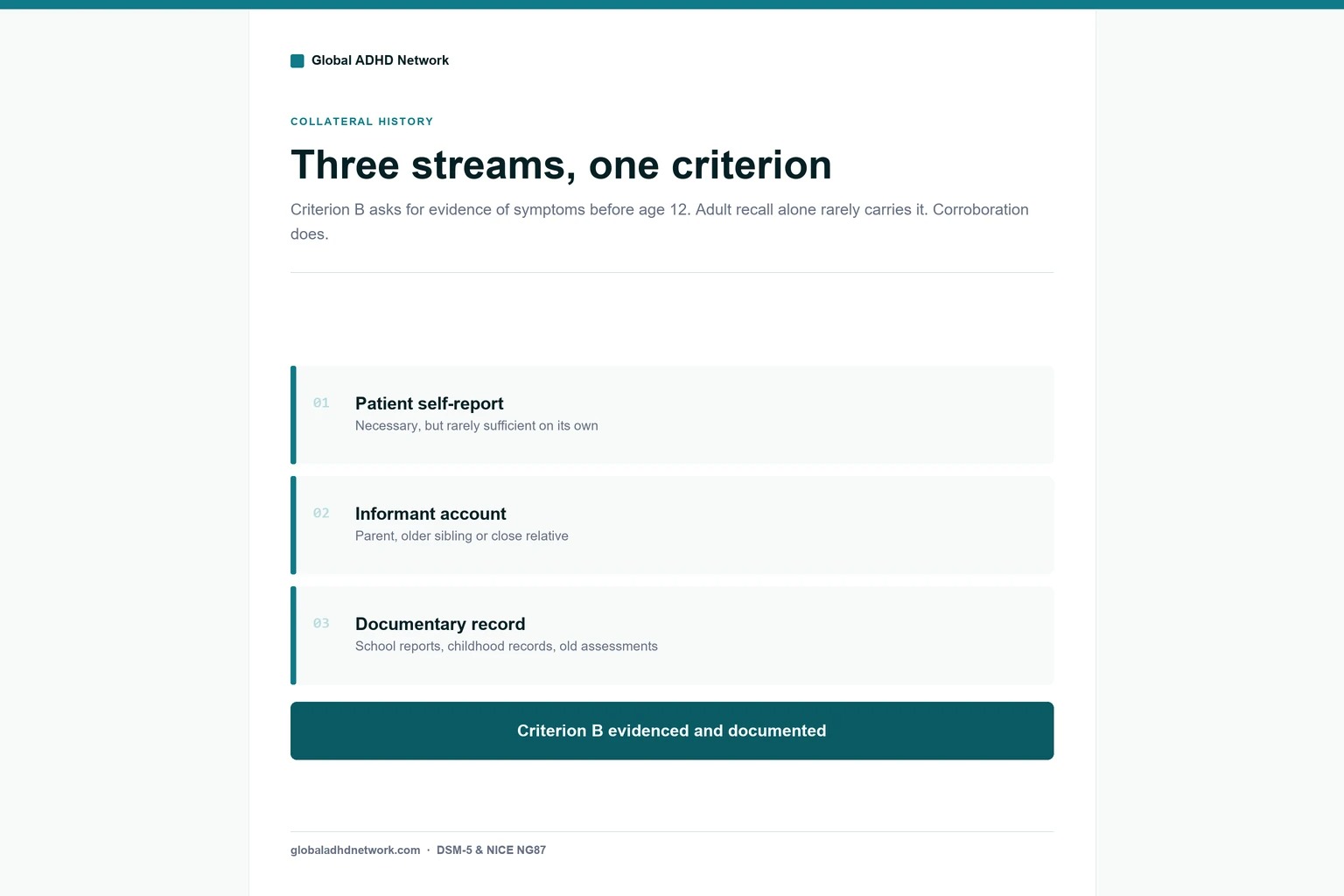
DSM-5 needs evidence of onset before age 12, and adult recall rarely carries it alone. How to run an informant interview properly: consent and framing, what to ask, asking without leading, handling disagreement, and what to do when no informant exists at all.
"My mum died in 2019. My dad wasn't around. I've got one sister and she's four years younger than me, so she wouldn't remember."
You have thirty minutes left, a patient who meets every other criterion comfortably, and a diagnostic framework that requires you to establish something about their life before the age of twelve. This is not an edge case. In a service seeing adults in their forties and fifties it is close to routine, and how you handle it separates a report that holds up from one that gets returned.
Collateral history is the least discussed part of adult ADHD assessment and the part most likely to be picked apart. This guide covers how to run an informant interview properly, how to weigh what you are told, and what to do when there is no informant to interview.
Who this guide is for
Collateral history is everyone's job in an assessing service, but it lands differently depending on your role:
Consultant psychiatrists and clinical psychologists signing off diagnoses, who carry the evidential risk if Criterion B is thin.
ADHD nurse specialists, who in most services conduct the majority of informant calls and set the standard for how they are recorded.
GPs with an extended role, who are often the first to be asked for childhood records and are well placed to prompt a subject access request early.
Trainees, for whom the informant call is usually the first piece of an assessment they run alone — and the easiest to run badly without noticing.
Why patient self-report is not enough for Criterion B
Two failure modes, pulling in opposite directions:
Under-reporting. A lifetime of difficulty normalised into personality — you cannot identify a deficit in something you have never experienced otherwise.
Over-reporting. A framework that finally explains thirty years of confusion, applied retrospectively to every memory.
Adults with ADHD are poor historians of their own symptoms, in both directions. Some under-report, because a lifetime of difficulty has been normalised into personality — you cannot identify a deficit in something you have never experienced otherwise. Others over-report, having recently found a framework that explains thirty years of confusion and now reading every memory through it.
Neither is dishonesty. Both are what happens when you ask someone to rate the frequency of a behaviour from twenty-five years ago on a five-point scale.
The research on retrospective recall bears this out consistently: adults' accounts of their own childhood ADHD symptoms correlate only modestly with contemporaneous accounts. This is precisely why NICE NG87 and DSM-5 both push toward corroboration, and why the DIVA-5 structure builds an informant column into the instrument rather than treating it as optional.
Who counts as an informant in an adult ADHD assessment
The requirement is simple: someone who knew the patient well, before age twelve, across more than one context if possible.
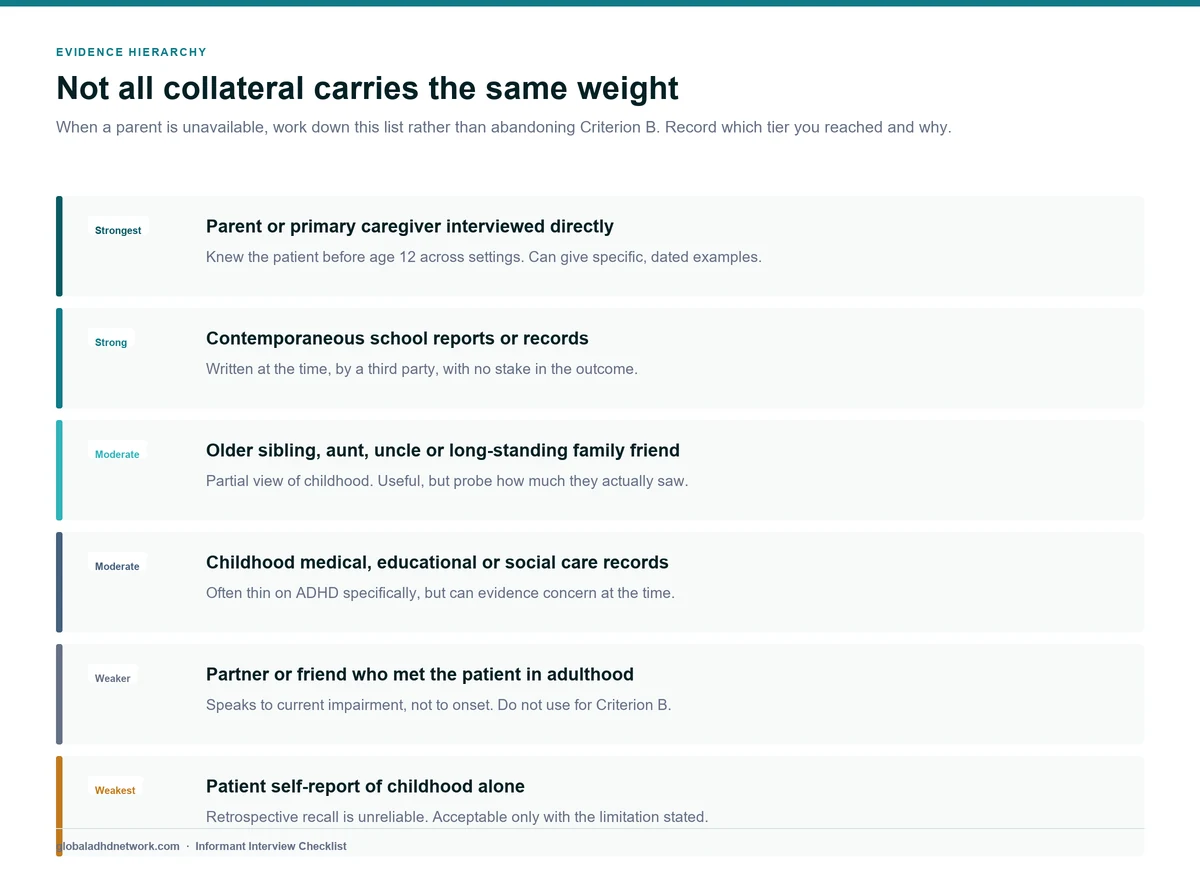
In descending order of usefulness:
A parent or primary caregiver
An older sibling with at least five or six years on the patient
An aunt, uncle or grandparent who was closely involved
A long-standing family friend
A teacher, where one can be traced
Note who is missing from that list. A partner met at twenty-eight is not a Criterion B informant. Neither is a close friend from university. They may be excellent witnesses to current impairment, and their account is worth having for Criteria C and D — but they cannot speak to onset, and a report that uses them as though they can invites exactly the query you are trying to avoid.
Record the relationship, the years known, and specifically which period of childhood the informant can speak to. An older sibling who left home when the patient was nine has a window, and the window has an edge.
Setting up the informant interview: consent and framing
Confirm consent. The patient consents to you speaking to the informant; the informant consents to the information being used and recorded. Both should be documented, and it takes one line.
Framing it so a parent does not hear an accusation
Then explain the purpose, because informants routinely misunderstand it. Parents in particular often arrive braced for judgement — they assume you are assessing their parenting, or that a diagnosis implies they did something wrong. A sentence at the start defuses most of this: I'm not assessing how they were brought up. I'm trying to build a picture of what they were like as a child, because that is part of what the diagnostic criteria ask for.
Say explicitly that you want examples rather than judgements, and that "I don't remember" is a perfectly acceptable answer. An informant who feels obliged to have an opinion about all eighteen symptoms will manufacture one.
Choosing the format
Telephone is fine. Video is fine. Written responses are the weakest option, because you cannot follow up, and following up is where most of the value is.
What to ask in an ADHD informant interview
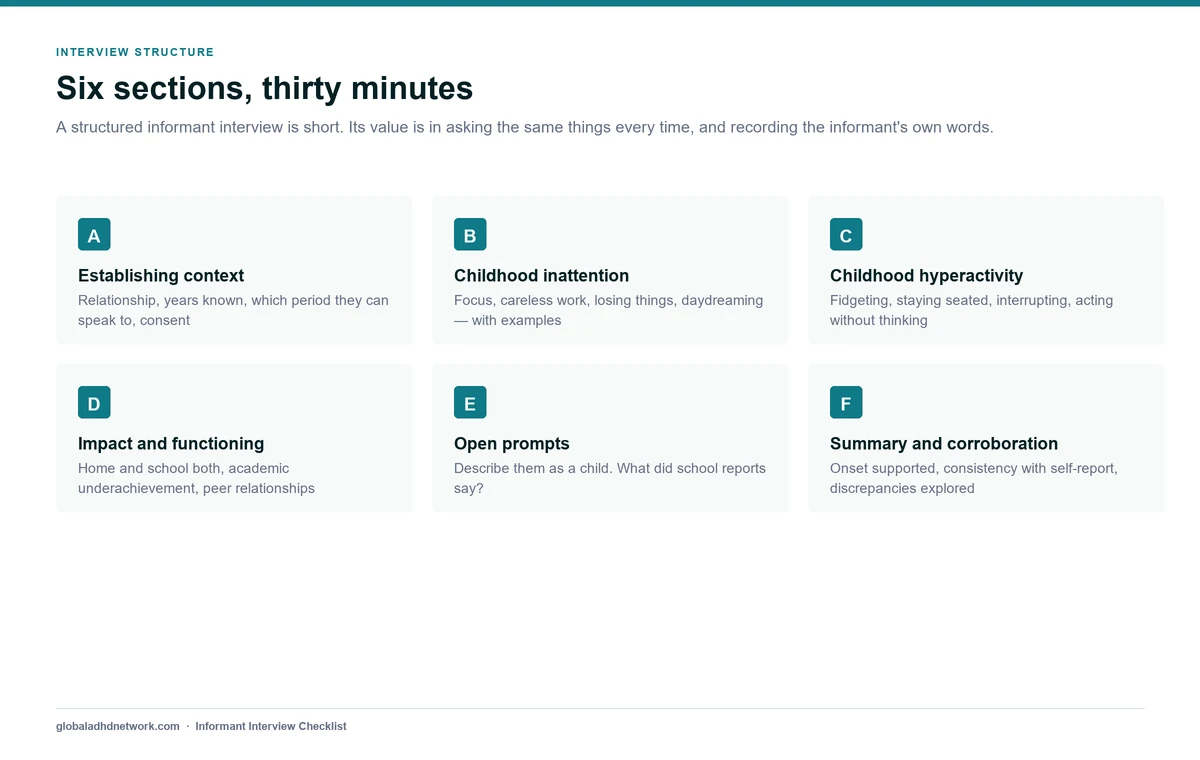
Structure matters here more than in the patient interview, because informants wander. Six sections, roughly thirty minutes.
Childhood inattention: what to ask
Focus in class and on homework — how long before they drifted?
Careless mistakes, rushed or unfinished work
Seeming not to listen when spoken to directly
Lost belongings — ask for a count, not an impression
Forgetfulness and disorganisation despite reminders
Daydreaming, being "in their own world"
Be specific on the losing-things item in particular. "Did they lose things?" produces a shrug; "how many PE kits, coats or lunchboxes did you replace in a year?" produces a number. Numbers go in the report.
Childhood hyperactivity and impulsivity: what to ask
Fidgeting and restlessness
Difficulty staying seated at meals, in class, during activities
Running and climbing excessively; struggling to play quietly
Talking excessively and interrupting
Impatience and difficulty taking turns
Acting without thinking; accident-proneness
Accident history is an underused prompt. Parents who cannot rate impulsivity on a scale will often tell you, unprompted, about three visits to A&E before the age of ten.
ADHD impact across home and school settings
Whether difficulties were noticed at home and at school
What school reports said about concentration, behaviour or effort
Underachievement relative to apparent ability
Whether friendships were affected
Whether behaviour caused conflict or concern at home
Presentation shapes what an informant noticed. Disruptive children got recorded; quiet ones often did not. Our guides to ADHD symptoms in young boys and signs in young children and girls set out the asymmetry that explains why so many adult referrals are women in their forties.
Two open prompts that produce the strongest evidence
End with these, and write down the answers verbatim:
How would you describe them as a child, in a few words?
What did teachers or school reports say about them?
These two questions produce more usable material than the structured items above them. "Bright but never finished anything." "Away with the fairies." "A lovely boy who could have done so much better." Those phrases go into the report in quotation marks, and they do more evidential work than any rating scale.
Asking about childhood ADHD symptoms without leading the informant
The structure above is a list of symptoms, and reading a list of symptoms to a willing parent is a reliable way to generate false positives. Informants want to help. If you ask "was he easily distracted?", a parent who is hoping their adult child finally gets an answer will very often say yes.
Three habits protect against this:
Open before closed — start each domain with an open question, use the symptom list to fill gaps
Example first, judgement second — an endorsement with no example behind it is a weak endorsement
Anchor to a comparison group — "compared with his brother at the same age", not "was he restless?"
Open before closed. Start each domain with an open question and only use the symptom list to fill gaps. "What was homework like in your house?" gets you a scene. "Did he have difficulty sustaining attention on homework?" gets you a yes.
Ask for the example first, the judgement second. If an informant endorses a symptom, ask what it looked like. An endorsement with no example behind it should be recorded as an endorsement with no example behind it — which is to say, weakly.
Ask about the comparison group. ADHD criteria are developmental: the behaviour has to be out of step with peers, not merely present. "Compared with his brother at the same age" or "compared with the other children in the class" turns an absolute judgement into a relative one, which is what the criteria actually ask for.
It is also worth asking at least one question in the negative — something the patient probably did not struggle with. An informant who endorses everything, including the item you expected them to reject, is telling you about their expectations rather than the patient's childhood.
Generation, culture and what counted as normal childhood behaviour
A parent's answers are calibrated against the world they were parenting in, not against DSM-5.
Someone raising a child in a class of thirty-six in 1985 has a different threshold for "restless" than a parent in a class of twenty-two today. Corporal punishment, streaming, and much higher tolerance for boys being disruptive all shaped what got noticed and what got recorded. A parent may genuinely report that nothing was unusual, while the school reports describe a child who was repeatedly disciplined for the same thing.
Cultural expectations matter in the same way. In some families and communities, academic underperformance is attributed to effort as a matter of course, and behavioural difficulty is a discipline question rather than a health one. A parent operating from that frame is not withholding — they are answering a different question from the one you think you asked.
The way round it is to ask about consequences rather than perceptions. Not "was his behaviour a problem?" but "was he ever kept behind, moved seats, sent out, or discussed at a parents' evening?" Events are less filtered than judgements.
When the informant's account contradicts the patient's
It happens often, and it is information rather than a problem.
The most common pattern is a parent who minimises. Sometimes this is generational — the behaviours described were unremarkable in a 1980s classroom of thirty-four children. Sometimes it is protective, of the child or of themselves. Occasionally a parent has their own undiagnosed ADHD and is comparing their child to a baseline that was never typical.
The reverse also occurs: a patient who recalls a placid childhood while a parent describes chaos. Adults who were consistently criticised as children often remember the criticism rather than the behaviour.
Do not resolve the discrepancy by picking a side. Record both accounts, note the discrepancy explicitly, and say how you weighed it. A report that says "the patient's account and his mother's differed on the severity of childhood restlessness; her account was consistent with the school reports provided, and was given greater weight" is a stronger document than one where the disagreement quietly disappeared.
Interviewing a parent who has ADHD themselves
ADHD is substantially heritable, so a meaningful proportion of the parents you interview will have it themselves, usually undiagnosed. This affects the interview in two ways, and both are worth anticipating.
The first is calibration. A parent comparing their child against their own childhood is comparing against a baseline that was never typical. "He was no worse than I was" is offered as reassurance and is often the single most diagnostically interesting sentence in the call. Follow it, gently.
The second is recall. A parent with untreated inattentive symptoms may struggle to retrieve specific dated examples, not because the events did not happen but because they were never well encoded. Where you suspect this, lean harder on documentary sources and on structured prompts rather than free recall, and be careful not to read a thin account as a negative one.
Occasionally the interview prompts a parent to recognise themselves. Have a sentence ready about how they might pursue that through their own GP — it is not your assessment to run, but leaving it unacknowledged is unkind.
Evidencing childhood ADHD onset when there is no informant
Back to the patient at the start of this article. No parents, a sibling too young to remember, no contact with extended family. This does not end the assessment, and it does not oblige you to diagnose or to decline. It obliges you to work down the evidence hierarchy and to write down where you got to.
Work down the evidence hierarchy
School records. Many people can obtain these, and many have never tried. Schools and local authorities hold records for varying periods, and a subject access request is free. It is worth pausing the assessment for six weeks to get them.
Other childhood documentation. GP records from childhood. Educational psychology involvement. Social care records. Any of these may contain a contemporaneous observation, even where ADHD was never mentioned.
Adult records with a long tail. Employment records, university records, or a psychiatric history stretching back to late adolescence can establish a pattern earlier than the current presentation.
Detailed, probed self-report. Weaker, but not worthless — and considerably stronger when it is anchored to verifiable landmarks. Rather than "were you inattentive at school?", ask which sets they were in and whether that matched their ability, whether they were ever kept behind, what their reports said, whether they moved schools and why. Specific, checkable memories are more reliable than global self-assessments.
Then write the limitation down
Then write the limitation into the report. Something like: No childhood informant was available; both parents are deceased and no sibling could speak to the relevant period. School records were requested but no longer held. Criterion B is therefore supported by the patient's detailed account of streaming and school reporting, which was internally consistent and specific, and this limitation should be borne in mind.
That paragraph is the difference between a report that survives scrutiny and one that does not. It does not weaken the diagnosis. It demonstrates that the clinician knew exactly what the evidence would and would not carry.
Recording collateral history in the assessment report
Three habits, all cheap:
Use the informant's words. Direct quotation is more persuasive than paraphrase and takes no longer to write.
Date the examples. "Around age seven" beats "in childhood" every time.
Identify the source in the report body. Name the relationship, the period they can speak to, and the fact of consent. An unattributed informant account reads as hearsay.
For GPs and trainees new to this: the corroboration summary is not a formality. It is the paragraph an ICB reviewer reads first when deciding whether to accept a diagnosis for shared care.
The corroboration summary is the last step: is childhood onset supported, is the account consistent with self-report, and have any discrepancies been explored? Three questions, three lines, and Criterion B is documented rather than assumed.
Frequently Asked Questions
Is an informant interview mandatory for adult ADHD diagnosis?
No. DSM-5 requires evidence of onset before age 12, not a specific source for it. An informant is the strongest way to obtain that evidence, but school records, childhood documentation or a detailed and clearly caveated self-report can support the criterion where no informant exists.
Who can act as an informant for an adult ADHD assessment?
Anyone who knew the patient well before age 12 — most often a parent, but an older sibling, grandparent, aunt, uncle or long-standing family friend can serve. A partner or friend met in adulthood cannot speak to onset, though their account is useful for current impairment.
What if the informant's account contradicts the patient's?
Record both, note the discrepancy, and state how you weighed it. Discrepancies are common and often informative. Resolving them silently is what creates problems later.
How long does an informant interview take?
Around thirty minutes when structured. Unstructured, it can take twice as long and cover less.
Can an informant interview be done by telephone?
Yes. Telephone and video are both appropriate and are often the only practical option. Written questionnaires are weaker because you cannot probe for examples.
%20(1).webp)