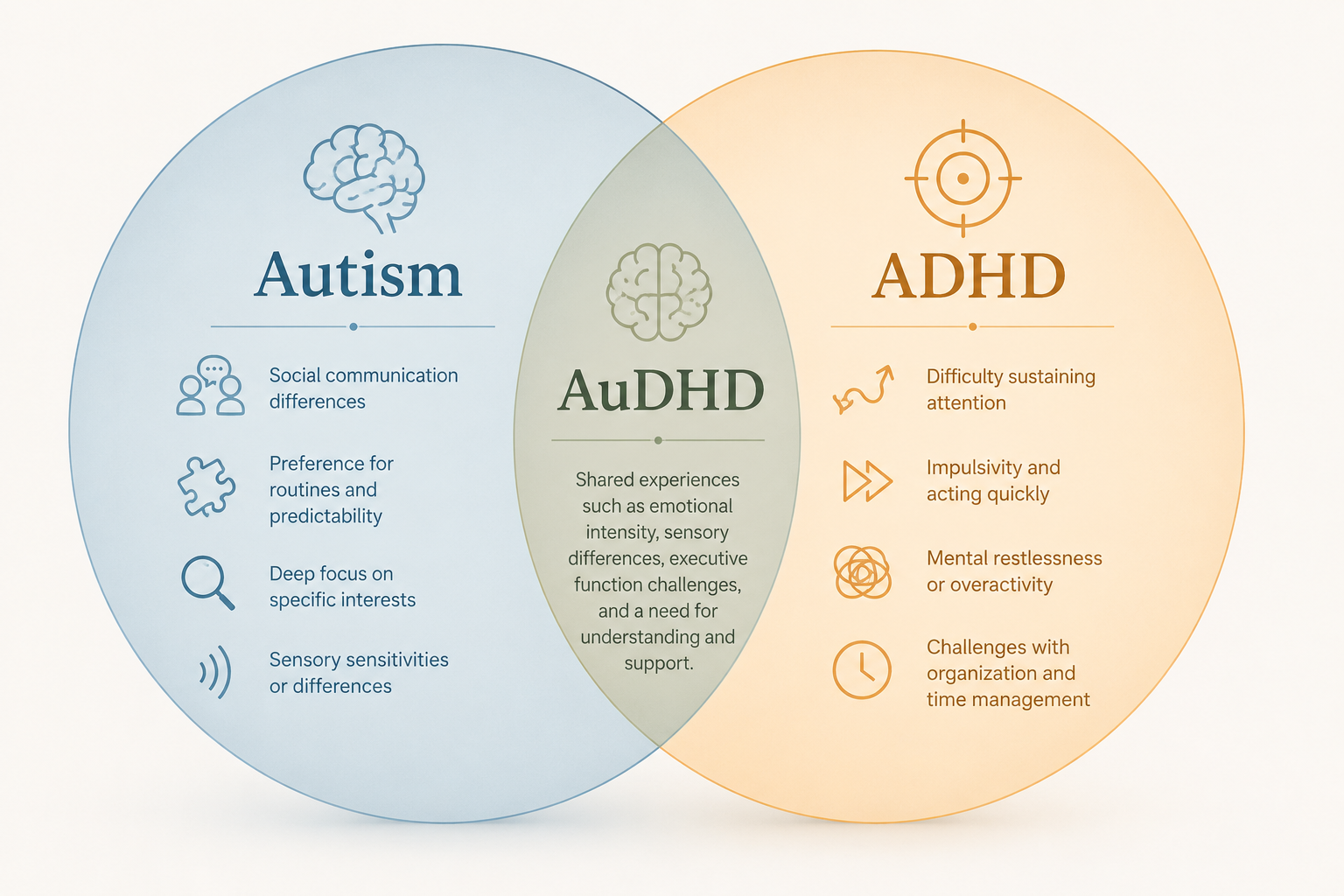
AuDHD is increasingly recognised in UK clinics, but assessment is still inconsistent. This guide covers how clinicians should approach co-occurring autism and ADHD, including the autism diagnostic tools to use, how to sequence the assessment, the autism assessment training routes available, and the most practical pathway for UK clinicians in 2026.
AuDHD Assessment: How Should UK Clinicians Assess Co-Occurring Autism and ADHD?
Most clinicians working in neurodevelopmental services have noticed the same trend over the last few years. Referrals for "possible ADHD" increasingly turn out to involve co-occurring autism, and adult autism assessments increasingly reveal untreated ADHD sitting alongside. The picture is no longer one diagnosis or the other. For many patients, it is both.
The honest answer to how to assess AuDHD is that the work needs more time, more tools, and more clinical judgement than a single-diagnosis assessment. It is not as complicated as it is sometimes made out to be, though, and a sensible structured approach makes the assessment manageable for clinicians already qualified in either ADHD or autism diagnosis.
This guide breaks down what AuDHD is, why it is so commonly missed, where the two conditions overlap, how to sequence a combined assessment, and the practical autism assessment clinician training routes available in the UK. It is written for clinicians, not for general readers.
Short answer: AuDHD should be assessed as two separate conditions using validated tools for each, with clinical formulation pulling the findings together. For most UK clinicians, the practical route is to be trained in ADHD diagnosis and at least one structured autism diagnostic tool (typically the ADI-R), and to follow a consistent assessment sequence that examines both conditions independently before integrating the findings.
Why AuDHD Has Become Central to Neurodevelopmental Practice
Until 2013, the DSM-IV explicitly prevented clinicians from diagnosing autism and ADHD in the same person. The change in DSM-5, and now DSM-5-TR, removed that exclusion, and the research that followed has reshaped clinical understanding.
Studies published over the past decade consistently show that 30 to 80 per cent of autistic individuals also meet criteria for ADHD, and that 20 to 50 per cent of people with ADHD meet criteria for autism, depending on the population studied. The variation reflects different sampling methods, but the central finding is now beyond serious dispute. Co-occurrence is the rule rather than the exception in modern neurodevelopmental clinics.
NICE NG87 on ADHD and NICE CG142 on adult autism both now expect clinicians to consider co-occurring neurodevelopmental conditions during assessment. In day-to-day practice, that means a clinician assessing for one should screen, and usually formally assess, for the other where indicated.
What Is AuDHD?
AuDHD is the informal but increasingly accepted shorthand for co-occurring autism and ADHD. It is not a separate diagnostic category in DSM-5-TR or ICD-11. It refers to an individual who meets full diagnostic criteria for both conditions, each diagnosed in its own right.
In clinical practice, AuDHD presentations vary widely. Some individuals show clear features of both from early childhood. Others present primarily as autistic with a less obvious ADHD layer, or primarily as ADHD with previously masked autistic traits emerging once the ADHD is treated. The shape of the presentation matters because it shapes how the assessment should be sequenced.
The important clinical point is that AuDHD is not a watered-down version of either condition. The two diagnoses are additive rather than averaging out. Functioning is often more impaired than in either condition alone, and the combination carries its own distinct clinical profile worth recognising in its own right.
Where Autism and ADHD Overlap
Part of what makes AuDHD assessment demanding is that several core features look superficially similar across the two conditions but mean different things diagnostically.
| Feature |
Autism |
ADHD |
| Attention difficulties |
Difficulty disengaging from preferred topics, narrow attentional focus |
Inconsistent attention across tasks, frequent shifts, difficulty sustaining focus |
| Social difficulties |
Differences in reciprocity and social communication |
Social impulsivity, interrupting, missing cues due to inattention |
| Sensory issues |
Hyper- or hypo-reactivity tied to autistic processing |
Sensory seeking tied to under-arousal |
| Restricted interests |
Long-standing, structured, often deep |
Intense but often short-lived hyper-focus on novel topics |
| Emotional regulation |
Difficulty with change, rigidity, shutdowns |
Emotional impulsivity, quick frustration, mood shifts |
| Executive function |
Difficulty with flexibility, planning, transitions |
Difficulty with initiation, working memory, sustained effort |
| Childhood onset |
From early childhood, anchored in the 3 to 5 window |
Present before age 12, but more variable pattern |
The overlap is real, but the underlying mechanism is different. A clinician who only looks at surface features will frequently misclassify one condition as the other, or attribute features to a single diagnosis when both are present. This is why structured autism diagnostic tools and a clear assessment sequence matter so much in AuDHD work.
When to Suspect AuDHD
A confident AuDHD formulation usually emerges from one of several common clinical pictures.
- ADHD diagnosed in childhood, autism suspected in adolescence or adulthood. Often once stimulant treatment improves attention, residual social communication differences and restricted interests become more visible.
- Late-diagnosed autistic adults with persistent attention and executive issues. ADHD may have been masked by autistic compensatory strategies, then re-emerges after autism diagnosis.
- Children who do not respond fully to ADHD treatment but continue to struggle socially, rigidly, or with transitions.
- Adults presenting in mental health services with chronic anxiety, depression, or burnout that does not respond well to standard treatment.
- Patients whose self-identification includes both, often through informed online communities. Self-identification is not diagnosis, but it is a useful clinical signal that warrants a structured assessment.
A high index of suspicion is appropriate any time one neurodevelopmental condition is being assessed. The default question for the modern clinician is not whether one is present, but whether both might be.
How to Sequence an AuDHD Assessment
A structured sequence keeps the assessment manageable and produces clearer evidence for diagnostic reasoning.
Step one: take a thorough developmental and clinical history. This sets the foundation. Autism evidence must be present from early childhood. ADHD evidence must be present before age 12. A combined history collects the relevant detail for both before any formal tools are administered.
Step two: assess ADHD using validated tools. In UK practice this usually involves a structured diagnostic interview such as the DIVA-5 for adults or an age-appropriate equivalent for children, combined with informant rating scales and, where relevant, continuous performance testing such as QbCheck. The process should align with NICE NG87.
Step three: complete a structured ADI-R autism assessment. The Autism Diagnostic Interview Revised (ADI-R) is the most widely used structured developmental interview in UK autism assessment, typically combined with ADOS-2 observation where available. For adults without a caregiver informant, the ADI-R assessment can still contribute structured developmental detail when a sibling, partner, or school records are accessible. Our ADI-R vs ADOS guide covers the choice between the two tools in more detail.
Step four: integrate the findings clinically. Each diagnosis is reached on its own merits. The integration stage looks at how the two conditions interact in functioning, treatment implications, and presentation. This is also where clinicians flag conditions in the differential, including anxiety, OCD, complex trauma, and learning disability.
The full assessment usually spans more than one appointment. Splitting it across two or three sessions improves the quality of both the data and the patient experience.
Autism Diagnostic Tools That Support an AuDHD Diagnosis
The toolkit for AuDHD is not new. It is the combination of well-established ADHD and autism diagnostic tools used in the same assessment pathway.
For ADHD, common tools include the DIVA-5 for adult assessment, the Conners and SNAP rating scales, the Brown ADD scales, and continuous performance tests such as QbCheck. For school-age children, the assessment typically draws on parent and teacher rating scales alongside clinical interview.
For autism, the ADI-R is the most widely used structured developmental interview, with the ADOS-2 adding direct observation. Adult-focused screening measures such as the AQ-10 and RAADS-R can support the broader picture but do not replace structured diagnostic tools.
No single tool diagnoses AuDHD. The diagnosis is made by a qualified clinician integrating tool findings, developmental history, current presentation, and the broader clinical picture against DSM-5-TR or ICD-11 criteria.
Common Pitfalls in AuDHD Assessment
Even experienced clinicians stumble in particular places.
Diagnostic overshadowing. This is the most common pitfall. A confirmed autism diagnosis can lead clinicians to attribute attention difficulties to autism alone, missing co-occurring ADHD. The reverse also happens. A confirmed ADHD diagnosis can lead clinicians to dismiss social and sensory features as ADHD-related impulsivity.
Skipping the developmental history. AuDHD assessments fail most often when the developmental history is rushed. Both conditions require evidence of early childhood onset, and a thin history makes both diagnoses harder to defend.
Treating self-identification as diagnosis. Many patients arrive with strong online-influenced self-identification. This is clinical information, not a substitute for assessment. Validate the patient's experience without short-cutting the structured process.
Under-recognising masking in women and girls. AuDHD in women is consistently under-diagnosed. The combined presentation often involves intense masking of both conditions, leading to misdiagnosis as anxiety, depression, or personality difficulties. The National Autistic Society has published useful clinical context on this.
Treating co-occurrence as a tie-breaker. Some clinicians label ambiguous cases as "autistic with ADHD traits" or vice versa to avoid the work of a full dual assessment. This produces unclear diagnoses that do not support good treatment planning.
Autism Assessment Training Routes for UK Clinicians
Clinicians who want to assess AuDHD competently need foundations in both ADHD diagnosis and autism assessment training. The pathway depends on where you are starting from.
Clinicians coming from ADHD practice typically need to add structured autism diagnostic training. The most efficient first step is the ADI-R Training Course, supported by a broader foundation through the Autism Awareness Training course. The ADI-R course is delivered live online over a full day, carries 8 CPD hours, and is the standard entry point into UK autism diagnostic work.
Clinicians coming from autism practice typically need to add ADHD diagnostic training. The Diagnosis Course for Professionals covers the structured assessment approach expected in NICE-aligned UK services. For clinicians who also plan to manage medication, the ADHD Prescribing and Management Course is the natural next step.
Clinicians focused specifically on combined assessment are best served by the Co-Occurring Autism and ADHD course. It pulls together the clinical reasoning, sequencing, and differential diagnosis specific to AuDHD and is designed for regulated healthcare professionals already practising in one or both areas. Like other Global ADHD Network autism assessment clinician training, it is delivered live online, CPD-certified, and submissible to the BPS, HCPC, NMC, GMC, and GPhC.
Bodies such as the Royal College of Psychiatrists and the British Psychological Society recognise structured neurodevelopmental CPD as appropriate for revalidation and for insurance credentialling. Whichever course you choose, plan for supervised practice afterwards. AuDHD work in particular benefits from peer discussion and case review.
Cost and Time Investment
A realistic snapshot for a UK clinician adding AuDHD competency over the next twelve months:
- One foundational autism course if not already completed, around half a day to one full day.
- ADI-R training, typically a full day plus a few weeks of self-directed practice.
- Structured ADHD diagnostic training, typically one to two days plus practice.
- A dedicated AuDHD or co-occurring course to integrate the two.
- Ongoing supervised practice in a service that carries out both ADHD and autism assessment in the UK.
Total realistic time to working confidently in AuDHD assessment under supervision is usually four to nine months for a clinician already practising in one of the two areas, and somewhat longer for clinicians newer to neurodevelopmental work.
There is also a less obvious cost worth flagging. AuDHD cases take longer to assess and write up than single-diagnosis cases. Services that take this work seriously protect longer assessment slots, more report-writing time, and structured peer review for complex cases.
Frequently Asked Questions
Can autism and ADHD be diagnosed together?
Yes. The DSM-5, DSM-5-TR, and ICD-11 all allow concurrent diagnosis. Research consistently shows substantial co-occurrence, and current UK guidance expects clinicians to consider both conditions when assessing for either.
Is AuDHD a separate diagnosis?
No. AuDHD is the informal term for co-occurring autism and ADHD. It is not a discrete category in DSM-5-TR or ICD-11. Both diagnoses are made in their own right and recorded separately.
Do I need ADOS-2 to diagnose AuDHD?
Not always. The ADOS-2 adds significant value when in-person observation is feasible and the population is appropriate. Many UK services build AuDHD assessments around an ADI-R assessment combined with structured ADHD tools, particularly for adults. The ADOS-2 is added where service infrastructure supports it.
How is AuDHD different from autism with attention difficulties?
The two are different clinically. Attention difficulties within autism reflect autistic patterns of processing. ADHD is a distinct condition with its own diagnostic criteria, evidence base, and treatment implications. The distinction matters for medication decisions, support planning, and patient self-understanding.
Should ADHD or autism be assessed first?
It varies. In adults presenting with attention difficulties, ADHD is often assessed first because treatment can unmask autistic features. In children with clear autism, ADHD is often considered once the autism formulation is in place. The order is less important than the consistency of the assessment process.
How long does a combined AuDHD assessment take?
Usually six to ten hours across two or three appointments, including history, structured ADHD tools, structured autism diagnostic tools, integration, and feedback. Complex cases or those involving differential diagnosis can take longer.
Can AuDHD be assessed remotely?
Yes, in large part. ADHD assessment using DIVA-5 and rating scales adapts well to remote delivery, and the ADI-R autism assessment is well suited to video administration. Direct observation through the ADOS-2 is the main element that benefits from in-person delivery.
Next Steps for Clinicians Building AuDHD Capability
If you have read this far and you want to develop your AuDHD assessment practice, a realistic next-twelve-months plan looks like this:
- Confirm your scope of practice with your regulatory body and indemnity provider for combined neurodevelopmental assessment.
- Complete a foundational autism course if you do not already have one, for example the Autism Awareness Training course.
- Train in structured ADHD diagnosis through the Diagnosis Course for Professionals if you are coming from an autism background, or in structured autism diagnostic interviewing through the ADI-R Training Course if you are coming from ADHD.
- Add the Co-Occurring Autism and ADHD course to integrate the two assessment pathways.
- Arrange supervised practice in a service that carries out both ADHD and autism assessments, with peer review of complex cases.
- Plan ADOS-2 training for the following twelve months if your service supports in-person observation.
You can view the full course catalogue and upcoming dates here, or read the companion guide on ADI-R vs ADOS autism assessment tools for the wider context on autism diagnostic instruments. For clinicians building a full route into UK autism assessment work, the guide on how to become an autism assessor in the UK covers qualifications, scope, and career pathway in detail.
%20(1).webp)