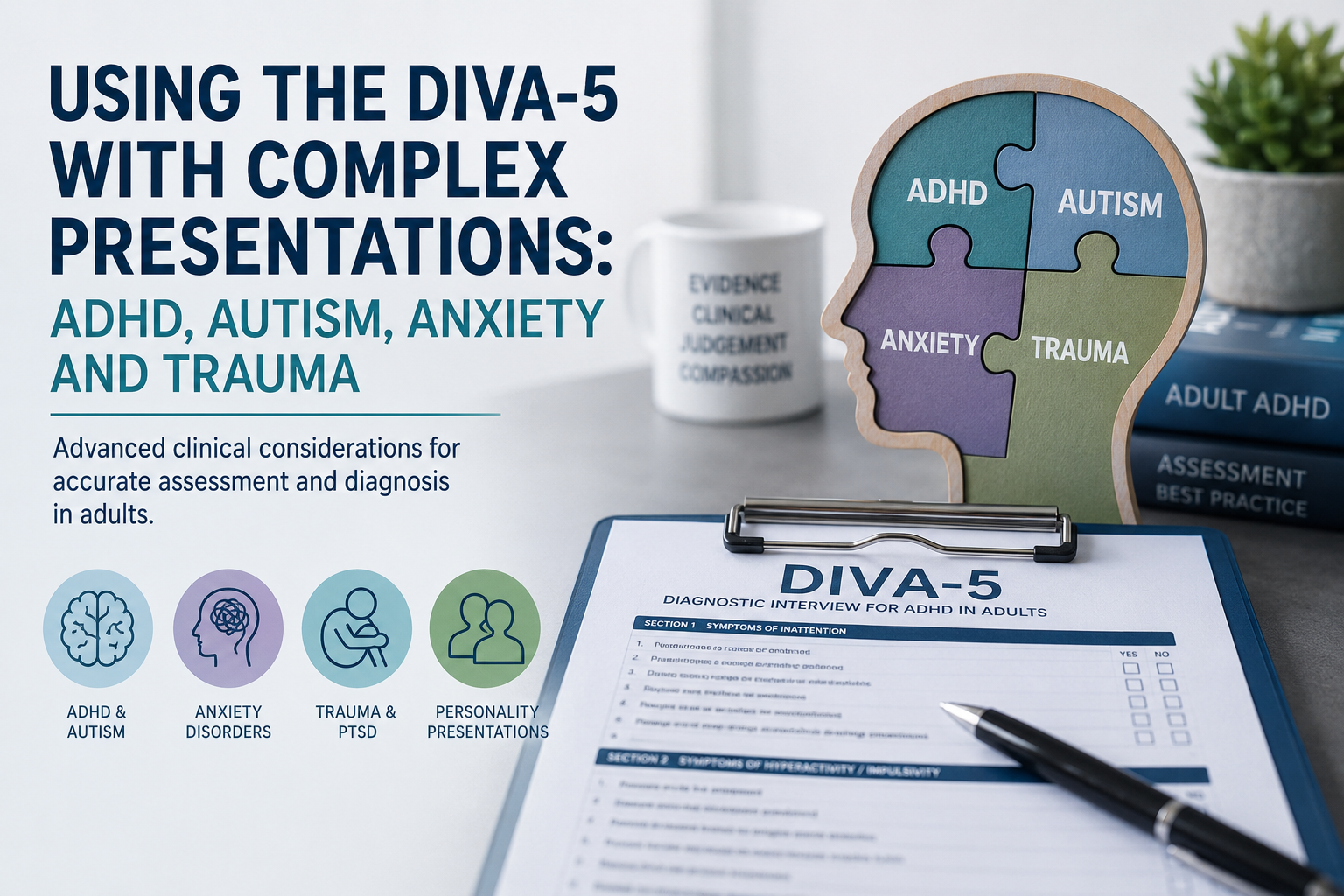
The DIVA-5 is one of the most widely used structured diagnostic interviews for adult ADHD in the United Kingdom. In straightforward presentations, it performs well. A patient attends, describes a clear lifelong pattern of inattentive and hyperactive-impulsive symptoms across multiple settings, reports onset before the age of 12, and the interview confirms what the clinical picture already suggested. The scoring is clear, the formulation writes itself, and the report is defensible.
But in clinical practice, straightforward presentations are only part of the caseload. A significant proportion of adults referred for ADHD assessment present with co-occurring conditions, complex trauma histories, neurodevelopmental profiles that include both ADHD and autism, anxiety disorders that mimic or mask attentional difficulties, or mood conditions that complicate the retrospective history. These are the cases where the DIVA-5 demands considerably more from the clinician than simply working through the interview script.
This article is written for clinicians who are already familiar with the DIVA-5 and want to develop their competence in using it with complex presentations. It covers the four most commonly encountered complexity factors in UK adult ADHD practice: autism and the AuDHD profile, anxiety disorders, trauma and PTSD, and personality presentations. For each, it addresses how the complexity affects DIVA-5 administration and scoring, what clinical adjustments are warranted, and how findings should be framed in diagnostic formulations and reports.
This material sits at the advanced end of ADHD diagnostic training. If you are new to the DIVA-5 and looking for foundational guidance, we recommend starting with our ADHD assessment training programmes before working through the more advanced clinical considerations covered here.
Why Complex Presentations Challenge the DIVA-5
The DIVA-5 was designed as a structured diagnostic interview for ADHD in adults. It does this job well when used by a trained clinician with a clear understanding of DSM-5 criteria and the phenomenology of adult ADHD. What it does not do is diagnose co-occurring conditions, account automatically for the ways those conditions modify ADHD symptom expression, or flag when symptoms that appear to meet ADHD criteria are actually better explained by something else.
That clinical discrimination is the assessor's responsibility, not the tool's. The DIVA-5 provides a systematic framework for gathering information. It is the clinician's job to interpret that information in the context of the whole clinical picture, including everything they know about the patient's history, their mental state, their developmental profile, and the conditions that are most likely to be relevant to their presentation.
When co-occurring conditions are present, three things can happen that distort DIVA-5 findings if the clinician is not alert to them. First, the co-occurring condition can generate symptoms that resemble ADHD criteria and lead to false positive endorsement. A patient with generalised anxiety disorder, for example, may describe significant difficulties with concentration and mental restlessness that genuinely meet the descriptive anchor for several inattentive and hyperactive-impulsive criteria. Whether those symptoms represent ADHD or anxiety-driven cognitive interference is a clinical judgement that the DIVA-5 scoring framework alone cannot resolve.
Second, the co-occurring condition can suppress or mask ADHD symptoms, leading to underendorsement of criteria that are genuinely present. This is particularly relevant in autism, where compensatory strategies, rigid routines, and high levels of self-monitoring can conceal the functional impact of inattentive symptoms in structured settings. A patient may not endorse a symptom criterion because their compensatory systems have made the symptom less visible to them, even though the underlying attentional dysregulation is present and causing significant difficulty in other domains.
Third, the co-occurring condition can alter the patient's ability to give a reliable retrospective account of childhood symptoms. Trauma, dissociation, and mood disorder can all affect autobiographical memory in ways that make the retrospective sections of the DIVA-5 particularly unreliable. A patient with complex PTSD may have significant gaps in their childhood memory. A patient with a history of severe depression may recall their childhood through a negative affective filter that exaggerates difficulties. A patient who experienced childhood trauma may find the retrospective questioning activating and withdraw from the interview in ways that reduce the completeness of the data gathered.
Good DIVA-5 assessment training addresses these challenges explicitly. Our ADHD training courses for UK clinicians include dedicated content on differential diagnosis and co-occurring conditions, equipping assessors to navigate these complexities with confidence and clinical rigour.
DIVA-5 With Autism: The AuDHD Assessment Challenge
The co-occurrence of ADHD and autism, increasingly referred to as AuDHD, is one of the most significant clinical challenges in adult neurodevelopmental assessment. Research estimates suggest that between 40 and 70 per cent of autistic adults also meet criteria for ADHD, with comparably high rates of autism diagnoses among adults with ADHD. Despite this, the clinical and research communities spent decades treating ADHD and autism as mutually exclusive diagnoses. DSM-5 removed the exclusion criterion in 2013, formally recognising that both diagnoses can coexist, but the clinical infrastructure for assessing them together has been slower to develop.
When using the DIVA-5 with a patient who has a known or suspected autism diagnosis, the assessor must hold several specific complexities simultaneously.
Literal Interpretation of Anchor Examples
The DIVA-5 uses concrete anchor examples to help patients understand what each symptom criterion is asking about. For most patients, these examples work as intended: they provide a frame of reference that helps the patient recognise whether the described pattern applies to them. Autistic patients, however, often interpret these examples very literally. If the anchor example for an inattentive criterion mentions difficulties following instructions at work, an autistic patient who has never been in paid employment may say no without recognising that the same pattern applies to other settings in their life.
Assessors working with autistic patients need to supplement the standard anchor examples with a broader range of contextual examples drawn from settings that are relevant to the individual patient's life. This requires more active clinical engagement with the interview than a standard administration involves and should be factored into the time allocated for assessment sessions.
Compensatory Strategies and Masking
Many autistic adults, and particularly autistic women and those with high intellectual ability, have developed extensive compensatory strategies that manage the functional impact of their ADHD symptoms. These strategies can range from rigid routines and environmental controls that reduce attentional demands, to hyperfocus on areas of intense interest that provides a reliable source of task completion. The patient may have little conscious awareness of the effort these compensatory systems require.
When the DIVA-5 asks about the impact of symptoms on functioning, patients who have been compensating heavily may underreport functional impairment because their systems have successfully managed the surface-level impact, even though the underlying dysregulation remains significant. Clinicians should probe specifically for the cost of maintaining these compensatory systems: exhaustion, burnout, inability to sustain them under stress, and the domains where they break down.
Attribution Differences
Autistic patients may attribute ADHD-consistent difficulties to autism rather than to a co-occurring attentional condition. A patient who has already received an autism diagnosis may present to the ADHD assessment saying that they think all their difficulties are autism-related and that they are not sure ADHD is relevant. This is not necessarily accurate. Many symptoms, including executive dysfunction, working memory difficulties, and emotional dysregulation, are features of both conditions and can be genuinely attributable to ADHD even in a confirmed autistic patient.
Assessors need to be careful not to accept the patient's own attribution framework uncritically. The DIVA-5 should be administered systematically regardless of the patient's explanatory model, with the clinician holding open the possibility that symptoms attributed to autism may in fact reflect co-occurring ADHD, and framing probe questions in ways that invite the patient to consider this.
Shared Symptom Overlap
Several DIVA-5 symptom criteria map onto features that are also characteristic of autism independently of ADHD. Inattention in social situations, difficulty sustaining attention on tasks that do not intrinsically interest the patient, poor organisation and planning, and the appearance of not listening when spoken to directly are all criteria that may be endorsed by an autistic patient for whom the primary driver is autism-related social and executive processing differences rather than ADHD-type attentional dysregulation.
The clinical distinction matters because while both conditions benefit from practical support and reasonable adjustments, the pharmacological interventions indicated for ADHD are not indicated for autism per se, and the diagnostic formulation should accurately represent what is driving the difficulties observed. Assessors need to probe the phenomenological quality of symptoms, not just their presence, to make this distinction. Is the inattention in social situations driven by attentional wandering and distractibility, or by reduced intrinsic motivation for social processing? The surface behaviour may look identical, but the underlying mechanism differs.
For clinicians building comprehensive neurodevelopmental assessment competencies, combining DIVA-5 training with autism assessment training and dedicated AuDHD training provides the clinical toolkit needed to navigate these cases well. Our ADHD clinician training programmes address the full neurodevelopmental complexity that clinicians encounter in UK practice.
DIVA-5 With Anxiety Disorders
Anxiety disorders are among the most common co-occurring conditions in adults with ADHD, with prevalence estimates consistently in the range of 40 to 50 per cent in clinical populations. The relationship between ADHD and anxiety is bidirectional and complex. ADHD creates conditions that generate secondary anxiety: chronic underperformance, relationship difficulties, financial stress, and the accumulated experience of failure despite effort all contribute to anxiety that is in some sense consequential to the ADHD rather than a separate primary condition. At the same time, primary anxiety disorders can generate attentional and cognitive symptoms that mimic ADHD, creating a diagnostic challenge that the DIVA-5 alone is not equipped to resolve.
Distinguishing Anxiety-Driven Inattention From ADHD Inattention
Both ADHD and anxiety produce significant difficulties with concentration and sustained attention, but the phenomenological quality of these difficulties differs in ways that are clinically important. In ADHD, inattention is typically characterised by attentional wandering, distractibility by external stimuli, difficulty initiating and completing tasks, and a pervasive pattern that is present across multiple settings regardless of the emotional valence of the situation. In anxiety, concentration difficulties tend to be more closely tied to worry and rumination: the patient cannot focus because their mind is occupied by anxious cognition, not because their attentional system is fundamentally dysregulated.
When administering the DIVA-5 with a patient with significant anxiety, the clinician should probe the context and phenomenology of each endorsed inattentive criterion carefully. Does the difficulty concentrating occur across all settings, including those where anxiety is low? Or is it primarily present in high-stakes, evaluative, or uncertainty-laden situations? Does the patient have domains of life where sustained attention is intact, perhaps activities they find intrinsically absorbing? ADHD-related inattention tends to persist even in low-anxiety, low-stakes settings, though it may be modulated by novelty and interest. Anxiety-related inattention tends to fluctuate more closely with anxiety levels.
Hyperarousal and Hyperactivity
The hyperactive-impulsive domain of the DIVA-5 presents a specific challenge when anxiety is present. Anxiety produces physiological and psychological hyperarousal that can closely resemble the internal restlessness and mental overactivity that ADHD hyperactivity looks like in adults. Patients with anxiety may endorse criteria around feeling driven by a motor, difficulty sitting still, and internal restlessness that are being driven primarily by anxiety rather than by ADHD-type hyperactivity.
Again, probing the context and chronology matters. Did these experiences precede the anxiety disorder, or did they develop alongside it? Are they present even when anxiety is well-managed or in remission? For patients who have had periods of effective anxiety treatment, exploring what changed and what remained is often clinically informative.
The Childhood History Section With Anxious Patients
Anxious patients may approach the retrospective childhood sections of the DIVA-5 with significant apprehension, particularly if their childhood was difficult or if they are worried about not meeting diagnostic criteria. This can produce two opposite distortions. Some patients, particularly those who are anxious about not being believed or not qualifying for diagnosis, may over-report childhood symptoms. Others, whose anxiety includes a strong component of self-doubt, may underreport symptoms from a sense that their difficulties were not serious enough to count.
Clinicians should be alert to the emotional texture of the interview as they move through the retrospective sections, and should create space for patients to reflect on their responses rather than accepting first-pass answers without probing. Where significant anxiety is present, collateral information from informants who knew the patient in childhood is particularly valuable as a check on the reliability of self-report.
DIVA-5 With Trauma and PTSD
Trauma and ADHD have a complex and clinically important relationship that is still incompletely understood. Epidemiological data consistently shows elevated rates of ADHD in populations with significant trauma histories, and conversely elevated rates of traumatic experiences in adults with ADHD. The reasons for this relationship are multiple and probably include the role of ADHD in creating situations of heightened risk, the neurobiological overlap between ADHD and trauma responses, and the possibility that for some individuals trauma-related neurodevelopmental effects produce ADHD-like presentations that are not straightforwardly primary ADHD.
Using the DIVA-5 with patients who have significant trauma histories requires particular care across several dimensions.
Memory and Retrospective Reliability
The DIVA-5 relies heavily on retrospective self-report for the childhood history sections. For patients with significant trauma histories, particularly those with complex or developmental trauma, autobiographical memory is frequently disrupted. Patients may have significant gaps in their childhood recollections, particularly for periods during which they experienced abuse, neglect, or household instability. They may have memories that are fragmented, emotionally charged, or difficult to access in the kind of orderly narrative the DIVA-5 retrospective sections implicitly assume.
Clinicians should acknowledge the challenges of retrospective recall directly with patients when it is clear that memory is unreliable, and should avoid pressing for detailed retrospective accounts in ways that may be activating. The DIVA-5 should be adapted to gather what is reliably available without creating distress that interferes with the rest of the assessment. Where childhood memory is substantially unavailable, greater weight should be placed on collateral information sources including school reports, assessments conducted in childhood, and informant accounts from family members.
PTSD Symptom Overlap With ADHD
The symptom overlap between PTSD and ADHD is substantial and clinically significant. Both conditions can produce difficulties with concentration, hypervigilance that resembles hyperactivity, emotional dysregulation, sleep disturbance that worsens attentional function, avoidance behaviours that affect task completion, and impaired working memory. A patient with untreated or undertreated PTSD may present with a DIVA-5 profile that meets symptom count thresholds for ADHD without the underlying attentional dysregulation being a primary ADHD presentation.
The temporal relationship between symptom onset and traumatic experiences is critical here. The DIVA-5 requires evidence of symptom onset before the age of 12. If a patient's attentional difficulties developed following a traumatic experience that occurred in adulthood or late adolescence, this temporal pattern is inconsistent with primary ADHD and should prompt careful consideration of whether PTSD or a trauma-related condition is the primary driver. This does not mean that ADHD cannot coexist with PTSD, only that the DIVA-5 findings need to be interpreted against a clear timeline of when different difficulties emerged and what was happening in the patient's life at the time.
Emotional Dysregulation and Impulsivity
Emotional dysregulation and impulsivity are features of both ADHD and trauma responses, and the DIVA-5 does not include specific items for these domains (though they are often present in clinical ADHD presentations and referenced in report formulations). When these features are prominent, clinicians need to consider carefully whether they reflect ADHD-type dysregulation, trauma-related hyperreactivity, or a combination of both. The clinical implications differ: ADHD medication may help with the ADHD component of dysregulation, but is unlikely to address trauma-driven emotional reactivity, which typically requires specific trauma-focused psychological treatment.
Signposting patients appropriately towards trauma-focused care, where indicated, alongside or prior to ADHD management, reflects the kind of holistic clinical formulation that comprehensive ADHD diagnostic training should instil. Clinicians who have completed our ADHD training courses are equipped to frame diagnostic formulations that account for this complexity rather than reducing it to a single diagnostic label.
DIVA-5 With Personality Presentations
Personality disorder diagnoses, particularly emotionally unstable personality disorder (EUPD, sometimes referred to as borderline personality disorder), present significant diagnostic challenges when ADHD is also being considered. The symptom overlap between ADHD and EUPD is considerable, including emotional dysregulation, impulsivity, unstable relationships, and difficulties with identity and self-organisation. Both conditions are also associated with significant rates of childhood adversity, trauma, and family disruption, making the retrospective sections of the DIVA-5 particularly complex to interpret.
The Risk of Diagnostic Overshadowing
Diagnostic overshadowing refers to the tendency for a prominent existing diagnosis to absorb and explain away symptoms that may in fact reflect a separate co-occurring condition. In clinical practice, patients with established EUPD diagnoses are frequently not referred for ADHD assessment because their attentional and executive difficulties are attributed to the personality presentation. This results in underdiagnosis of ADHD in this population and a failure to provide pharmacological interventions that may significantly improve quality of life for patients where ADHD is a genuine co-occurring condition.
When a patient with EUPD is referred for ADHD assessment and the DIVA-5 is administered, the clinician should resist the pull towards overshadowing in both directions: neither assuming that all ADHD-like symptoms are EUPD-driven, nor assuming that because criteria are met the diagnosis is straightforward. The DIVA-5 findings need to be interpreted in the context of a comprehensive clinical picture that considers both the personality presentation and the possibility of co-occurring ADHD.
Impulsivity in ADHD and Personality Disorder
Impulsivity is a shared feature of ADHD and several personality presentations, but the clinical character of impulsivity differs. ADHD-type impulsivity tends to be pervasive, relatively consistent across contexts, and not strongly tied to interpersonal emotional states. It is the impulsivity of acting before thinking, of interrupting conversations, of making decisions without sufficient reflection. Personality-related impulsivity is often more contextually linked to emotional dysregulation, abandonment fears, and interpersonal stress. It tends to be more volatile and more closely tied to the affective states that characterise the personality presentation.
These distinctions are clinically meaningful and should be explored in the DIVA-5 impulsivity items through careful probing. Is the impulsive behaviour consistent across contexts, including when the patient is emotionally regulated? Or does it arise primarily in the context of interpersonal stress or emotional crisis? The answers do not resolve the diagnostic question unilaterally, but they provide important evidence for the formulation.
Adjusting DIVA-5 Administration for Complex Presentations
Across all of these complexity factors, several general principles of DIVA-5 administration apply when the clinical picture is complicated by co-occurring conditions.
Allow More Time
Complex presentations reliably take longer to assess than straightforward ones. The additional probing required, the need to manage emotional activation during the retrospective sections, the greater volume of collateral information to review, and the clinical complexity of the formulation all add time. Assessors should allocate extended appointment slots for patients with known co-occurring conditions and should not allow time pressure to compress the quality of the interview.
Conduct a Multi-Stage Assessment Where Indicated
For the most complex presentations, a single extended assessment appointment may not be sufficient or appropriate. Patients with significant trauma histories, active psychiatric conditions, or particularly complex histories may benefit from a multi-stage assessment that separates different components of the evaluation across multiple sessions. This allows time for rapport building, reduces the risk of overwhelming patients with the breadth of retrospective questioning, and enables the assessor to gather and review additional information between sessions.
Weight Collateral Information More Heavily
When self-report reliability is compromised by the factors described above, collateral information from informants who knew the patient in childhood and adolescence becomes particularly important. School reports, childhood clinical records, and informant interviews can provide a more objective record of symptom presence and impairment than retrospective self-report alone. Clinicians should actively seek this collateral information for complex cases and should factor its absence explicitly into the confidence level they express in their diagnostic conclusions.
Be Explicit About Diagnostic Uncertainty
In complex presentations, diagnostic certainty is often not achievable, and clinicians should resist the pressure to produce a cleaner diagnostic conclusion than the evidence supports. A report that clearly articulates the diagnostic possibilities, explains the factors that make definitive conclusions difficult, and describes a clinical management plan that addresses the presenting difficulties regardless of diagnostic resolution is more professionally defensible and more useful to the patient than a report that forces a binary conclusion onto genuinely ambiguous data.
ADHD report writing training should equip clinicians to articulate diagnostic uncertainty clearly and constructively. Our ADHD clinician training includes detailed guidance on how to frame complex diagnostic formulations in reports that are clinically useful, professionally defensible, and comprehensible to referring clinicians, GPs, and patients themselves.
The Role of Supervision in Complex DIVA-5 Cases
One of the most important quality assurance mechanisms for complex ADHD assessments is clinical supervision. Even experienced assessors benefit from the opportunity to discuss difficult cases with a senior colleague, review scoring decisions that felt uncertain, and reflect on how their own clinical assumptions and biases may have influenced the interview. For less experienced clinicians, supervision of complex DIVA-5 cases is not optional: it is a professional requirement.
Services should have clear supervision arrangements in place for ADHD assessment, including a named supervisor with appropriate clinical expertise, a defined frequency of supervision, and a process for escalating particularly complex cases to a more senior clinician. The supervision framework should be documented and should form part of the service's quality assurance infrastructure rather than being an informal arrangement that depends on individual relationships.
For clinicians working in independent practice without access to a service-level supervision structure, peer supervision groups and formal supervision contracts with experienced supervisors provide an alternative. The ADHD assessment community in the UK is relatively small, and there are now a number of peer networks and professional groups through which independent clinicians can access supervision support for complex cases.
Implications for DIVA-5 Training Content
The clinical complexities described in this article have direct implications for what comprehensive DIVA-5 training should include. A training programme that only covers standard administration of the interview without addressing complex presentations is insufficient preparation for the clinical reality of adult ADHD assessment in the UK.
High-quality DIVA-5 assessment training for complex presentations should include case-based learning with examples drawn from autism, AuDHD, anxiety, trauma, and personality presentations. It should address the phenomenological distinctions between ADHD symptoms and symptom-alike features of co-occurring conditions. It should provide guidance on adapting interview administration while maintaining fidelity to the tool. It should cover report writing for complex and diagnostically uncertain cases. And it should address the supervision and governance frameworks that support safe and defensible practice with complex caseloads.
These are not niche considerations for a small subset of clinicians. They are core competencies for anyone working in adult ADHD assessment in the UK, where complex and co-occurring presentations are the norm rather than the exception. Any clinician seeking a pathway to becoming an ADHD assessor should ensure their training programme addresses these areas explicitly before they begin independent practice.
NICE Guidance and Complex Presentations
The NICE guideline NG87 on ADHD recognises the importance of comprehensive assessment that considers co-occurring conditions and differential diagnoses. It recommends that the assessment process should consider whether other conditions might better account for the presenting symptoms, and that co-occurring conditions should be identified and addressed as part of the overall management plan.
This guidance has direct implications for how the DIVA-5 is used in practice. Clinicians cannot fulfil the NICE requirement for a comprehensive, differential-diagnosis-aware assessment simply by administering the DIVA-5 and scoring it. They need to situate the DIVA-5 findings within a broader clinical assessment that addresses the question of whether co-occurring conditions are present, how they interact with the ADHD presentation, and what the implications are for management.
The NHS guidance on ADHD diagnosis similarly emphasises the need for a thorough assessment that goes beyond symptom checklists and considers the full context of the patient's presentation. For clinicians working within NHS services, this means that the skills described in this article are not aspirational extras: they are the minimum standard the NHS expects of clinicians conducting adult ADHD assessments.
CPD and Complex Presentation Skills
Developing competence in using the DIVA-5 with complex presentations is an ongoing process rather than a destination. The clinical literature on ADHD co-occurring conditions continues to develop rapidly, and clinicians need to keep pace with new evidence on prevalence, phenomenology, and management of complex presentations as it emerges.
CPD certified ADHD courses that address complex presentations explicitly are a valuable resource for clinicians looking to formalise and develop this area of their practice. Our CPD-accredited ADHD courses include advanced content on complex presentations for clinicians who have completed foundational ADHD assessment training and are ready to develop their practice in more challenging clinical territory.
Alongside formal CPD, engagement with the clinical literature, case-based peer learning, and reflective practice through supervision all contribute to the ongoing development of complex assessment competencies. Clinicians who make this investment will find that their diagnostic practice becomes not only more accurate and defensible, but more genuinely useful to the patients they assess: patients who, in many cases, have been struggling with unrecognised complexity for years and whose clinical needs deserve the most sophisticated assessment their clinician can offer.
Summary
Using the DIVA-5 with complex presentations requires a level of clinical sophistication that goes well beyond standard interview administration. When autism, anxiety, trauma, or personality presentations are part of the clinical picture, assessors must understand how these conditions can generate false positive endorsements of ADHD criteria, suppress genuine symptoms through masking and compensation, compromise the reliability of retrospective self-report, and complicate the diagnostic formulation.
The four guiding principles for complex DIVA-5 assessments are: allow more time, use collateral information actively, probe the phenomenological quality of symptoms not just their presence, and be explicit about diagnostic uncertainty in formulations and reports. These principles, applied consistently and supported by appropriate supervision and ongoing CPD, are what distinguishes a clinician who is merely competent at using the DIVA-5 from one who uses it in a way that genuinely serves the complex patients presenting to adult ADHD services across the UK.
Global ADHD Network provides CPD-accredited training for healthcare professionals working in adult ADHD services across the UK. Our advanced clinical training programmes include dedicated content on complex presentations, differential diagnosis, and DIVA-5 assessment skills for challenging caseloads.
%20(1).webp)