Global ADHD Network — One of the most highly reviewed ADHD CPD and CME training providers in ADHD diagnosis and neurodiversity training.Global ADHD Network — One of the most highly reviewed ADHD CPD and CME training providers in ADHD diagnosis and neurodiversity training.Global ADHD Network — One of the most highly reviewed ADHD CPD and CME training providers in ADHD diagnosis and neurodiversity training.
The Five DSM-5 Criteria Clinicians Most Often Fail to Evidence in an ADHD Report
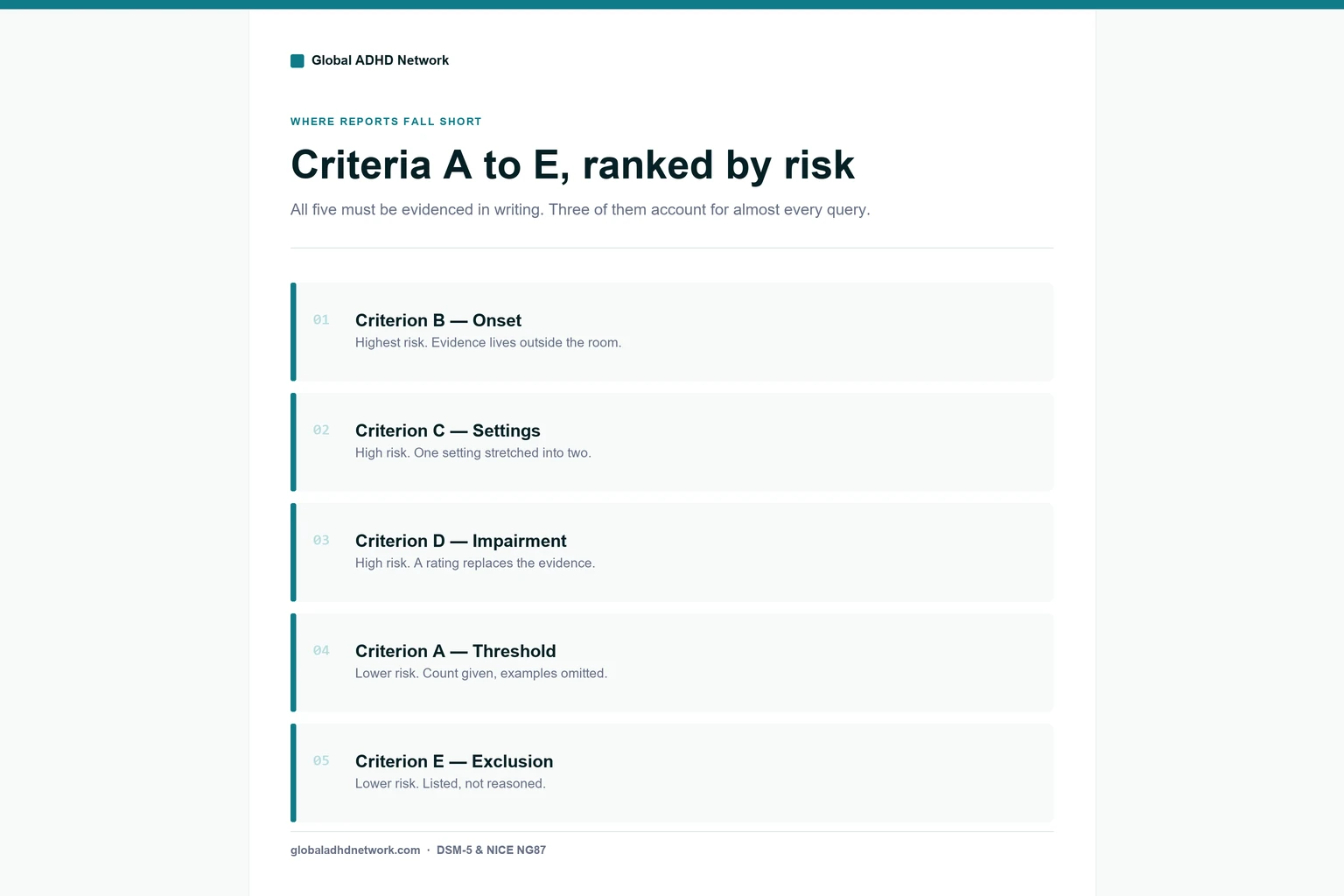
Criteria B, C and D account for almost every queried ADHD report, and almost never because the clinician skipped them. Where adult reports fall short, why the gaps arise, and the wording that closes each one — with a worked example of the same case written twice.
A report comes back with a single line against it: please clarify the evidence for childhood onset. You know the evidence. You spent twenty minutes on it. The patient's mother described a specific incident involving a school trip and a lost coat, and you remember thinking at the time that it was exactly what you needed.
It is not in the report. What is in the report is the sentence "symptoms have been present since childhood".
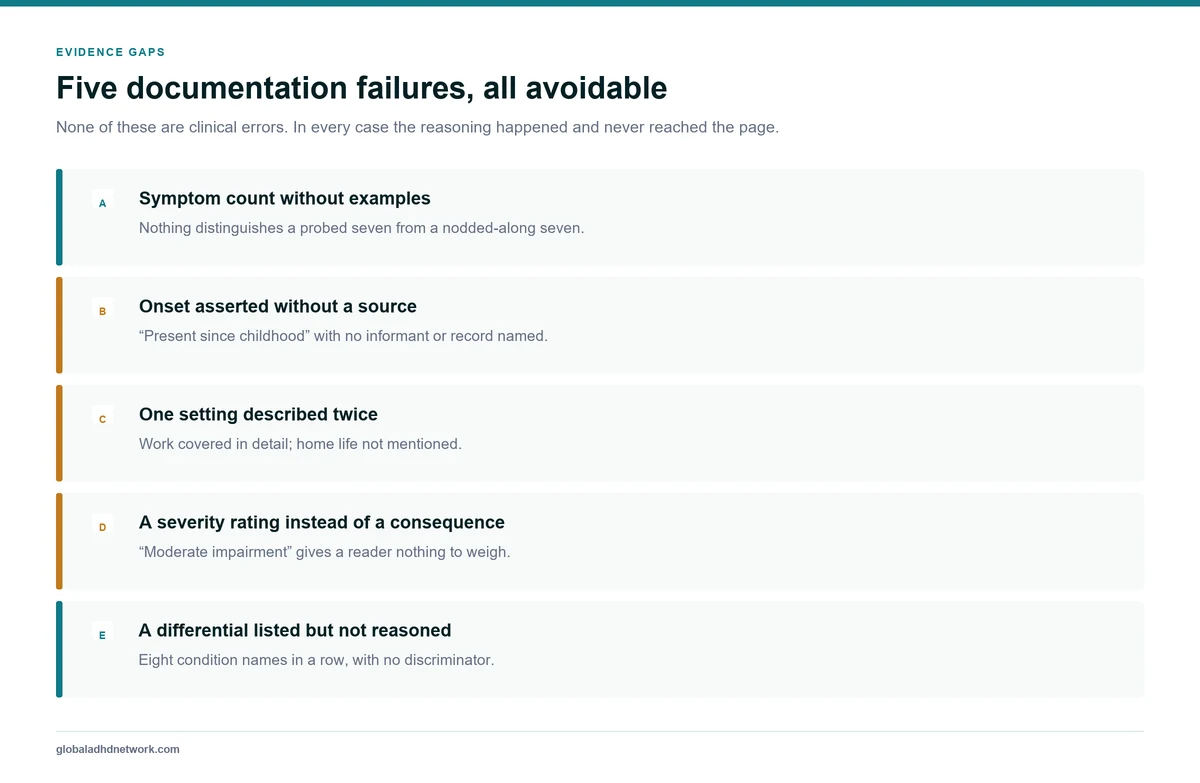
This is the shape of almost every ADHD report query. Not a clinical failure — a documentation failure. The reasoning happened and never reached the page. Below are the five criteria in the order they cause trouble, and what a reader needs to see for each.
Who this is for
Written for the clinicians whose signature goes on the report:
Consultant psychiatrists and clinical psychologists carrying the medico-legal exposure
ADHD nurse specialists and nurse prescribers diagnosing under NICE NG87
GPs with an extended role, who see which reports are unusable from the receiving end
Trainees, for whom the gap between good assessment and good documentation is widest
Criterion B: onset before age 12 — the biggest single gap
This produces more queries than the other four combined, and almost never because the clinician skipped it.
The problem is that childhood onset is the one criterion where the evidence lives outside the room. Symptom counts come from the interview. Impairment comes from the interview. Onset comes from someone else's memory, or from a document, and if you do not name which, the reader has nothing to weigh.
What a reader needs to see
Who the source was — relationship, and which period of childhood they can speak to
What they described, ideally in their own words and dated
Why you found it credible, especially where accounts differ
What was missing, where evidence was thin, and what you relied on instead
Our collateral history guide covers how to gather this properly, including what to do when there is no informant available at all.
Criterion C: two or more settings — the quietly modern problem
Symptoms have to appear in more than one setting. The criterion exists to separate a pervasive difficulty from a situational one: someone who cannot concentrate in a job they hate is describing the job.
What has changed is that a growing share of patients genuinely have one setting. Living alone, working remotely, few social commitments — the ordinary two-setting evidence simply is not there, and clinicians either stretch one setting into two or quietly skip the criterion.
Neither survives a careful read. Two named settings sharing one example is one setting described twice.
Criterion D: impairment — where a rating replaces the evidence
Criterion D asks for clear evidence that symptoms interfere with functioning. The single most common failure is summarising that into a severity word. "Moderate impairment" is a conclusion presented as evidence, and it gives a reader nothing they can picture or weigh.
What a reader can act on is a consequence: three formal warnings, two courses abandoned, utilities disconnected twice despite sufficient funds. The DIVA-5 structure spreads this across five life domains and is worth using as a prompt even where you are not running a full DIVA.
Criterion A: threshold — usually met, often under-recorded
Criterion A is the one clinicians worry about most and get queried on least. The threshold is five or more symptoms in either domain for those aged 17 and over, six for under-17s.
The failure here is subtler. Reports state the count without recording what sat behind each endorsement, which means nothing in the document distinguishes a carefully probed seven from a nodded-along seven. Three or four vivid, specific examples do more work than a full list of paraphrased criteria.
Assessed twice, not once
Each symptom is rated for childhood and for adulthood. Reports that give only the adult picture leave the reader reconstructing Criterion B from Criterion A, which is exactly the ambiguity that generates a query.
Criterion E: exclusion — listed rather than reasoned
The last criterion asks whether the presentation is better explained by something else. Naming eight conditions in a row does not answer it. The reader wants to know why each was set aside.
One clause per condition is enough. Sequence usually does the work: inattention that predates anxiety by two decades, or a presentation that is chronic where a mood disorder would be episodic.
The fix is the same in every case
Across all five criteria, the same three habits close the gap:
Name the source. Every claim in a report should be traceable to an interview, an informant, a record or an observation.
Date the example. "Around age seven" carries weight that "in childhood" does not.
Give a consequence, not a rating. Something a reader can picture and, if necessary, test.
None of this adds clinical work. It adds about ten minutes of writing, and it is the difference between a report that is accepted and one that comes back — a distinction that matters more as commissioners scrutinise assessment quality more closely. Service governance expectations are moving in one direction only.
Related guides in this cluster
This article is part of GAN's assessment workflow cluster. The pillar covers the whole pathway; each supporting guide takes one criterion and goes deeper.
It is worth being concrete about why this matters, because "write it up more carefully" is easy advice to ignore when the clinic is full.
A query does not just cost the ten minutes it takes to reply. It delays treatment, usually by weeks and sometimes by months, for a patient who has often already waited years. It generates a second piece of correspondence that itself has to be filed, read and actioned. It puts the diagnosis into a provisional state in the GP's mind, which affects prescribing confidence. And where the report was private, it invites the question of whether the assessment was adequate — a question that is now being asked far more publicly than it was five years ago.
Multiply that across a service and the cumulative cost of loose documentation is substantial. Services that audit this usually find that a small number of recurring omissions account for most of their queries, which means the fix is systemic rather than individual.
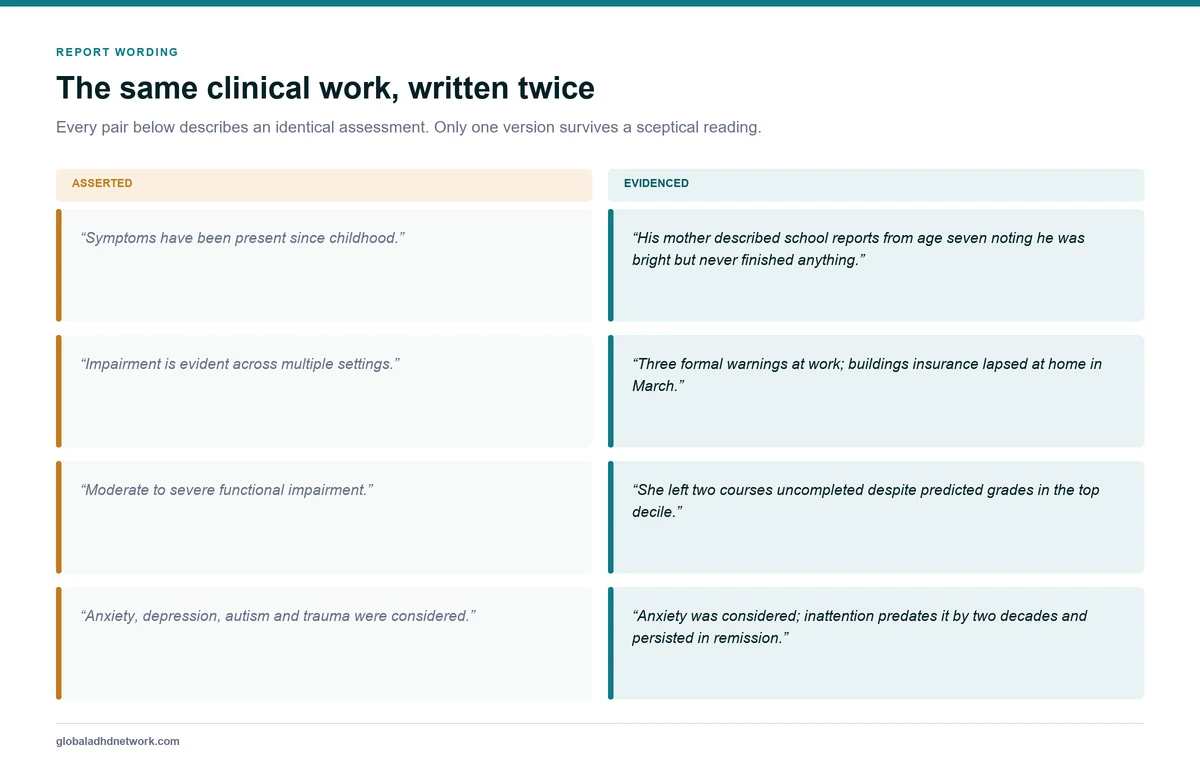
The same case, written twice
A worked example makes the difference concrete. Same patient, same assessment, same clinician.
Version one
Mr A meets criteria for ADHD, combined presentation. Symptoms have been present since childhood and cause significant impairment across multiple settings. Other psychiatric causes were considered and excluded.
Version two
Mr A meets criteria for ADHD, combined presentation — seven of nine inattentive and six of nine hyperactive-impulsive symptoms endorsed for adulthood, each with a specific example recorded. His mother, interviewed by telephone with his consent on 14 August, described school reports from age seven onward noting he was “bright but never finished anything”; two such reports were provided. Impairment is evident at work (three formal warnings for missed deadlines in two years) and in household administration (utilities twice disconnected despite sufficient funds). Anxiety was considered; the attentional difficulties predate anxiety onset by approximately two decades.
The second version is longer by about eighty words. It took perhaps four extra minutes to write. Every criterion is traceable to a source, and there is nothing in it for a reviewer to query.
Auditing your own reports
A quick self-check that takes two minutes per report and works better than any amount of general resolve:
Read the report as though you have never met the patient.
For each of the five criteria, underline the sentence that satisfies it.
If you cannot find one, the criterion is not evidenced — write the sentence now, while you still remember the answer.
Check that every underlined sentence names a source, a date or a consequence.
Services running this as a peer exercise on a sample of reports each quarter tend to see queries fall sharply within two cycles, largely because the same three omissions keep surfacing and become visible as a pattern rather than as individual oversights.
Where the gaps come from
It is worth understanding why competent clinicians produce under-evidenced reports, because the causes are structural rather than personal and they respond to structural fixes.
The delay between assessment and writing. Specific detail decays fast. A report written the same week contains dated examples and direct quotations; a report written six weeks later contains summaries, because summaries are what survive in memory. This is the single largest driver, and the fix is to capture criterion-level evidence during the appointment rather than reconstructing it afterwards.
Knowing the answer too well. Expertise makes omission more likely, not less. When you are certain childhood onset is established, the sentence establishing it feels redundant to write. The reader does not have your certainty and cannot borrow it.
Templates that prompt for conclusions. A template with a field labelled “Criterion B: met / not met” invites a tick. A template with a field labelled “Criterion B — source and example” invites evidence. Form design shapes clinician behaviour more reliably than training does.
Reluctance to record limitations. Clinicians often omit the gap because naming it feels like weakening the case. It does the opposite — a named limitation demonstrates that the clinician knew exactly what the evidence would carry, which is the judgement a sceptical reader is trying to assess.
If you fix one thing
Capture the evidence during the appointment, in the form the report needs.
Everything else follows from that. A criterion-structured record completed in the room means the report is transcription rather than reconstruction, examples survive with their detail intact, and the gaps are visible while the patient is still in front of you and can be asked. It also takes less total time than writing from notes, because you are not re-deriving what you already knew.
Frequently Asked Questions
Which DSM-5 ADHD criterion is most often challenged?
Criterion B, onset before age 12. It is the one criterion whose evidence comes from outside the clinical interview, so it requires a named source — an informant, school records, or an explicit statement of what was used instead.
Do you have to evidence all five DSM-5 criteria in the report?
Yes. All five must be met for a diagnosis, and a reader should be able to point to the sentence in the report that satisfies each one. A criterion that is met but not documented is, from the reader's perspective, not evidenced.
How many examples should a report give for Criterion A?
Three or four specific, dated examples carry more weight than a full list of paraphrased symptoms. State the total count endorsed, then illustrate it.
Can a report say symptoms have been present since childhood without a source?
It can, but it is the single most common reason for a query. Name the informant or the record, or state explicitly that neither was available and what you relied on instead.
What does NICE NG87 require in an ADHD diagnostic report?
NG87 requires a full clinical and psychosocial assessment, developmental and psychiatric history, and evidence of impairment across settings. It does not prescribe a report format, which is why criterion-by-criterion structure is the safest default.
%20(1).webp)