Global ADHD Network — One of the most highly reviewed ADHD CPD and CME training providers in ADHD diagnosis and neurodiversity training.Global ADHD Network — One of the most highly reviewed ADHD CPD and CME training providers in ADHD diagnosis and neurodiversity training.Global ADHD Network — One of the most highly reviewed ADHD CPD and CME training providers in ADHD diagnosis and neurodiversity training.
Two Settings, One Diagnosis: Evidencing Criterion C in Adults Who Live Alone and Work Remotely
A patient who lives alone and works remotely appears to have one setting. They rarely do. Where the second setting hides — household administration, money, health, study — and how to word Criterion C so that two named settings each carry their own distinct consequence.
He is thirty-eight, lives alone, and has worked from a spare bedroom since 2020. He has a manager he speaks to on video twice a week and no colleagues he has met in person. His parents are alive but abroad. He sees friends perhaps three times a year.
Every other criterion is comfortably met. Criterion C asks you to demonstrate impairment in two or more settings, and on the face of it he has one.
This is not an unusual patient any more. It is a substantial and growing share of adult ADHD referrals, and how you handle it determines whether the report holds.
Who this is for
Consultant psychiatrists and clinical psychologists signing reports that will be read by an ICB
ADHD nurse specialists conducting the structured interview
GPs with an extended role, who see the downstream consequence when a report is refused
Trainees, who most often resolve this by quietly not mentioning it
What the criterion is actually asking
Criterion C exists to distinguish a pervasive difficulty from a situational one. Someone who cannot concentrate in a job they detest is describing the job. Someone who cannot concentrate anywhere is describing something else.
The word doing the work is pervasive, not two. The number is a proxy for the concept, and the concept is that the difficulty travels with the person rather than with the environment. Keeping that in mind stops the criterion becoming a box-counting exercise.
Settings hide in plain sight
A patient who lives alone still runs a household. That household has correspondence, a tenancy or mortgage, utilities, insurance renewals, a boiler that needs servicing, and a bin collection with a schedule. All of it is a setting, and for many adults with ADHD it is the setting where impairment is most visible.
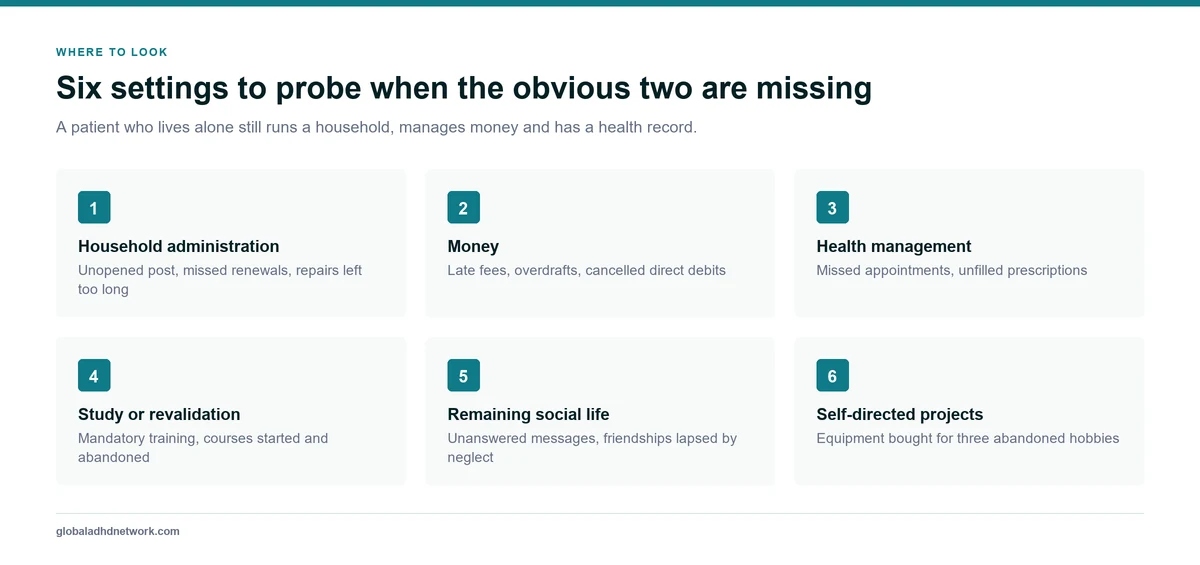
Where to look when the obvious two are missing
Household administration — unopened post, missed renewals, repairs left until they become emergencies
Money — late fees, overdraft charges, direct debits cancelled and forgotten, unclaimed refunds
Health — missed appointments, unfilled prescriptions, ignored screening invitations, unregistered with a dentist
Study or professional development — revalidation, mandatory training, courses started and abandoned
What social life remains — unanswered messages, friendships that lapsed through neglect rather than intent
Self-directed projects — the garage full of equipment for three abandoned hobbies
The last of these is often the richest and is almost never volunteered, because patients do not think of it as functioning. Ask what they have bought and stopped using.
Remote work is a setting, but interrogate it
Do not accept "work is fine" at face value from someone who has engineered a job with no meetings, no deadlines they did not set themselves, and no colleagues who can see their screen. That is not the absence of impairment — it is a very effective accommodation, and it usually cost them something to arrive at.
Useful questions: what happened in previous roles that were less flexible? What do they avoid applying for? What happens when a deadline is externally imposed? A history of three jobs left within eighteen months tells you more than the current one that fits.
Childhood is a second setting, and it is usually the cleanest
The most reliable cross-setting evidence in an adult assessment often comes from age nine, not from last month.
Children have very little control over their environments. A child who was disorganised at school and disorganised at home could not opt out of either, and if teachers and parents were independently describing the same difficulties, you have Criterion C evidence that no amount of adult self-selection can undermine.
Record it under both criteria. It is doing double work and there is no reason to waste it — the informant interview is where most of it surfaces.
Writing it up
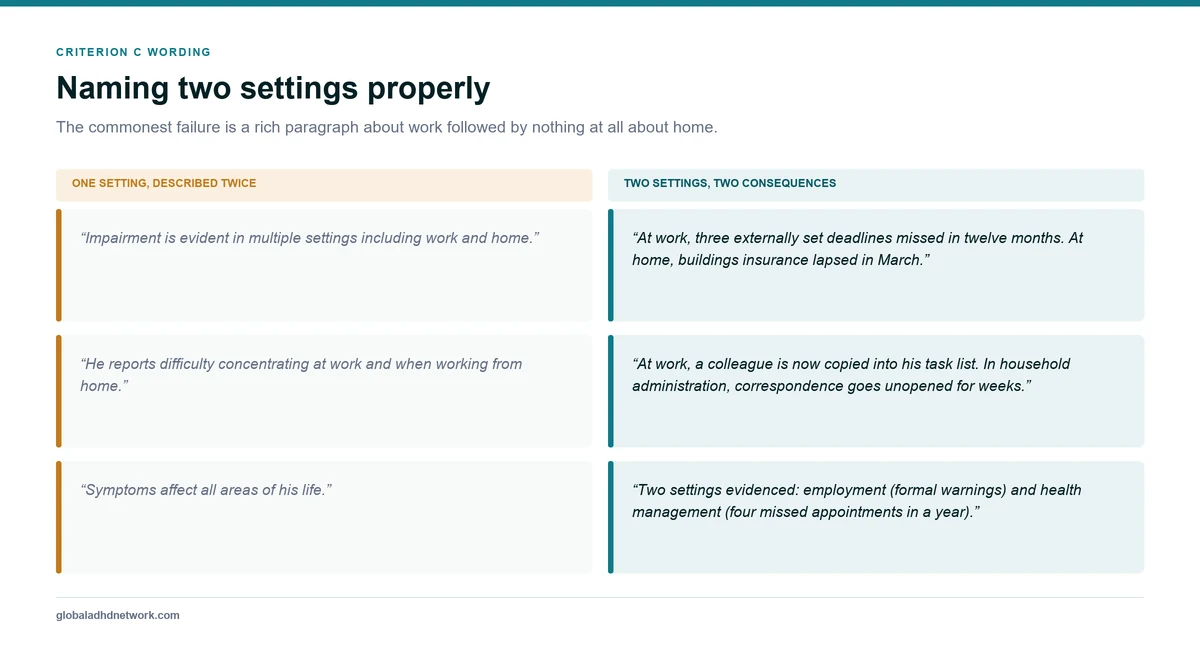
Name two settings explicitly, and give each one a distinct consequence. The commonest failure is a paragraph rich in detail about work followed by nothing at all about home, which reads to a sceptical reader as a criterion the clinician hoped would pass unnoticed.
Impairment was evident in two settings. At work, he has missed three externally set deadlines in twelve months and now has a colleague copied into his task list at his manager's request. At home, correspondence goes unopened for weeks; his buildings insurance lapsed in March and was reinstated only after a leak.
Two settings, two consequences, no overlap. That paragraph takes ninety seconds to write and closes the criterion.
When you genuinely cannot evidence two settings
It happens, and the honest response is not to manufacture a second one. Record what you found, record what you could not, and say what would resolve it — a period of observation, an informant account, or review after a change in circumstances.
A report that says the criterion is not yet fully evidenced is a report a reader can trust on the criteria that are. A report that quietly stretches one setting into two undermines everything else in the document if anyone notices.
Related guides in this cluster
This article is part of GAN's assessment workflow cluster. The pillar covers the whole pathway; each supporting guide takes one criterion and goes deeper.
The “why now” usually points at the second setting
Adults rarely present for assessment because their symptoms changed. They present because their environment did, and the change is almost always a change in external structure.
A promotion into a role with more administration. A team reorganisation that removed a manager who had been quietly compensating. A relationship ending, taking with it the person who managed the calendar and the bills. A child's diagnosis, which reframes a lifetime of difficulty. Returning to study.
Each of those is a natural experiment, and each usually reveals a second setting. The patient who coped at work until their PA left is telling you that work was never the only setting — it was the setting with the most scaffolding. Ask what changed, then ask what stopped working, and the second domain often names itself.
Other people as observers, without over-relying on them
A partner, flatmate or close friend can evidence a setting the patient cannot see. They notice the unopened post, the abandoned projects, the pattern of starting and stopping.
Two cautions. First, a partner met in adulthood cannot speak to onset — their account is Criterion C and D evidence, not Criterion B evidence, and should be labelled as such in the report. Second, a partner may have an interest in the outcome, whether financial, relational, or simply hoping for an explanation that resolves a long-running conflict. That does not invalidate the account, but it should be recorded alongside it.
Where the relationship is strained, a separate conversation produces a more usable account than a joint one.
Settings change, and the report should say when
A patient's settings at the point of assessment are a snapshot. Someone who currently works remotely may have spent fifteen years in an open-plan office, and that history is often where the clearest evidence sits.
Take the working history properly rather than the current role. Where impairment was evident in a previous setting and is now masked by an accommodation, say so explicitly — it is stronger evidence of pervasiveness than a description of the current arrangement, and it pre-empts the reader who notices that the patient seems to be managing.
Impairment was evident in two settings historically. In open-plan employment until 2020 he received two formal warnings relating to missed deadlines; since moving to remote work these difficulties have been partially masked by self-directed scheduling, though household administration remains significantly affected.
What a reviewer is looking for
When an ICB or a second clinician reads the Criterion C section, they are asking three questions:
Are two settings actually named, as opposed to gestured at?
Does each carry its own consequence, or is one example doing duty for both?
Has the clinician acknowledged any limitation in the evidence rather than glossing it?
A section that answers all three in four sentences will not be queried. A section that answers none of them will be, however sound the underlying assessment was.
Criterion C in people who have never worked
The remote-worker case is the common one. The harder version is the patient with no employment history at all — someone whose ADHD has contributed to long-term unemployment, or who has been out of work through illness or caring responsibilities.
Work is not a required setting. The criterion asks for pervasiveness, and pervasiveness can be demonstrated wherever the person actually functions. For this group, the productive areas are usually benefits and statutory administration, healthcare engagement, caring responsibilities, housing, and any voluntary or informal activity.
Benefits administration in particular is a demanding executive task with hard deadlines and real consequences, and it is frequently where impairment is most visible. A patient who has had a claim suspended for a missed form is describing Criterion C evidence, though they will rarely present it as such.
Be careful with the framing in the report. Describe the demand and the consequence rather than the failure, and attribute the difficulty to the condition rather than to the person.
Two settings in students and recent graduates
The other frequently awkward group is the young adult in full-time education, where academic life can appear to be the whole picture.
Education is one setting. The second is usually independent living — the first sustained period of managing food, money, laundry, medication and a sleep schedule without a parent providing structure. For many students this is where difficulties surface most sharply, and it is rarely volunteered because they assume everyone finds it hard.
Ask about the practicalities rather than the studying. Rent paid on time, bills in their name, whether they have registered with a GP, how food actually happens. The answers are usually specific and usually diagnostic.
Frequently Asked Questions
What counts as a setting for ADHD Criterion C?
Any distinct context in which the person functions — paid work, education, household and financial administration, health management, social and family life, or self-directed activity. It is not limited to home and work.
Can ADHD be diagnosed in someone who lives alone and works remotely?
Yes. The second setting is usually found in household administration, money management, health management or what remains of their social life. Childhood cross-setting evidence also counts.
Does childhood evidence satisfy Criterion C?
It can, and it is often the cleanest evidence available. A child described as having the same difficulties at home and at school by independent observers demonstrates pervasiveness directly.
How should Criterion C be worded in the report?
Name both settings and give a distinct consequence in each. Two named settings sharing a single example reads as one setting described twice.
What if only one setting can be evidenced?
Record what was found and what was not, and state what would resolve it. An acknowledged gap is more defensible than a stretched claim.
%20(1).webp)