Global ADHD Network — One of the most highly reviewed ADHD CPD and CME training providers in ADHD diagnosis and neurodiversity training.Global ADHD Network — One of the most highly reviewed ADHD CPD and CME training providers in ADHD diagnosis and neurodiversity training.Global ADHD Network — One of the most highly reviewed ADHD CPD and CME training providers in ADHD diagnosis and neurodiversity training.
Before the Appointment: What to Gather Before an Adult ADHD Assessment
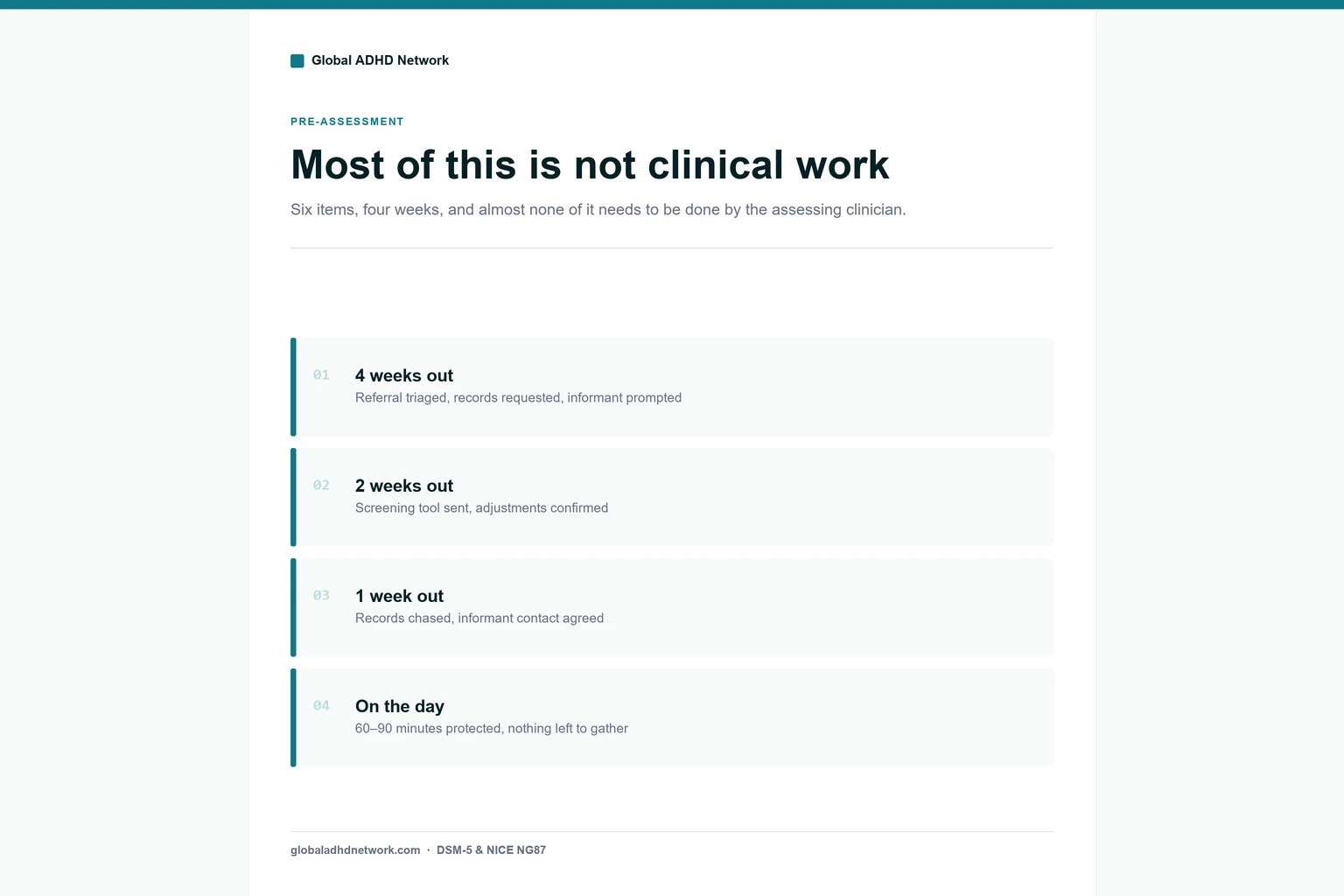
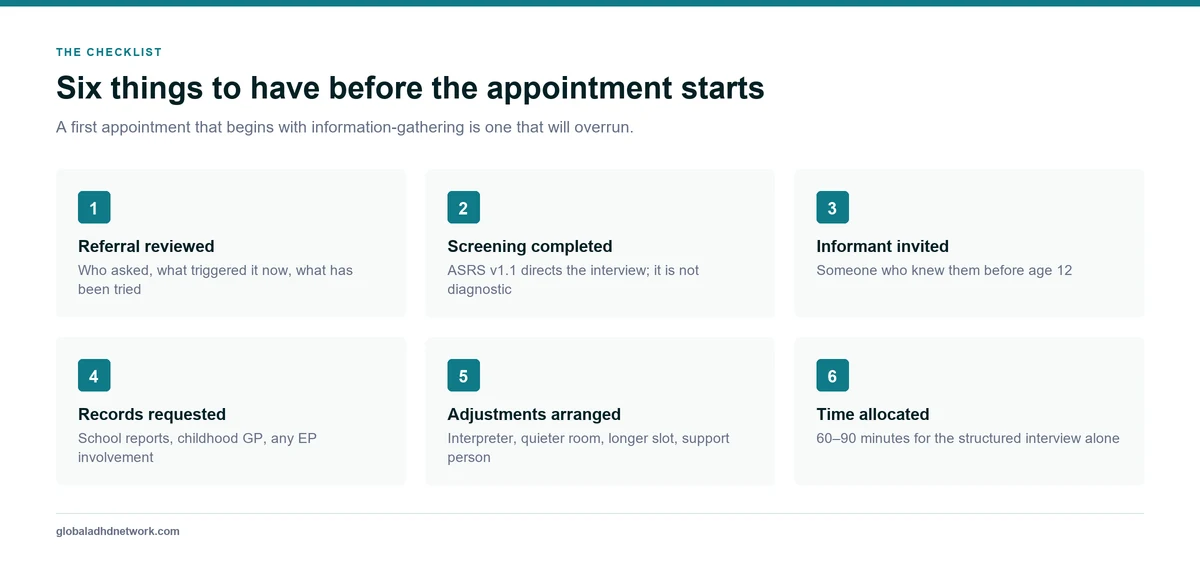
A first appointment that begins with information-gathering is one that will overrun. What to have in place four weeks out: referral reviewed, screening sent, informant invited, childhood records requested, adjustments arranged, and enough time actually in the diary.
The appointment is booked for ninety minutes. Twenty of those go on establishing what the referral was actually about, another ten on explaining what an informant is and why the patient should have brought one, and by the time you reach childhood you have twenty-five minutes and a patient who is losing focus.
Almost none of that was clinical work. It was administration that happened in the wrong place.
Who this is for
Preparation is a service design question as much as a clinical one, so this is written for:
Service leads and consultant psychiatrists designing an adult ADHD pathway
ADHD nurse specialists who often hold the pre-assessment process
GPs with an extended role, who are usually the ones asked for historic records
Trainees inheriting a clinic template and wondering why appointments overrun
Review the referral properly, not on the way in
Referral letters vary from three lines to three pages. What you are looking for is not a summary of symptoms but the shape of the question: who is asking, what triggered it now, what has already been tried, and whether anyone has raised an alternative explanation.
The "why now" is diagnostically useful and almost always in the referral. Adults present after a life change — a promotion into a role with more admin, a child's diagnosis, a relationship ending. That context frames the impairment history you are about to take.
Send the screening tool ahead, and know what it is for
A completed ASRS v1.1 saves you fifteen minutes and gives the patient a vocabulary before they arrive. It contributes nothing to the diagnostic criteria and should not appear in the report as though it does.
Say so at the start of the appointment. A significant proportion of patients now arrive having completed several online screeners and expecting confirmation rather than assessment. Naming the distinction early prevents a difficult conversation ninety minutes later.
The informant invitation is the highest-value item on the list
One sentence in the appointment letter changes the quality of the assessment more than anything else you can do in advance: ask the patient to invite someone who knew them as a child.
Patients frequently misread this as a credibility check. Explain the reason plainly — DSM-5 requires evidence that symptoms were present before age twelve, and nobody remembers being nine accurately. Give them the option of the informant joining separately rather than sitting in, which usually produces a franker account.
Request records early, because they take longer than you think
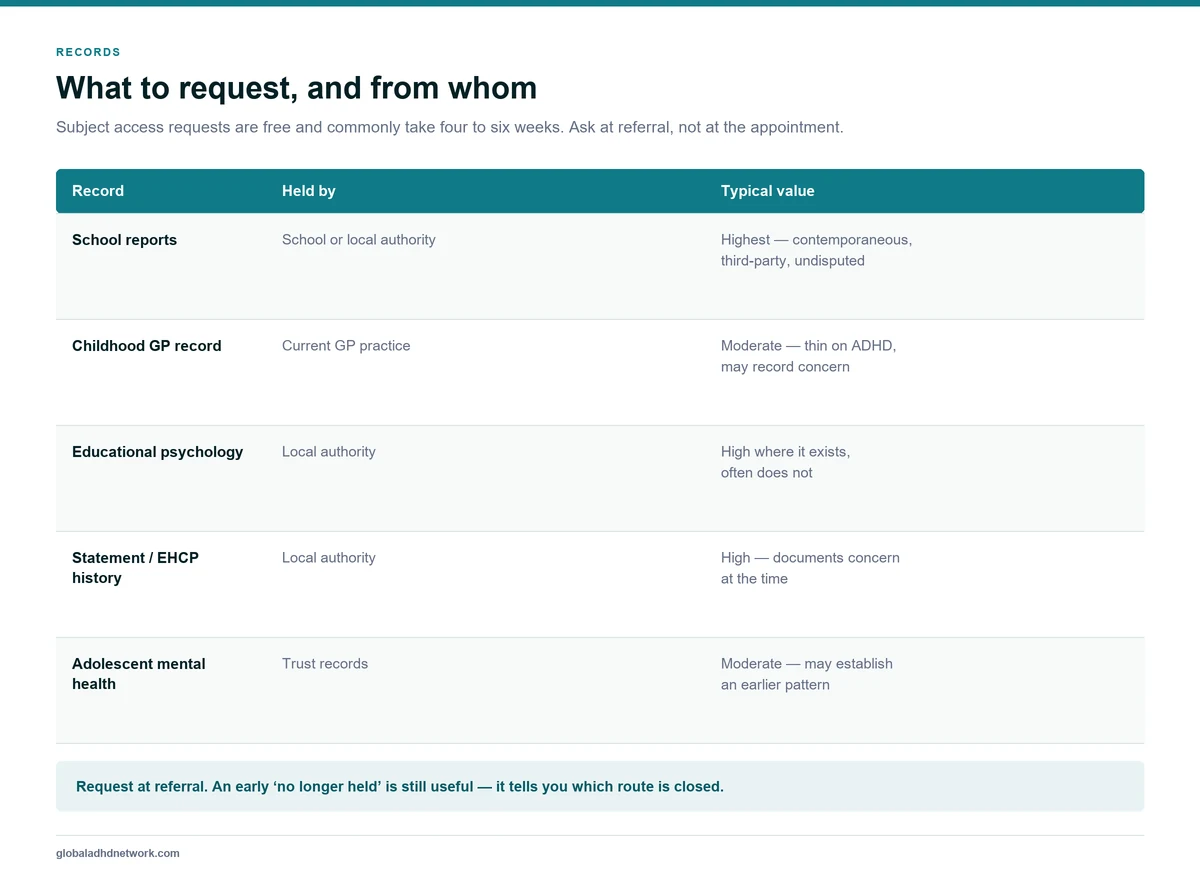
Childhood documentation is the fallback when no informant exists, and it takes weeks to obtain. Requesting it at the first appointment means a second appointment; requesting it at referral means it may arrive in time.
What is worth asking for
School reports — the single most useful document, written contemporaneously by a third party
Childhood GP records — often thin on ADHD but may record concern at the time
Educational psychology involvement — where there was any statementing or assessment
Previous mental health assessments — particularly anything from adolescence
Patients can make a subject access request themselves, free of charge, and many have simply never realised they can. Retention periods vary by school and local authority, so an early no is still useful — it tells you which evidence route is closed.
Arrange adjustments before the day
Interpreters, longer appointments, a quieter room, written summaries, a support person present. Adjustments booked on the day are adjustments that do not happen.
This matters more in ADHD assessment than in most clinics, because the population you are assessing is the population least likely to have navigated the booking process smoothly in the first place. A patient who missed two previous appointments is giving you information, not being difficult.
Allocate the time honestly
A full DIVA-5 takes sixty to ninety minutes before informant contact, records review and report writing. Booking that into a forty-minute new-patient slot is a decision about the quality of the assessment, whether or not it is framed as one.
Where capacity genuinely does not allow it, the honest alternative is to split the assessment across two appointments rather than compress it into one. Patients tolerate that far better than a rushed single session, and the evidence quality is not comparable.
A note for primary care
As ADHD assessment moves closer to primary care, more of this preparation will sit with GP practices. The two highest-value things a practice can do before onward referral are to request historic records and to prompt the patient about an informant — both take minutes and both remove weeks from the pathway. Our guide for GPs and primary care clinicians covers the wider role.
Related guides in this cluster
This article is part of GAN's assessment workflow cluster. The pillar covers the whole pathway; each supporting guide takes one criterion and goes deeper.
Triage: not every referral needs the same preparation
Treating every referral identically wastes preparation on straightforward cases and under-prepares the complex ones.
A brief triage at referral — five minutes, done by whoever processes the letter — can sort referrals into rough categories and attach the right preparation to each.
Straightforward adult presentation, informant available: standard pack, standard slot.
No informant identified: start records requests immediately, flag for a longer slot, and prepare the patient for the possibility of a two-stage assessment.
Suspected co-occurring autism: allow additional time and consider whether the pathway should be joint from the outset rather than sequential.
Significant psychiatric or substance history: request prior records before the appointment, because reconstructing a complex history in the room will consume the assessment.
Previous assessment elsewhere: obtain the earlier report first. Assessing without it risks producing a contradictory document nobody can reconcile.
The invitation letter is doing more work than you think
The appointment letter is the only communication most patients receive before they arrive, and it sets expectations that are difficult to reset afterwards.
Three things worth including that most letters omit. First, an explanation of the informant request in plain language, framed as a diagnostic requirement rather than a credibility check. Second, a clear statement that the appointment is an assessment rather than a confirmation, which prevents the conversation about screening scores from becoming a negotiation. Third, a specific list of documents worth bringing — school reports, previous assessments, a list of current medications — because "any relevant paperwork" produces nothing.
It is also worth saying how long the appointment will take and that it is normal to find it tiring. Patients frequently arrive expecting twenty minutes.
When the patient arrives with their own research
Increasingly they will, and it will sometimes be an AI-generated summary of their own symptoms mapped against DSM-5.
This is not a problem to be managed so much as material to be used. Someone who has read the criteria closely can give you better-organised answers. What it changes is the risk of criterion contamination — the patient reporting the symptom as written rather than their own experience of it. The countermeasure is the same one that protects against a leading informant interview: ask for the example before the endorsement, and ask what it looked like rather than whether it happened.
Where a patient has arrived with a firm conclusion, acknowledging their work explicitly tends to defuse the defensiveness that otherwise surfaces around the ninety-minute mark.
Building a pre-assessment pack
Most of what is described here can be assembled once and reused. A working pack contains the appointment letter with the informant explanation, a screening questionnaire, a one-page records request template the patient can send to their school or local authority, a short form for the informant's contact details and consent, and an adjustments question.
Building it takes an afternoon. It removes twenty minutes from every subsequent assessment and materially improves the evidence available at the point of writing. For services under waiting-list pressure it is one of the few interventions that improves quality and throughput at the same time.
What good preparation is worth
Services that invest in pre-assessment consistently report the same three effects, and they compound.
Appointments stop overrunning. Twenty minutes of administration removed from the room is twenty minutes returned to the childhood history, which is where assessments are usually thinnest. The appointment does not get shorter; it gets better.
Fewer two-stage assessments. Records requested at referral often arrive before the appointment. Requested at the appointment, they guarantee a second one. In a service with a waiting list, avoided second appointments are capacity.
Better reports. Criterion B is the criterion most often unevidenced, and its evidence is precisely what good preparation secures — the informant, the school reports, the childhood record.
Preparation when the patient is already waiting
Most services are not preparing for assessments booked next month. They are working through a list of people who have been waiting a year or more, which changes what preparation looks like.
Two things are worth doing at the point someone joins the list rather than at the point they reach the top of it. Send the records-request template immediately — a patient with eighteen months of waiting has ample time to obtain school reports, and no reason not to. And ask about an informant early, because identifying that nobody is available is itself useful information, and it gives everyone time to find an alternative.
This also gives people something to do with the wait, which matters more than it sounds. The ADHD Taskforce has emphasised support before and during the wait rather than only at the point of assessment, and involving patients in assembling their own evidence is one of the few genuinely useful things a service can offer while they queue.
Frequently Asked Questions
What should a patient bring to an adult ADHD assessment?
Any school reports or childhood records they hold, a completed screening questionnaire if one was sent, a list of current medications, and ideally an informant who knew them before age 12 — or that person's contact details and consent to speak to them.
How far in advance should childhood records be requested?
At referral, not at the first appointment. Subject access requests are free but commonly take four to six weeks, and school retention periods vary, so an early request also gives you time to find an alternative if the records no longer exist.
Is a screening questionnaire required before an ADHD assessment?
Not required, but useful. A completed ASRS directs the clinical interview and saves appointment time. It is a screening tool and contributes nothing to the DSM-5 criteria.
How long should an adult ADHD assessment appointment be?
Sixty to ninety minutes for the structured interview alone, excluding informant contact, records review and report writing.
What if the patient cannot bring an informant?
Proceed, and use documentary evidence instead. Record what was unavailable and what you relied on, so Criterion B is supported with a stated limitation rather than left implied.
%20(1).webp)