Global ADHD Network — One of the most highly reviewed ADHD CPD and CME training providers in ADHD diagnosis and neurodiversity training.Global ADHD Network — One of the most highly reviewed ADHD CPD and CME training providers in ADHD diagnosis and neurodiversity training.Global ADHD Network — One of the most highly reviewed ADHD CPD and CME training providers in ADHD diagnosis and neurodiversity training.
Symptom Count Is Not Impairment: Why ADHD Assessments Get Challenged on Criterion D
A symptom count is not impairment, and a severity rating is not evidence. The five DIVA-5 domains and what belongs in each, how to evidence impairment in patients who are objectively succeeding, and why a concrete consequence always beats an adjective in a report.
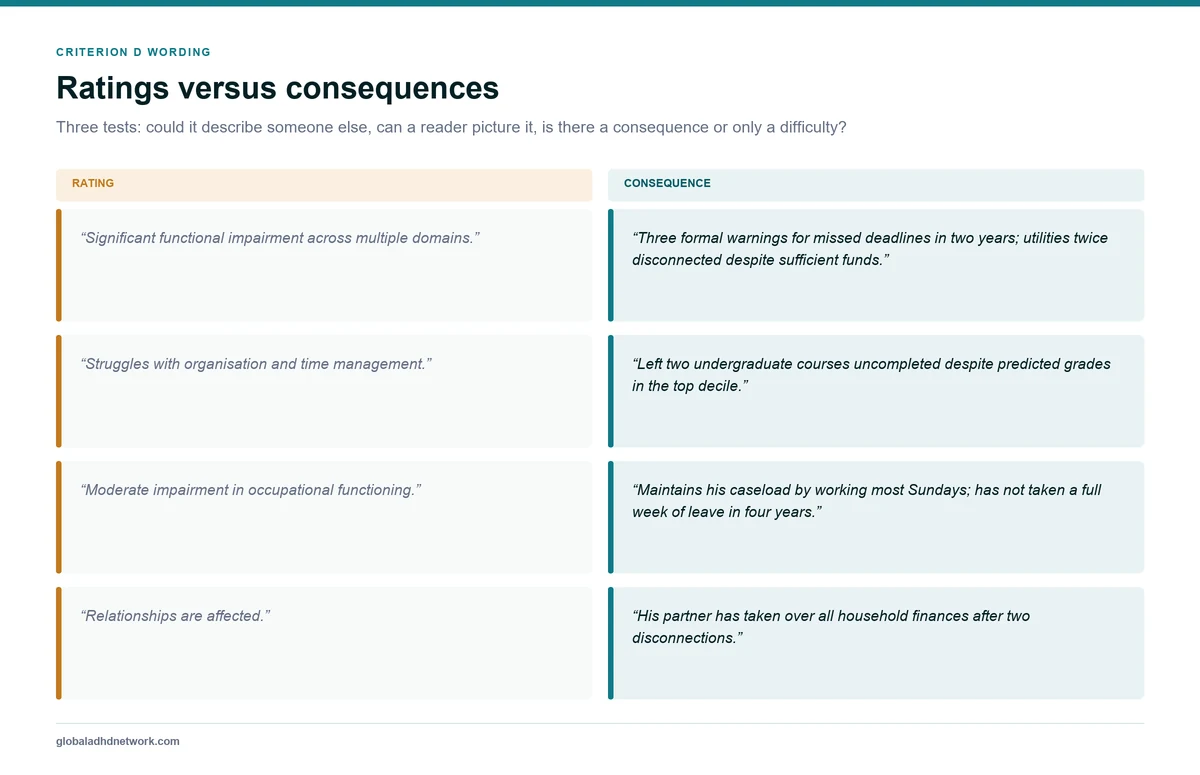
Two reports land on the same desk. Both describe a patient meeting seven inattentive symptoms. One says "significant functional impairment is evident across multiple domains". The other says she left two undergraduate courses uncompleted despite predicted grades in the top decile, and has been passed over for promotion twice in a role she has held for nine years.
Only one of those reports has evidenced Criterion D.
Who this is for
Consultant psychiatrists and clinical psychologists whose reports go to ICBs and insurers
ADHD nurse specialists running the impairment section of a structured interview
GPs with an extended role, deciding whether a report supports shared care
Trainees, who tend to record severity because it feels more clinical than an anecdote
Why the severity rating is so tempting
It feels like clinical language. "Moderate to severe functional impairment" has the cadence of a professional judgement, and it compresses a long conversation into four words.
The problem is that it is a conclusion, and Criterion D asks for the evidence underneath the conclusion. A reader cannot audit "moderate". They can audit three formal warnings.
There is also an equity issue. Severity language drifts with the assessor's frame of reference, and patients who present articulately — often the ones who have compensated hardest — are systematically rated as less impaired. Concrete consequences are harder to bias.
The five domains, and what actually belongs in each
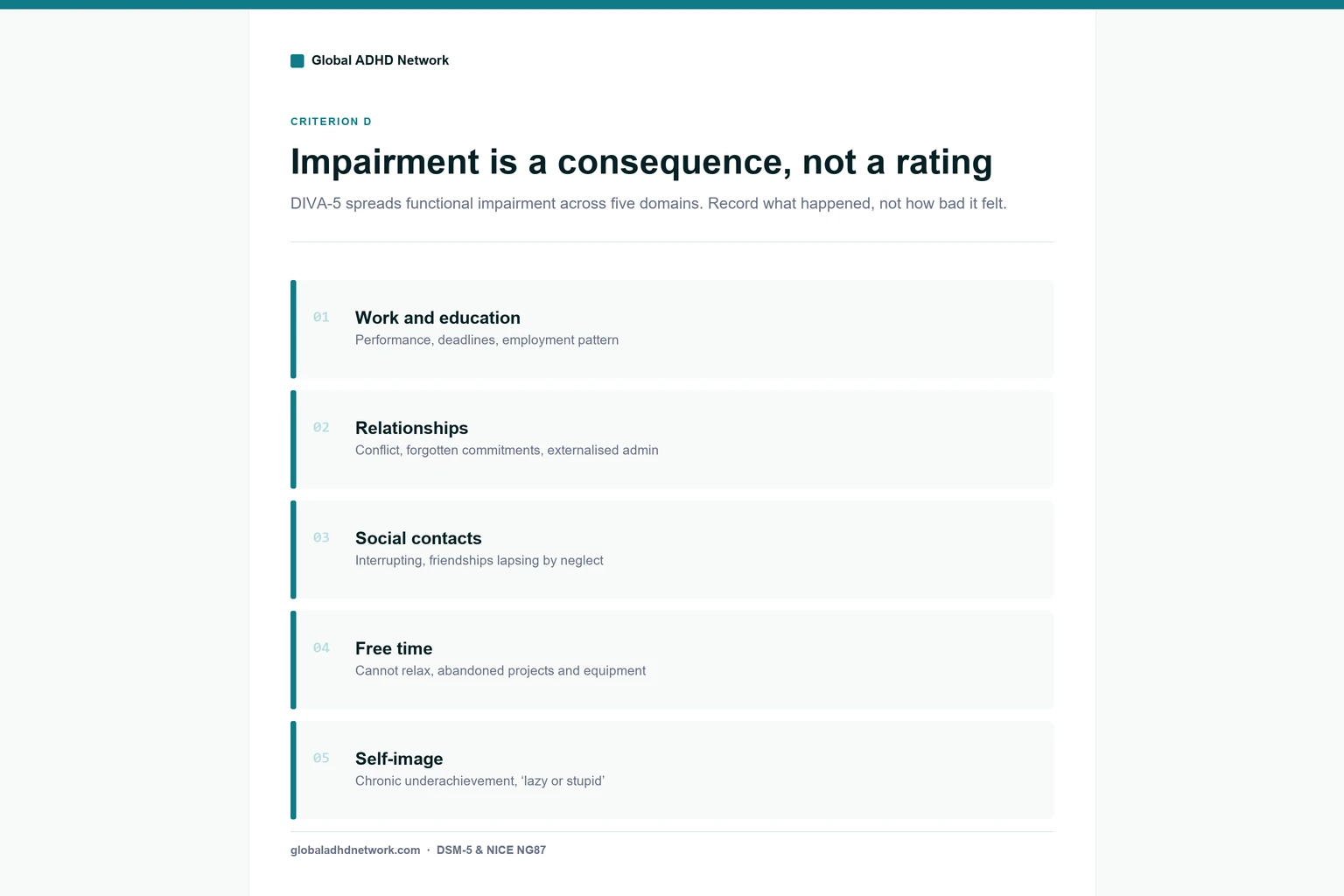
The DIVA-5 structure is worth using as a prompt even where you are not running a full DIVA-5.
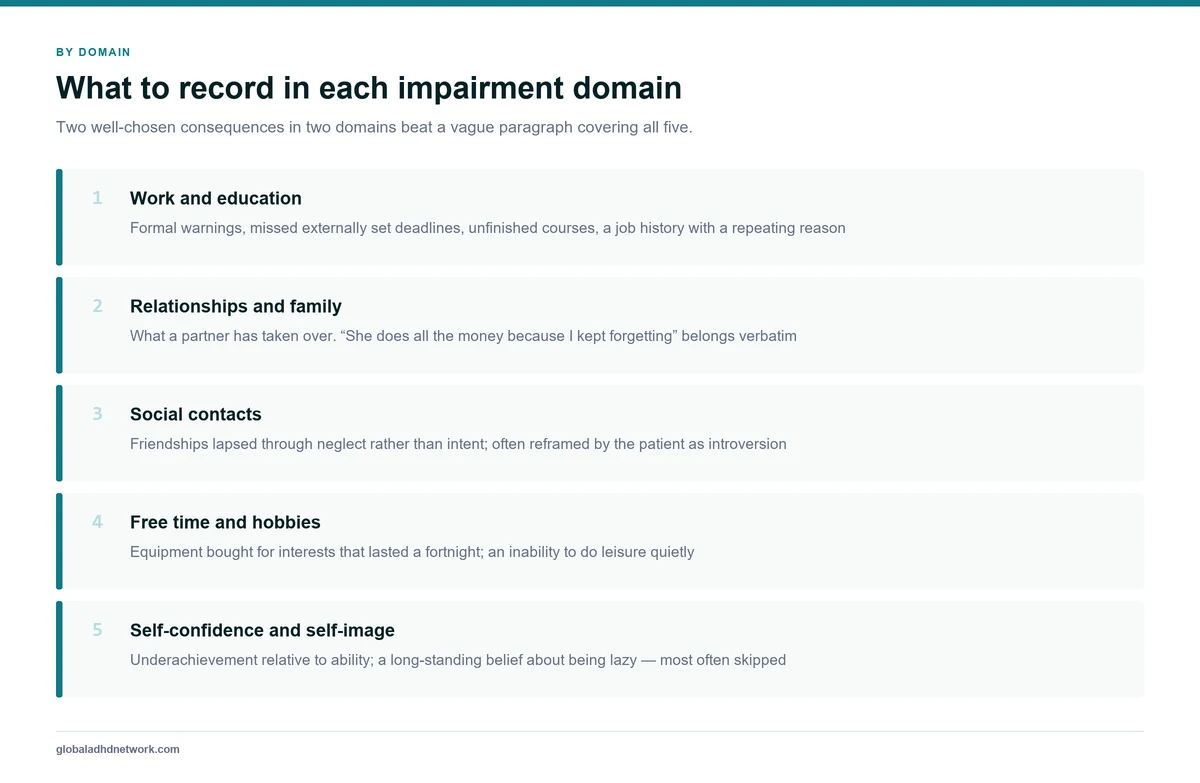
Work and education
Performance relative to ability, missed deadlines, disciplinary history, employment pattern. The most useful evidence is usually structural rather than episodic: a person who has changed jobs six times in ten years, always for the same reason, is describing a pattern that no single incident captures.
Relationships and family life
Conflict, forgotten commitments, an uneven division of household administration. Ask what their partner has taken over. "She does all the money because I kept forgetting" is a sentence that belongs in the report verbatim.
Social contacts
Interrupting, dominating conversation, friendships that lapse through neglect rather than intent. Many patients have reframed this as introversion, which is worth gently testing.
Free time and hobbies
An inability to relax, projects abandoned, money spent on equipment for interests that lasted a fortnight. This domain is easy to dismiss as trivial and frequently produces the most vivid single example in an entire assessment.
Self-confidence and self-image
Chronic underachievement relative to apparent ability, and a long-standing belief about being lazy or stupid. This is the domain most often skipped, and in late-diagnosed adults it is often where the deepest impairment sits — see inattentive ADHD in women for the pattern that most often goes unrecorded.
Impairment despite success
The hardest version of Criterion D is the patient who is objectively doing well. A consultant, a partner in a firm, a successful business owner — someone whose CV would suggest nothing is wrong.
Impairment is not the absence of achievement. It is the cost of it. Look for:
Effort disproportionate to output — working weekends to produce what colleagues produce in hours
Externalised function — a PA, a partner or a colleague absorbing the executive load
Attrition elsewhere — a career sustained at the cost of health, relationships or everything unstructured
Narrowing — roles and opportunities declined because they knew they could not sustain them
Record the cost, not just the outcome. "He maintains his caseload by working most Sundays and has not taken a full week of annual leave in four years" evidences impairment in someone whose appraisals are excellent.
Wording that holds
Three tests before a sentence goes in the impairment section:
Could this describe someone else? If yes, it is not evidence.
Can a reader picture it? Numbers, dates and events beat adjectives.
Is there a consequence, or only a difficulty? "Struggles with deadlines" is a symptom. "Three formal warnings" is impairment.
Two well-chosen consequences in two domains do more than a paragraph covering all five vaguely. Where you have material in all five, use it — but do not pad. Detail on structure is in the report writing guide.
Related guides in this cluster
This article is part of GAN's assessment workflow cluster. The pillar covers the whole pathway; each supporting guide takes one criterion and goes deeper.
Clinicians reach for severity ratings partly because they want something that looks measurable. There are better ways to introduce precision without inventing a metric.
Count things. Formal warnings, missed appointments, jobs held, courses started, times a utility was disconnected. Numbers are inherently auditable.
Date things. “Since 2019” and “three times this year” locate the impairment in time.
Compare to a baseline. Predicted grades against achieved grades; peers at the same career stage; the patient's own functioning during a period of better support.
Name what someone else absorbs. Externalised executive function is measurable in a way that internal struggle is not.
Where your service requires a severity rating for reporting purposes, give it — after the evidence, not instead of it. The rating is a summary of the consequences, and a reader should be able to see how you arrived at it.
The domains patients minimise
Patients under-report impairment in predictable places, and knowing where saves a great deal of probing.
Self-image is minimised almost universally, because a lifetime of being told you are lazy tends to produce agreement rather than complaint. Asking “how do you explain it to yourself when things go wrong?” usually opens it.
Free time is dismissed as trivial. Patients apologise for mentioning abandoned hobbies. It is often the single most vivid example in the assessment.
Social contacts get reframed as personality — introversion, being a homebody, not needing many friends. Worth gently testing whether that was a choice or an adaptation.
Relationships are minimised out of loyalty. The useful question is not whether there is conflict but what their partner has taken over.
Impairment changes over the lifespan, and the report should reflect it
ADHD presentation shifts with age and circumstance. Hyperactivity typically becomes internalised restlessness. Impairment migrates from education to employment to household management, and often intensifies at transition points where external structure falls away — leaving school, leaving a structured job, retirement, the end of a relationship.
A report that captures the trajectory is more persuasive than one that photographs the present moment. It also does useful clinical work: it identifies where support should be targeted, and it gives the patient a coherent account of their own history, which is frequently the part of the assessment they value most.
From impairment to treatment plan
The impairment section is not only evidential. It is the part of the report that should drive the recommendations, and the two are often disconnected.
If the dominant impairment is occupational, the plan should address workplace adjustments and not only medication. If it is in household and financial management, coaching or practical support may matter more than a dose increase. If it is in self-image, the psychological consequences of decades of undiagnosed difficulty deserve naming, and often deserve a referral of their own.
A reader who can trace a line from the impairment section to the recommendations is reading a report that was thought about rather than assembled.
Distinguishing impairment from distress
A distinction worth holding, because conflating the two weakens the criterion in both directions.
Distress is how the person feels about their functioning. Impairment is what is happening to their functioning. They correlate loosely, and either can exist without the other.
Some patients are profoundly distressed by difficulties that have not yet produced measurable consequences — often younger adults, often early in a career, often before the scaffolding of school has been fully withdrawn. Others describe no distress at all while reporting a history that includes three dismissals and a bankruptcy, because they have assimilated it as ordinary.
Criterion D asks about the second. Record distress as well, because it matters clinically and shapes the treatment plan, but do not let it substitute for the evidence — and do not discount impairment because the patient reports it cheerfully. Equanimity is not the absence of consequence.
Impairment and the question of who is served
There is an equity dimension here that is easy to miss.
Consequences are more visible in people with less margin. A patient with financial security, a supportive partner and a flexible employer may have the same difficulties as one without any of those and far fewer recordable consequences, because the buffer absorbed them. Assessed purely on consequences, the better-resourced patient looks less impaired.
The correction is to record the buffer as well as the consequence. Someone whose functioning depends on a partner managing their calendar, a PA absorbing the administration, or a family able to cover the cost of repeated mistakes is impaired — the impairment is being paid for by someone else. Say that in the report. It is both more accurate and more equitable than a criterion that quietly rewards affluence.
Recording impairment the patient disputes
Occasionally an informant or a record describes impairment the patient does not accept, and the disagreement is itself diagnostically interesting.
A partner describing chaos the patient experiences as normal is not a contradiction to be resolved by picking a side. It is a description of how thoroughly the difficulty has been assimilated, which is common in people who have never had a point of comparison. Record both accounts, attribute each, and note the discrepancy explicitly.
The opposite pattern also occurs, particularly in people who have recently found an explanatory framework: impairment reported more severely than the collateral record supports. That too should be recorded rather than silently averaged. A report that shows the clinician noticed the divergence is stronger than one where it quietly disappeared.
One sentence that improves most impairment sections
Where the evidence is uneven — strong in one domain, thin in another — say which. A reader who can see that you assessed five domains and found compelling evidence in two will trust the two. A reader who sees five domains described in identically confident terms will wonder whether all five were actually asked about.
Impairment is most clearly evidenced in occupational functioning and household administration. Social functioning was less affected, and she described a stable friendship group of long standing.
That sentence costs nothing, and it is the kind of proportionate reporting that makes the rest of the document credible.
Frequently Asked Questions
What is functional impairment in ADHD?
Clear evidence that symptoms interfere with or reduce the quality of social, academic or occupational functioning. DSM-5 requires it as Criterion D, separately from the symptom threshold in Criterion A.
Is a symptom count enough for an ADHD diagnosis?
No. Meeting the symptom threshold satisfies Criterion A only. Criteria B to E — onset, settings, impairment and exclusion — each need their own evidence.
What are the five DIVA-5 impairment domains?
Work and education; relationships and family life; social contacts; free time and hobbies; and self-confidence and self-image.
Can someone have ADHD if they are successful at work?
Yes. Impairment is the cost of the achievement rather than the absence of it — disproportionate effort, externalised executive function, attrition in other areas, or opportunities declined.
Should an ADHD report give a severity rating?
A rating alone does not evidence Criterion D. Give the consequence, and add a severity judgement afterwards if your service requires one.
%20(1).webp)