Global ADHD Network — One of the most highly reviewed ADHD CPD and CME training providers in ADHD diagnosis and neurodiversity training.Global ADHD Network — One of the most highly reviewed ADHD CPD and CME training providers in ADHD diagnosis and neurodiversity training.Global ADHD Network — One of the most highly reviewed ADHD CPD and CME training providers in ADHD diagnosis and neurodiversity training.
School Reports as Diagnostic Evidence: What to Request and How Much Weight to Give It
A report written in 1994 by a teacher who never heard the word ADHD is one of the best documents you will ever get. Who holds childhood records, how to request them free of charge, what the phrases actually map onto, and the three things the documents cannot do.
A school report written in 1994 by a teacher who never heard the word ADHD is, in evidential terms, one of the best documents you will ever get.
It was written at the time. It was written by a third party with no interest in the outcome. It describes observed behaviour rather than remembered impression. And it was produced for an entirely unrelated purpose, which is precisely what makes it credible.
Most adult ADHD assessments never obtain one, largely because nobody asked early enough.
Who this is for
Consultant psychiatrists and clinical psychologists weighing documentary evidence against recall
ADHD nurse specialists who usually initiate the request during pre-assessment
GPs with an extended role, well placed to prompt the request at referral, weeks before assessment
Trainees, who often do not realise the records can be obtained at all
Who holds what
Educational records in the UK are held in several places, and knowing which to approach saves weeks.
The school itself, if it still exists — usually holds the educational record for a limited period after the pupil leaves
The local authority — often holds records for closed or merged schools, and holds statementing and EHCP files
The academy trust, where a school has converted — records may have transferred
The family — a surprising number of parents kept every report in a drawer, and nobody has asked
That last one is worth doing first. It costs a phone call and frequently produces the documents immediately.
How to request them
The patient makes the request, not the clinician. It is their personal data, the request is free, and the organisation has one month to respond.
A short template the patient can send saves considerable back-and-forth: name at the time of attendance, date of birth, years attended, and a request for the full educational record including reports, attendance records and any records of concern or intervention. Providing that template as part of a pre-assessment pack turns a vague instruction into a completed action.
Set expectations honestly. Retention periods vary, many older records have been destroyed, and a nil return is common for anyone over about forty-five. That is not a wasted exercise — a documented nil return is itself part of the evidence trail, and it tells you which tier of the hierarchy you are working at.
Reading the documents
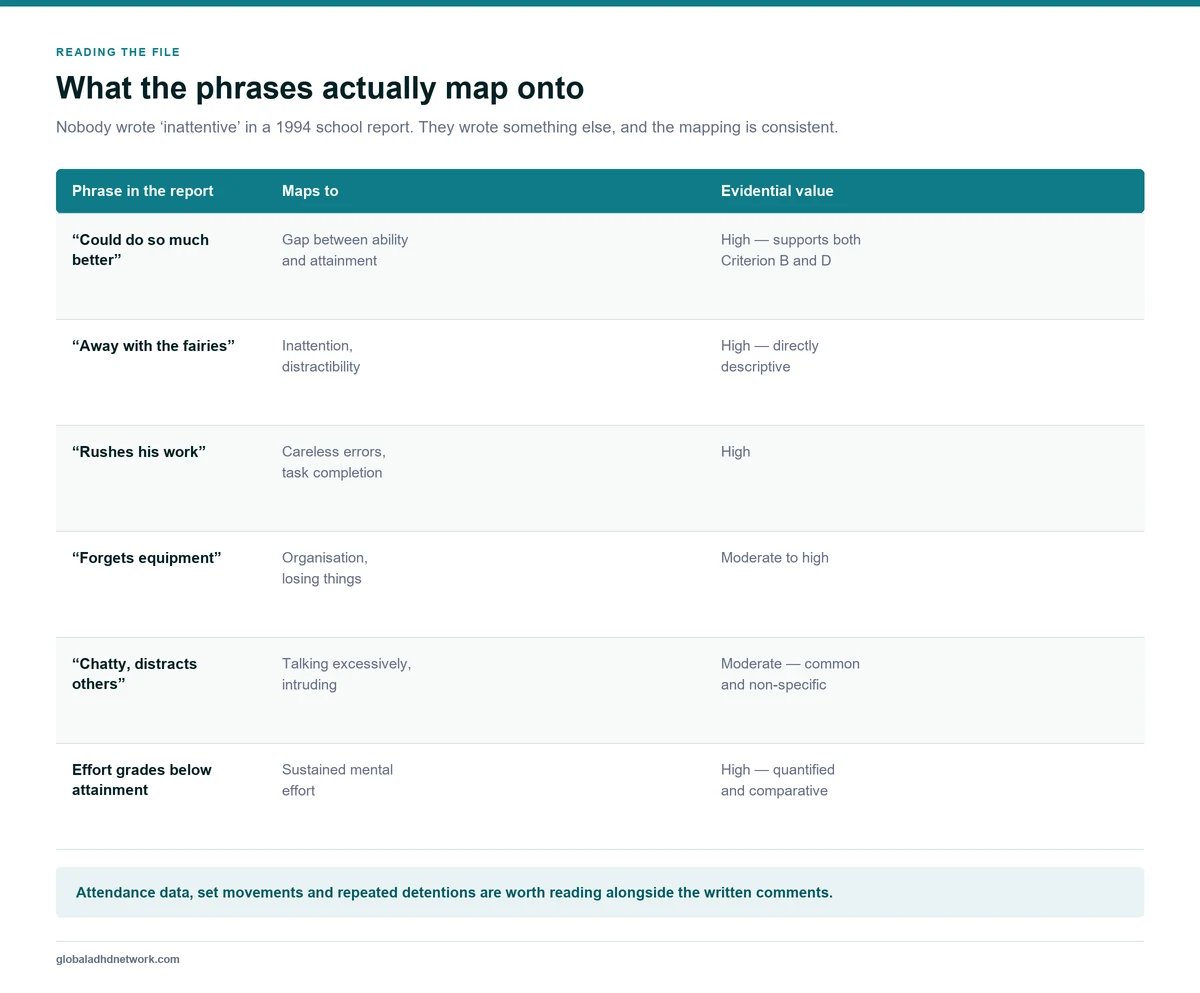
Nobody wrote "inattentive" in a 1994 school report. They wrote something else, and the mapping is fairly consistent.
Unfulfilled potential — "could do so much better", "not fulfilling his potential", "capable of much more". Maps to the gap between ability and attainment that underpins Criterion D.
Attention — "daydreaming", "away with the fairies", "needs constant reminders", "does not listen".
Task completion — "rushes his work", "careless errors", "rarely finishes", "homework frequently late or missing".
Activity and impulsivity — "restless", "cannot sit still", "calls out", "distracts others", "chatty".
Attendance and punctuality data is worth reading too, as is any record of moving sets, being kept behind, or repeated detentions. Effort grades that sit consistently below attainment grades are a particularly clean signal.
What the documents cannot do
Three limits worth holding, because over-claiming from a school report is as damaging as ignoring one.
Absence is weak evidence. A report that says nothing relevant does not establish that nothing was happening. Quiet children generate no comment, which is precisely why inattentive presentations and girls were systematically missed — the pattern set out in inattentive ADHD in women.
Reports describe behaviour, not cause. A child described as disruptive may have been anxious, bereaved, hungry, bullied or bored. The document evidences the behaviour; the differential remains yours.
Reporting conventions varied enormously. Some schools wrote three sentences per subject, some wrote three words. A thin file may reflect the school's practice rather than the child's functioning.
Using them in the report
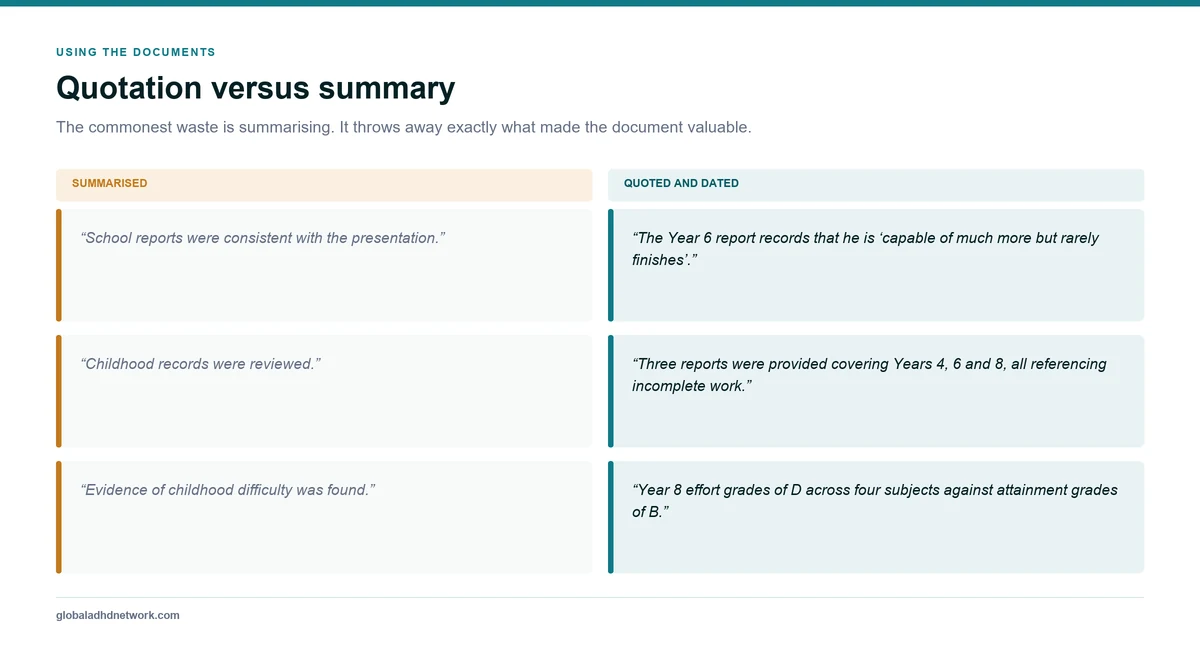
The commonest waste is summarising. "School reports were consistent with the presentation" throws away everything that made the document valuable.
Three school reports were provided by the patient's mother, covering Years 4, 6 and 8. The Year 4 report notes that he "finds it hard to settle and needs frequent reminders"; Year 6 records that he is "capable of much more but rarely finishes"; and Year 8 gives effort grades of D across four subjects against attainment grades of B. These are consistent with the childhood account given by both the patient and his mother.
Quote the phrase, name the year, and say what it supports. That paragraph settles Criterion B on its own, and it is the kind of specificity that makes a reader trust everything around it.
When records arrive after the assessment
It happens frequently, because the request was made late. Two options, and the choice should be deliberate.
Where the diagnosis was made with a documented limitation, an addendum recording the records and their effect is straightforward and strengthens the file considerably. Where the assessment concluded that Criterion B was not evidenced, arriving records may warrant a genuine review rather than a note.
Either way, date the addendum, say what changed, and make sure the version reaching the GP is the current one. An undated second version circulating alongside a first is the kind of avoidable governance problem that undermines an otherwise sound assessment.
Related guides in this cluster
This article is part of GAN's collateral history cluster. Childhood evidence is the criterion most often queried, and each guide addresses a different way of establishing it.
Cluster pillar — The informant interview — gathering collateral history, and the six-section structure
This article is part of GAN's collateral history cluster. Childhood evidence is the criterion most often queried, and each guide addresses a different way of establishing it.
Cluster pillar — The informant interview — gathering collateral history, and the six-section structure
The request is straightforward. The emotional weight of it is not always.
For some patients, reading a decade of comments about wasted potential is genuinely painful, particularly where the assessment has already surfaced a lifetime of being told they were lazy. For others the documents are vindicating in a way nothing else in the process is — the first external confirmation that they were not imagining it.
Warn them that both reactions are common, and offer to go through the documents together rather than leaving them to read alone. It takes ten minutes and it is frequently the most valuable ten minutes of the assessment for the patient, whatever it contributes evidentially.
Records that predate the concept
A patient in their fifties or sixties was at school before ADHD was recognised in the UK in any practical sense. Their reports will not use the language, and the behaviours may have been interpreted through frames that no longer apply — laziness, defiance, poor home circumstances, low ability.
That does not reduce the evidential value; it changes how you read it. Comments framed as moral judgements about effort are frequently describing exactly what the criteria describe, and the moralising tone is itself informative about how the child was experienced.
Quote them as written, and note the period. A reader who sees "lazy and disinterested, 1978" alongside your interpretation can follow the reasoning. A reader who sees only your paraphrase cannot.
Other documents worth asking about
Exam access arrangements — extra time granted at GCSE or A-level, which implies an assessed need
Educational psychology reports — rare, but decisive where they exist
Statements of special educational need or EHCPs — held by the local authority for extended periods
School attendance and behaviour records — detentions, exclusions, internal referrals
University disability service records — do not reach childhood but establish a long pattern
Occupational health assessments — sometimes contain the first formal recognition of difficulty
Patients rarely think of these as medical evidence and will not mention them unless asked specifically.
A note for schools and services working together
Some services have begun building direct relationships with local schools and authorities for records requests, and it measurably shortens the pathway. Where that is not possible, the next best thing is giving the patient a template and a realistic timeline at referral rather than at assessment — the difference between records arriving in time and arriving after the report is written is usually just when the letter went out. Our piece on a school embedding ADHD support shows what the other side of that relationship can look like.
Weighing a partial or ambiguous record
Records rarely arrive as a clean confirmation. More often you get three reports from a nine-year education, two of which say nothing relevant and one of which contains a single suggestive phrase.
The honest treatment is proportionate. One phrase in one report is supporting evidence rather than proof, and should be described that way. Where the record is thin, say what you have and what weight you placed on it, rather than either over-reading a single comment or discarding it.
One of the three reports provided contains a comment that he "needs frequent reminders to stay on task" (Year 5). The remaining two are brief and largely subject-specific. This is consistent with, but does not independently establish, the childhood account given.
That sentence is more persuasive than a confident claim, because it demonstrates that the clinician read the documents rather than searching them for confirmation.
Frequently Asked Questions
How do you get old school records in the UK?
The person makes a subject access request to the school, the academy trust or the local authority. It is free and the organisation has one month to respond. Retention periods vary, so older records may no longer exist.
Are school reports enough to evidence childhood ADHD onset?
They are the strongest documentary evidence available and can support Criterion B on their own where the content is clear. They describe behaviour rather than cause, so the differential still has to be addressed separately.
What should you look for in a school report?
Comments about unfulfilled potential, daydreaming, careless or unfinished work, disorganisation and restlessness — plus effort grades sitting consistently below attainment grades.
Does a school report that says nothing rule out ADHD?
No. Quiet, inattentive children generate little comment, which is a large part of why inattentive presentations and girls were historically missed. Absence of comment is weak evidence.
What if school records arrive after the report is written?
Issue a dated addendum recording the documents and their effect on the conclusion, and ensure the current version reaches the GP.
%20(1).webp)