Global ADHD Network — One of the most highly reviewed ADHD CPD and CME training providers in ADHD diagnosis and neurodiversity training.Global ADHD Network — One of the most highly reviewed ADHD CPD and CME training providers in ADHD diagnosis and neurodiversity training.Global ADHD Network — One of the most highly reviewed ADHD CPD and CME training providers in ADHD diagnosis and neurodiversity training.
“My Parents Have Died”: Evidencing Childhood ADHD Onset When There Is No Informant
Both parents dead, a sibling too young to remember, and twenty-five minutes left. An absent informant narrows the evidence available; it does not close the criterion. The four-tier hierarchy, anchored questions that produce checkable answers, and how to write the limitation.
"My mum died in 2019. My dad wasn't around. My sister's four years younger, so she wouldn't remember."
Twenty-five minutes left. Every other criterion comfortably met. And a diagnostic framework that requires you to establish something about a life before the age of twelve.
This is not an edge case. In a service assessing adults in their forties and fifties it is close to routine, and it is the single situation where competent clinicians most often either over-reach or give up. Neither is necessary.
Who this is for
Consultant psychiatrists and clinical psychologists who have to sign the diagnosis either way
ADHD nurse specialists who usually discover the absence during the pre-assessment call
GPs with an extended role, well placed to prompt a records request early in the pathway
Trainees, for whom this is the situation most likely to produce either paralysis or an unsupported claim
What Criterion B actually requires
Worth being precise, because the criterion is more permissive than clinicians often assume.
DSM-5 requires that several inattentive or hyperactive-impulsive symptoms were present before age 12. It does not specify a source. It does not require an informant. It does not require documentary proof. It requires evidence, and it leaves the standard of that evidence to clinical judgement.
That matters, because the common failure is not clinicians diagnosing without evidence. It is clinicians treating an absent parent as an absolute bar and either declining to diagnose someone who clearly meets criteria, or diagnosing and writing nothing about how onset was established. Both are avoidable.
Work down the hierarchy
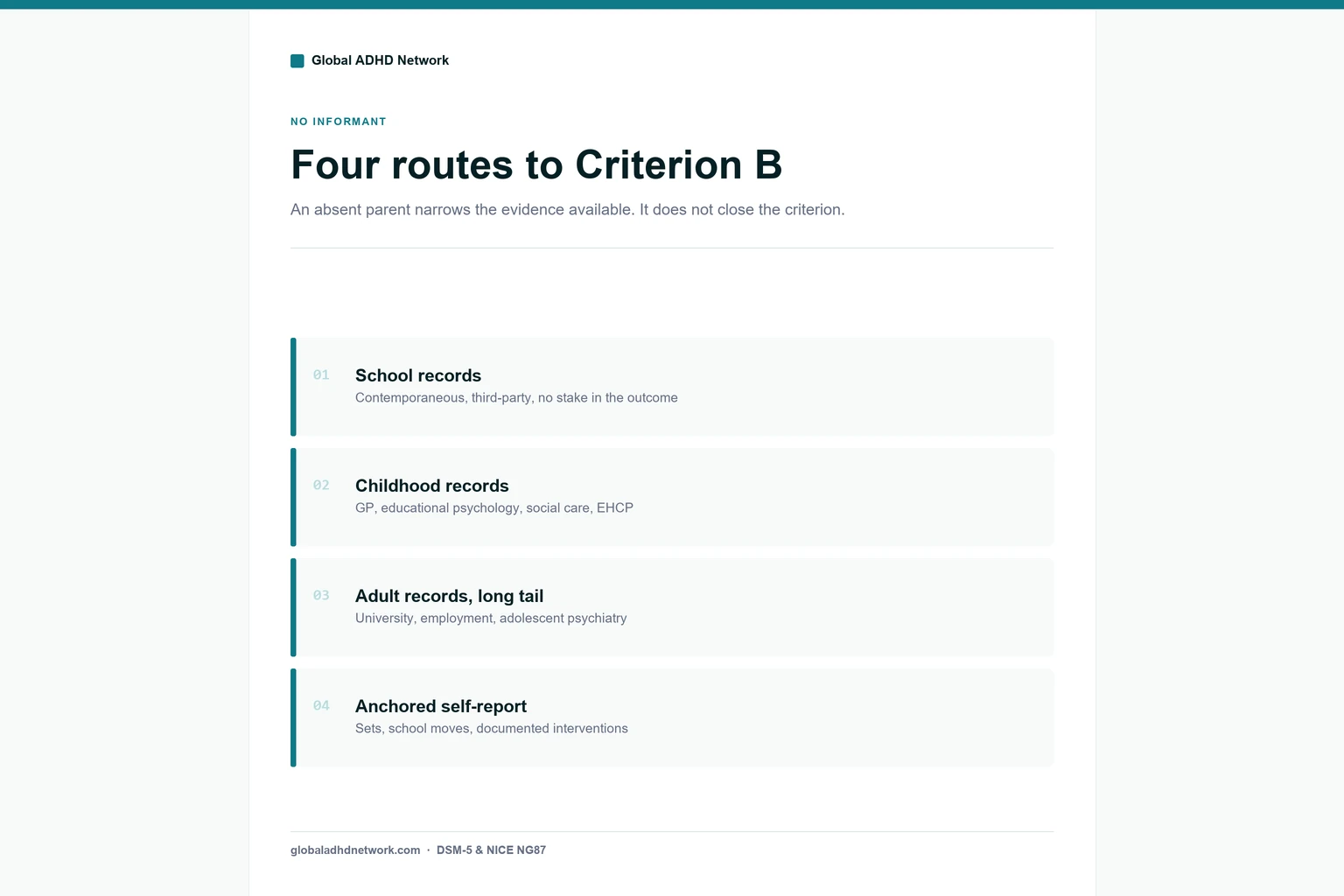
Tier one: school records
The strongest available substitute, and the most under-used. School reports are contemporaneous, written by a third party with no stake in the outcome, and frequently explicit about exactly the behaviours the criteria describe — "does not apply himself", "easily distracted", "could do so much better".
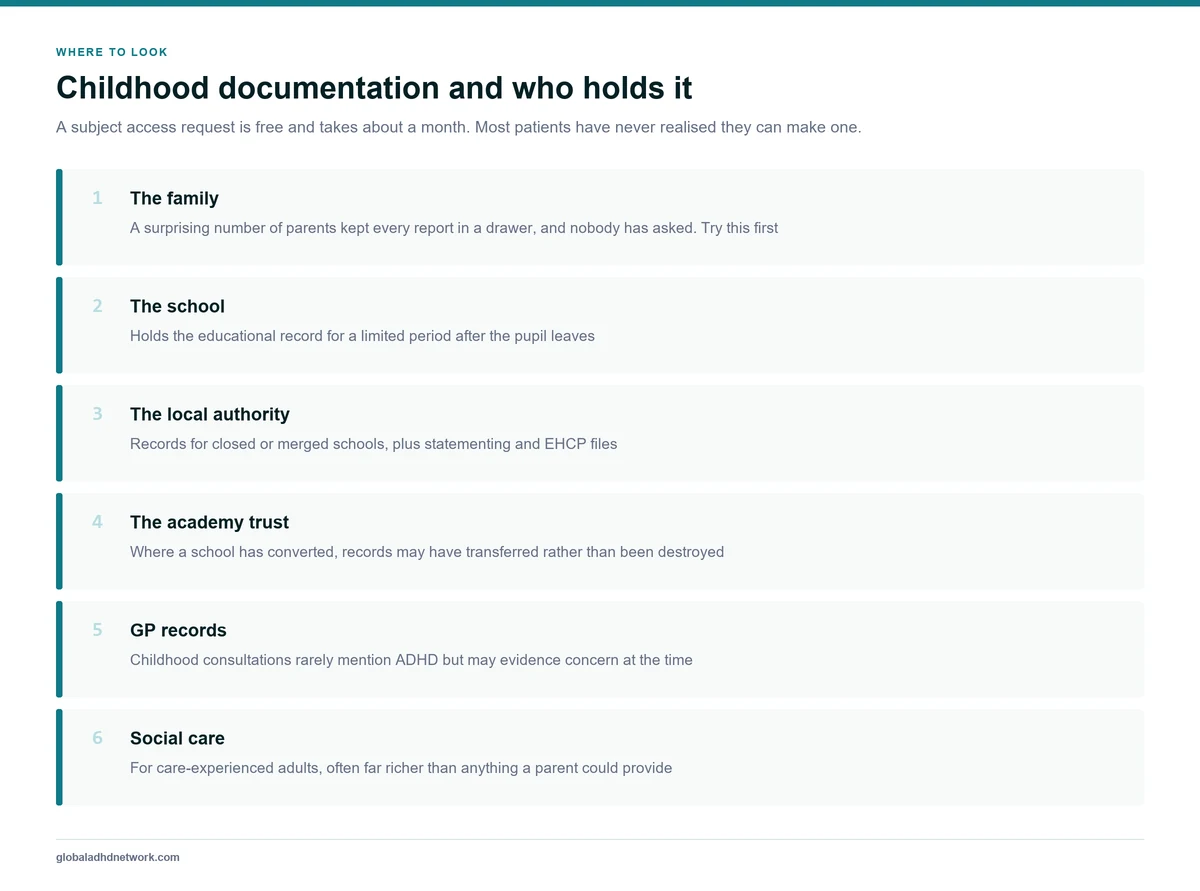
Many patients have never realised they can request them. Schools and local authorities hold records for varying periods, and a subject access request is free. It is worth pausing an assessment for six weeks to get them.
Tier two: other childhood documentation
Childhood GP records, educational psychology involvement, statementing or EHCP history, social care records. None of these will usually mention ADHD, because nobody was looking for it. What they may contain is evidence that somebody was concerned, which is what the criterion is really asking about.
Tier three: adult records with a long tail
University records, employment records, or a psychiatric history reaching back into late adolescence. These do not reach before twelve, but they establish that the pattern predates the current presentation by decades, which substantially strengthens an inference.
Tier four: detailed, anchored self-report
Weaker, and not worthless. The distinction that matters is between global self-assessment and specific, checkable memory.
How to take an anchored childhood history
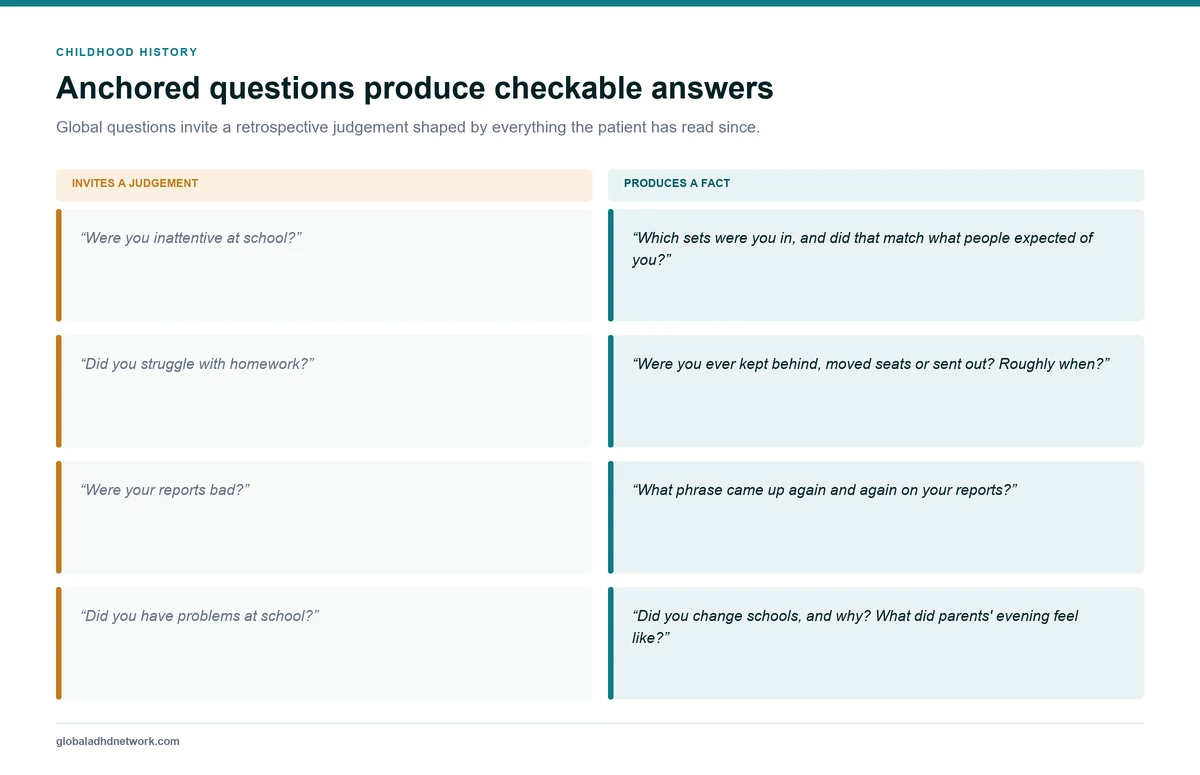
"Were you inattentive at school?" invites a retrospective judgement shaped by everything the patient has read since. Anchored questions ask about facts, and facts are more stable.
Which sets were you in, and did that match what people expected of you? Streaming is a hard, memorable fact and a good proxy for the gap between ability and attainment.
What did your reports say? Most people remember the recurring phrase even without the document.
Were you ever kept behind, moved seats, or sent out? Events rather than impressions.
Did you change schools, and why?
What did parents' evening feel like? Frequently produces a vivid and specific answer.
Who else in the family has been diagnosed? Heritability is high, and a diagnosed sibling or child raises the prior considerably.
Where the patient's presentation is inattentive rather than hyperactive, expect the record to be thinner in both directions — quiet children generate fewer incidents and fewer memories. Our guides to inattentive ADHD and inattentive ADHD in women set out why this group is systematically under-evidenced, and why a thin record is not the same as a negative one.
Widen the definition of informant before abandoning it
Clinicians tend to think parent-or-nothing. Before concluding that nobody is available, ask specifically about:
An older sibling with five or six years on the patient — enough to remember primary school
An aunt, uncle or grandparent who was closely involved
A parent's long-term partner or a step-parent from the relevant period
A family friend, neighbour or a friend's parent
A former teacher, where the school is still traceable
Anyone the patient lived with before the age of twelve, including in care
Patients rarely volunteer these because they have understood the request as "a parent". Asking the question the other way round — who knew you before you were twelve, and is any of them still around? — produces a different answer surprisingly often.
Care-experienced adults
A group where this problem is both more common and more consequential, and where the records position is different.
Adults who spent childhood in care frequently have no family informant, but often have unusually extensive documentation — social care files, LAC reviews, placement records, educational statements. These can be requested and are sometimes far richer than anything a parent could provide.
Two cautions. Accessing those records can be distressing and should be handled with that in mind rather than as a purely administrative step. And behaviour recorded in a care context is heavily confounded by adversity, so a differential involving trauma needs proper attention rather than a formulaic exclusion.
Writing the limitation
This is the part that determines whether the report holds, and it takes one paragraph.
No childhood informant was available; both parents are deceased and her only sibling is four years younger. School records were requested from the local authority in July and are no longer held. Criterion B is therefore supported by the patient's detailed and internally consistent account of academic streaming, repeated report comments regarding unfulfilled potential, and a documented referral to the school counsellor at age ten. This limitation should be borne in mind, though the account was specific, checkable in parts, and consistent with the adult presentation.
Compare that with silence on the point, or with "symptoms have been present since childhood". The clinical position is identical. Only one of the three survives a careful reading, and only one tells the next clinician what was actually established.
When the honest answer is that you cannot
Sometimes the evidence genuinely will not support the criterion — no records, no informant, and a self-report that is vague, shifting, or clearly shaped by recent reading.
The options are not diagnose or refuse. A provisional formulation, a period of review, a recommendation to obtain specific records before a further appointment, or a diagnosis of ADHD with onset unconfirmed and the reasoning stated, are all legitimate positions. What is not legitimate is a confident diagnosis resting on an unstated inference.
Patients almost always accept an honest account of the difficulty when it is explained, particularly if you give them something to do — a records request, a relative to contact. What they do not accept, and should not have to, is being turned away without an explanation of what was missing and what would resolve it.
Related guides in this cluster
This article is part of GAN's collateral history cluster. Childhood evidence is the criterion most often queried, and each guide addresses a different way of establishing it.
Cluster pillar — The informant interview — gathering collateral history, and the six-section structure
This article is part of GAN's collateral history cluster. Childhood evidence is the criterion most often queried, and each guide addresses a different way of establishing it.
Cluster pillar — The informant interview — gathering collateral history, and the six-section structure
Before any of the evidence-gathering, there is a conversation to have, and how it is handled shapes everything after it.
Patients in this position are frequently anxious that the absence of a parent will disqualify them. Some have been told as much by a previous service. Others are carrying grief that the question reactivates without warning, and a clinician who moves briskly from "are your parents available?" to "in that case, school records" can miss that entirely.
Name it. Say that the criterion asks for evidence rather than a specific person, that there are several routes, and that you will work through them together. Then give them something concrete to do — a records request, a relative to call. Agency matters here more than reassurance does.
How much evidence is enough
There is no threshold, which is uncomfortable but true. What there is, is a defensible standard: would another clinician, reading your report, be able to see what you relied on and reach a reasonable conclusion from it?
In practice, most assessors are comfortable where two of the following are present — a specific, internally consistent self-report anchored to checkable facts; a documentary trace of concern at the time; an adult record establishing a long-standing pattern; or a partial informant who can speak to some of the period.
One alone, particularly unanchored self-report, is thin. Saying so in the report is better than deciding it privately.
Adults who were adopted or in care
A group where this arises constantly and where the usual advice can miss.
Adoption records, LAC review minutes, placement histories and social care files often contain detailed contemporaneous observation of exactly the behaviours the criteria describe. Access routes differ from educational records and can take longer, but the material is frequently richer than anything a parent would have produced.
Two things to hold. Accessing those files can be significantly distressing, and should be framed and paced accordingly rather than treated as an administrative step. And behaviour recorded in a care context is heavily confounded by adversity, so the trauma differential needs genuine attention rather than a formulaic sentence.
What not to do
Do not treat an absent parent as an automatic bar. DSM-5 requires evidence of onset, not a specific witness to it.
Do not diagnose and write nothing. An unstated inference is the version that fails on review.
Do not accept a global self-report unanchored. "I've always been like this" is a starting point, not evidence.
Do not send the patient away without a plan. Name what is missing and what would resolve it.
Frequently Asked Questions
Can you diagnose ADHD without a parent or informant?
Yes. DSM-5 requires evidence that several symptoms were present before age 12, but does not specify the source. School records, childhood documentation or detailed anchored self-report can support the criterion where the limitation is stated.
How do you get childhood school records in the UK?
The patient can make a subject access request to the school or the local authority, free of charge. Retention periods vary, so an early request is worthwhile even if it returns nothing.
Who else can act as an informant if parents are unavailable?
An older sibling with five or six years on the patient, an aunt, uncle or grandparent, a step-parent from the relevant period, a family friend, or a former teacher. Anyone who knew the patient well before age 12.
Is self-report enough for Criterion B?
It is the weakest tier, but it is not worthless — particularly where anchored to checkable facts such as academic sets, school moves or documented interventions. The limitation must be recorded.
What should the report say when childhood evidence is thin?
State what was unavailable and why, what you relied on instead, and what weight you placed on it. A documented limitation is more defensible than an unexplained gap.
%20(1).webp)