Global ADHD Network — One of the most highly reviewed ADHD CPD and CME training providers in ADHD diagnosis and neurodiversity training.Global ADHD Network — One of the most highly reviewed ADHD CPD and CME training providers in ADHD diagnosis and neurodiversity training.Global ADHD Network — One of the most highly reviewed ADHD CPD and CME training providers in ADHD diagnosis and neurodiversity training.
When the Informant Disagrees: Handling Discrepancies Between Self-Report and Collateral History
A parent describing a happy childhood against a patient who remembers otherwise is not a contradiction to be resolved by picking a side. Why accounts diverge, the six factors that determine weight, and how to record a discrepancy so the report survives a careful reading.
The patient described a childhood of lost books, unfinished homework and reports that all said the same thing. His mother, on the phone twenty minutes later, describes a happy boy who did perfectly well and was no different from his brother.
One of them is not lying. Neither is necessarily wrong.
Who this is for
Consultant psychiatrists and clinical psychologists making the weighting judgement
ADHD nurse specialists, usually the first to encounter the divergence on the call
GPs with an extended role, who may hold longitudinal knowledge of the family
Trainees, who tend to treat a discrepancy as a problem to be resolved rather than data
The four common patterns
The parent who minimises
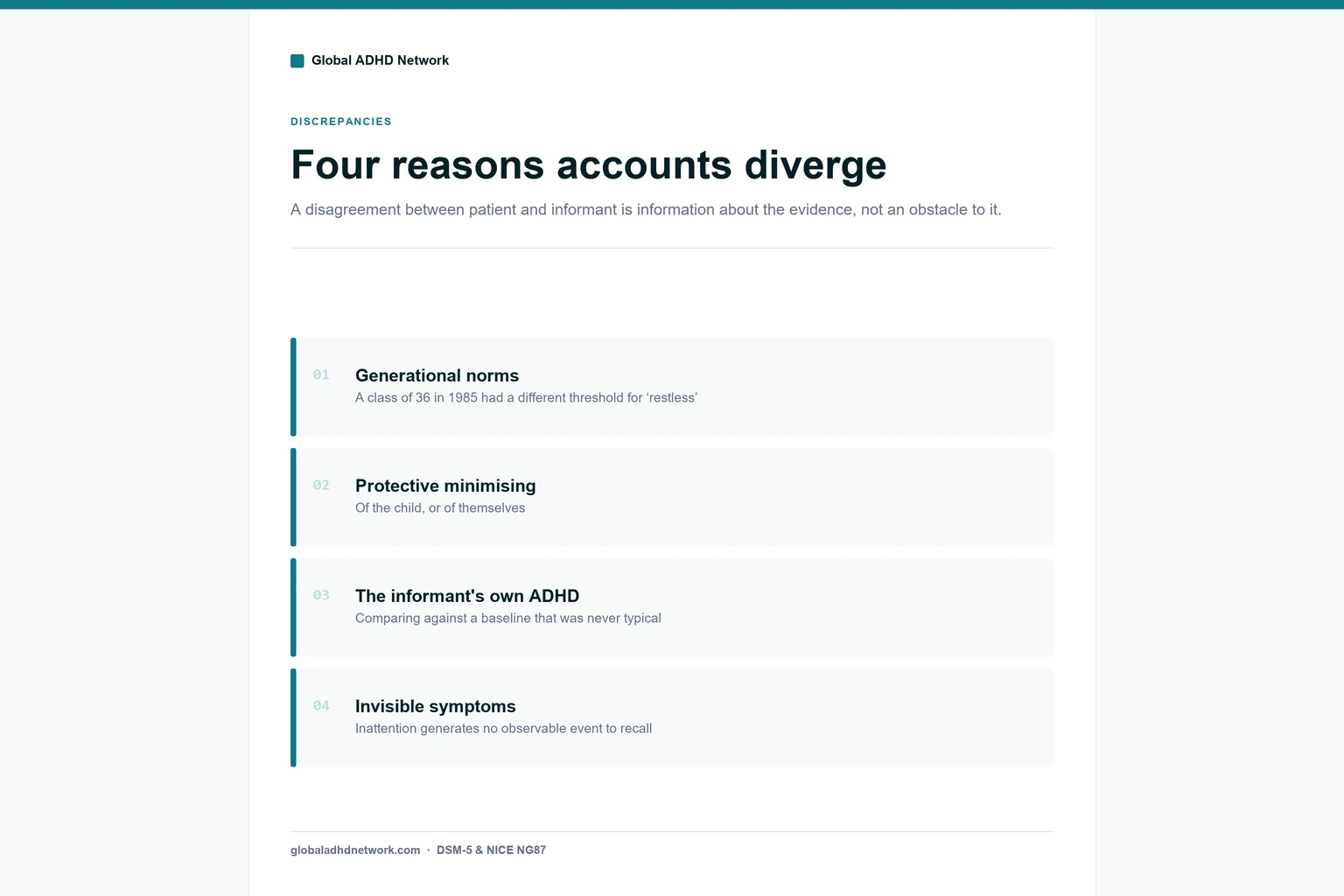
The most frequent by some distance, and rarely dishonest. Several things drive it.
Generational calibration is the largest. A parent raising a child in a class of thirty-six in 1985 has a different threshold for restless than a parent today. Behaviour that would now prompt a referral was, in that setting, simply how boys were. Our guide to ADHD symptoms in young boys covers how much of this went unrecorded.
Protection is the second — of the child, or of themselves. A parent who suspects the question implies criticism will instinctively smooth the account.
The parent who has ADHD themselves
ADHD is substantially heritable, so a meaningful proportion of informants have it undiagnosed. They are comparing their child against a baseline that was never typical.
"He was no worse than I was" is offered as reassurance and is one of the most diagnostically interesting sentences you will hear. Follow it gently.
The invisible symptom
Inattentive presentations generate no observable event. A child quietly failing to follow a three-step instruction produces nothing for a parent to remember, while the child remembers the confusion vividly. Divergence here is expected and is not evidence against the symptom — see inattentive ADHD for why this group is systematically under-observed.
The patient who over-attributes
The reverse pattern, and it deserves the same neutrality. Someone who has recently found a framework that explains thirty years of difficulty may read every memory through it. That is not fabrication; it is how explanatory frameworks work. It does mean the account needs anchoring to checkable facts rather than accepted at face value.
Weighing the two accounts
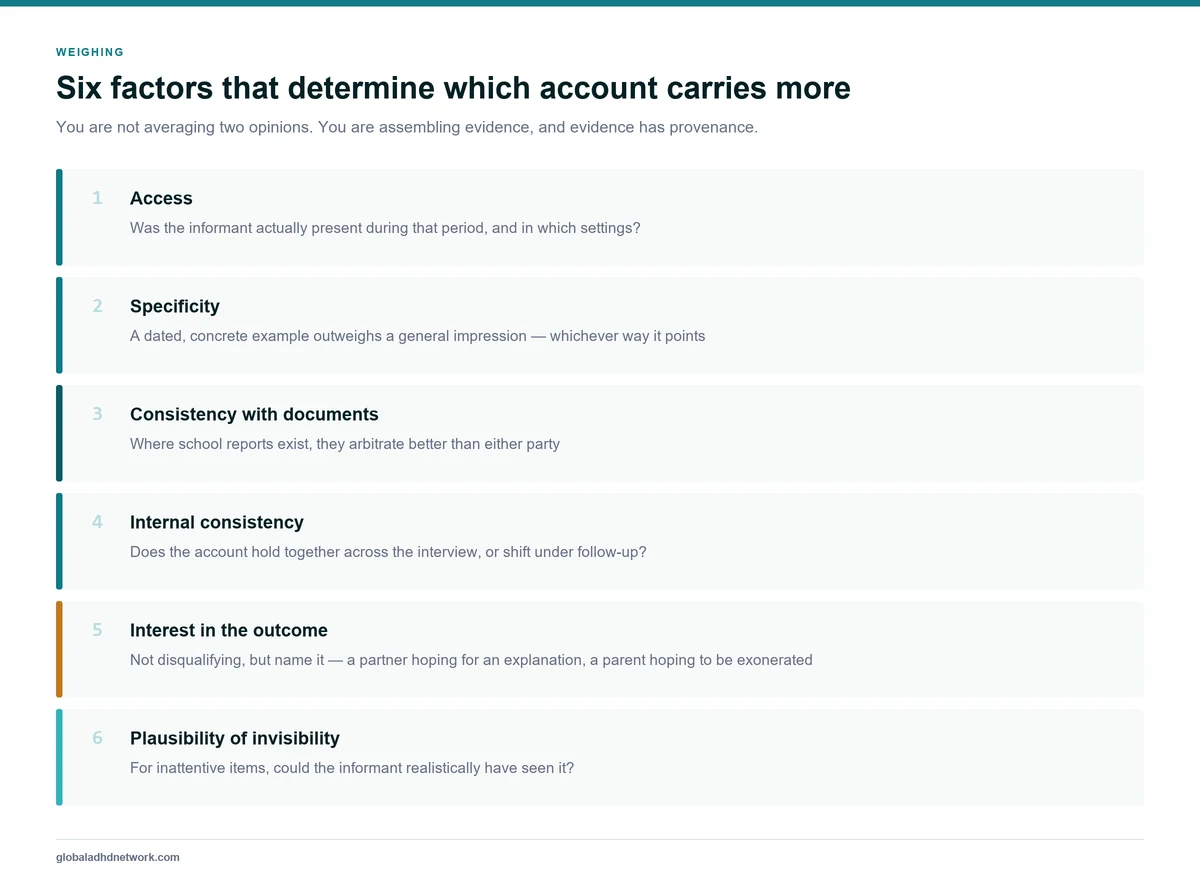
You are not averaging opinions. You are assembling evidence, and evidence has provenance. Six things determine weight:
Access. Was the informant actually present during the period in question, and in which settings?
Specificity. A dated, concrete example outweighs a general impression, whichever direction it points.
Consistency with documents. Where school reports exist, they arbitrate better than either party.
Internal consistency. Does each account hold together across the interview, or shift under follow-up?
Interest in the outcome. Not disqualifying, but worth naming — a partner hoping for an explanation, a parent hoping to be exonerated.
Plausibility of invisibility. For inattentive items, ask whether the informant could realistically have seen it.
Applied honestly, these usually resolve most of the disagreement. Where they do not, the residual uncertainty belongs in the report rather than in your head.
Asking about the discrepancy directly
One underused move: put it to them, neutrally.
To the informant: he remembers struggling quite a lot with homework — does that match your memory, or did it look different from where you were standing? To the patient: your mother remembers school going reasonably well; what do you make of that?
Both questions frequently produce the explanation rather than a contradiction. Parents say they did not know because the child hid it. Patients say their mother was working two jobs and was not there for homework. The apparent conflict dissolves into two accurate accounts of different vantage points, and that is a far better paragraph than either version alone.
The uncomfortable versions
Two situations that need naming.
A strained or abusive family relationship. An informant may minimise for reasons that have nothing to do with recall, and a patient may find the call itself distressing. Ask about the relationship before arranging the contact, and be prepared to weight the account accordingly or not to seek it at all.
An informant with a stake. Occasionally a partner or parent has a financial, legal or relational interest in the outcome. It does not invalidate the account. It should be recorded alongside it, and it should temper how much load that account is asked to carry.
Writing it up
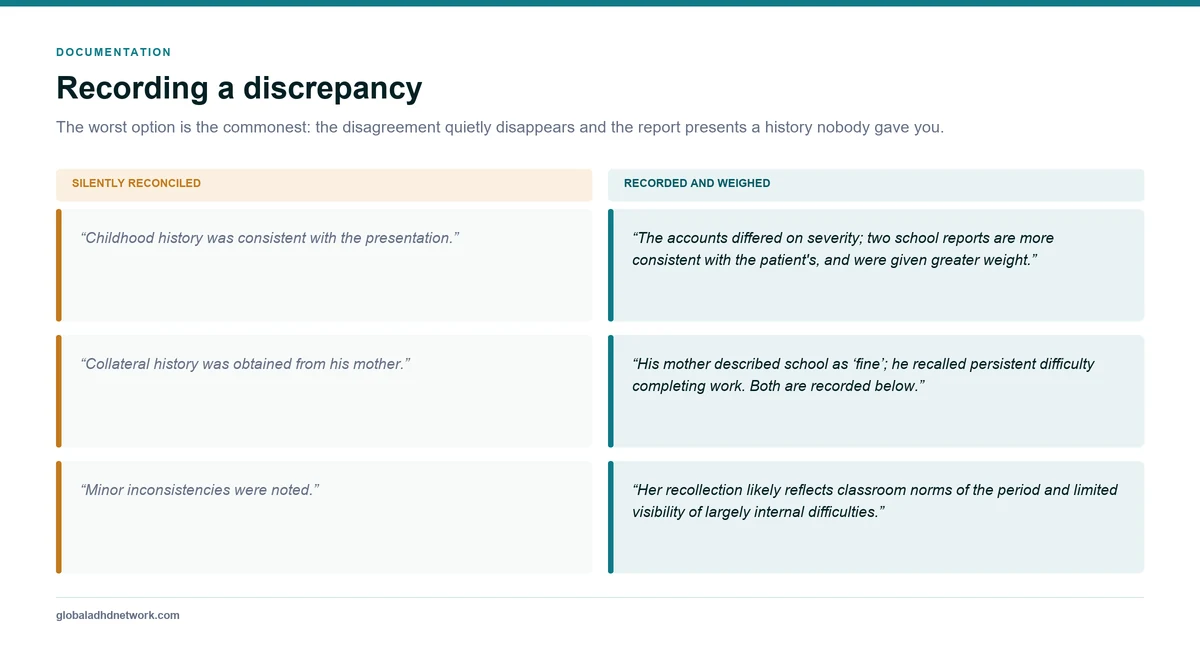
The single worst option is the one most commonly taken: the disagreement quietly disappears, and the report presents a single coherent history that nobody actually gave you.
The patient's account and his mother's differed on the severity of childhood inattention. She described school as "fine", while he recalled persistent difficulty completing work. Two school reports provided by the family reference incomplete homework and unfulfilled potential in Years 5 and 6, and are more consistent with his account. Her recollection is likely to reflect both the classroom norms of the period and limited visibility of difficulties that were largely internal. Greater weight has been given to the documentary evidence.
Five sentences. Both accounts recorded, both attributed, the arbitrating evidence named, the weighting stated and justified. A reader can disagree with the conclusion and still trust the process, which is the most a report can reasonably achieve.
When the discrepancy changes the diagnosis
Occasionally it should. An informant account that is specific, well-evidenced and firmly contradicts a thin self-report is a genuine reason to pause.
The test is not who is more confident but whose account is better supported. Where a parent describes a childhood that sounds unremarkable, school reports are consistent with that, and the patient's own account is general rather than specific, the honest conclusion may be that Criterion B is not met on current evidence.
Say that clearly, say what would change it, and say what you found instead. A negative outcome that explains itself is far better received than one that does not, and it is considerably less likely to send the patient to a fourth opinion elsewhere.
Related guides in this cluster
This article is part of GAN's collateral history cluster. Childhood evidence is the criterion most often queried, and each guide addresses a different way of establishing it.
Cluster pillar — The informant interview — gathering collateral history, and the six-section structure
This article is part of GAN's collateral history cluster. Childhood evidence is the criterion most often queried, and each guide addresses a different way of establishing it.
Cluster pillar — The informant interview — gathering collateral history, and the six-section structure
One specific mechanism worth isolating, because it accounts for a surprising share of parental minimisation.
Parents rate children against each other rather than against a population. A child with ADHD whose sibling also has it — which, given heritability, is common — will be described as unremarkable, because within that family they were. The same child in a different family would have stood out.
The countermeasure is to move the comparison group deliberately outside the household. "Compared with the other children in the class" or "compared with his friends at the time" produces a materially different answer from "compared with his brother", and it is worth asking both and recording the difference.
Discrepancy as a diagnostic signal in its own right
A pattern worth recognising: certain discrepancies point toward particular presentations rather than away from the diagnosis.
A patient reporting substantial internal difficulty against a parent reporting a straightforward childhood is the classic signature of an inattentive presentation — and, disproportionately, of women diagnosed late, whose compensatory strategies were effective enough to conceal the difficulty from everyone including themselves. The pattern is set out in inattentive ADHD in women.
Read that way, the discrepancy is not a reason for doubt. It is consistent with the presentation, and saying so in the report is a stronger move than treating the parental account as a partial refutation.
When there are two informants who disagree with each other
It happens — separated parents, a parent and an older sibling, two relatives with different vantage points — and it is usually more informative than a single account would have been.
Treat the disagreement as a natural experiment. Which settings did each see? A parent who had the child at weekends saw unstructured time; a parent who managed the school week saw homework and mornings. Those are different settings, and two accounts diverging along exactly that line is Criterion C evidence rather than a contradiction.
Where the divergence tracks a conflicted relationship rather than a difference in access, weight accordingly and say so.
Supervision and second opinions
A genuinely irreconcilable discrepancy on a criterion that determines the outcome is a reasonable trigger for discussion rather than a judgement to make alone.
Services with a threshold for second opinion — significant diagnostic uncertainty, suspected co-occurring autism, medico-legal context, or a discrepancy that determines Criterion B — handle these considerably better than services where it depends on individual confidence. Setting that threshold in advance also removes the implicit suggestion that seeking a view is a sign of inexperience.
Discrepancy on impairment rather than symptoms
Most discussion of conflicting accounts focuses on Criterion B. Disagreement about current impairment is at least as common and gets much less attention.
A partner describing significant difficulty against a patient who minimises is the usual direction, and it usually reflects assimilation rather than denial — someone who has never functioned differently has no baseline to notice the difference against. The partner's account is often the more accurate one here, and it should be weighted accordingly while being clearly attributed.
Record both, and prefer the account that comes with a consequence attached. "He says it's fine; she describes two disconnected utilities in eighteen months" resolves itself.
Frequently Asked Questions
What if a parent disagrees with the patient's account of their childhood?
Record both accounts, attribute each, and state which you gave greater weight and why. Discrepancies are common and usually reflect vantage point, generational norms or invisible symptoms rather than inaccuracy.
Whose account carries more weight in an ADHD assessment?
Neither automatically. Weight depends on access to the period, specificity of the example, consistency with documents, internal consistency, any interest in the outcome, and whether the symptom would have been visible from outside.
Why do parents often minimise childhood ADHD symptoms?
Generational classroom norms, a protective instinct toward the child or themselves, and sometimes their own undiagnosed ADHD providing an atypical baseline for comparison.
Should you tell the informant what the patient said?
Putting the discrepancy neutrally often produces the explanation rather than a conflict — but only with the patient's consent, and without disclosing more than the question requires.
Can a discrepancy change the diagnostic outcome?
Yes. Where the informant account is specific and well supported and the self-report is general, the honest conclusion may be that Criterion B is not met on current evidence.
%20(1).webp)