Global ADHD Network — One of the most highly reviewed ADHD CPD and CME training providers in ADHD diagnosis and neurodiversity training.Global ADHD Network — One of the most highly reviewed ADHD CPD and CME training providers in ADHD diagnosis and neurodiversity training.Global ADHD Network — One of the most highly reviewed ADHD CPD and CME training providers in ADHD diagnosis and neurodiversity training.
How Reliable Is Retrospective Recall? What the Evidence Says About Childhood ADHD Symptoms
Adults recall their own childhood symptoms imperfectly, and the error runs toward under-reporting rather than over. What the evidence base actually supports, why recall fails in the specific ways it does, what that changes in practice, and what it does not support.
Every adult ADHD assessment rests on an assumption that deserves more scrutiny than it usually gets: that somebody can accurately tell you what a person was like at the age of nine.
Sometimes that somebody is the patient, recalling their own childhood across three or four decades. Sometimes it is a parent recalling one child among several, filtered through everything that has happened since. Neither is a recording.
This matters practically rather than philosophically. Criterion B is the criterion most often queried, and knowing what the evidence base actually supports tells you how hard to push, what to anchor to, and what to say in the report.
Who this is for
Consultant psychiatrists and clinical psychologists defending a Criterion B judgement
Clinical psychologists and researchers interested in the measurement question directly
ADHD nurse specialists deciding how hard to probe a thin childhood account
Trainees, who are often taught that collateral history solves the problem rather than mitigating it
What the research broadly shows
Self-report has modest agreement with the contemporaneous record
Where researchers have been able to compare adults' retrospective accounts against records or ratings collected during their childhood, agreement is generally modest rather than strong. The direction of error is not random: adults tend to under-report the symptoms they had, particularly hyperactive-impulsive ones, rather than over-report them.
That direction matters clinically. The commoner failure mode in adult assessment is a false negative on childhood history, not a false positive — which is the opposite of the assumption behind most public commentary about over-diagnosis.
Informants are better, but not a solution
Parental recall is generally more accurate than self-recall for observable behaviours, which is why DSM-5 and NICE NG87 both push toward corroboration and why the DIVA-5 builds an informant column into the instrument.
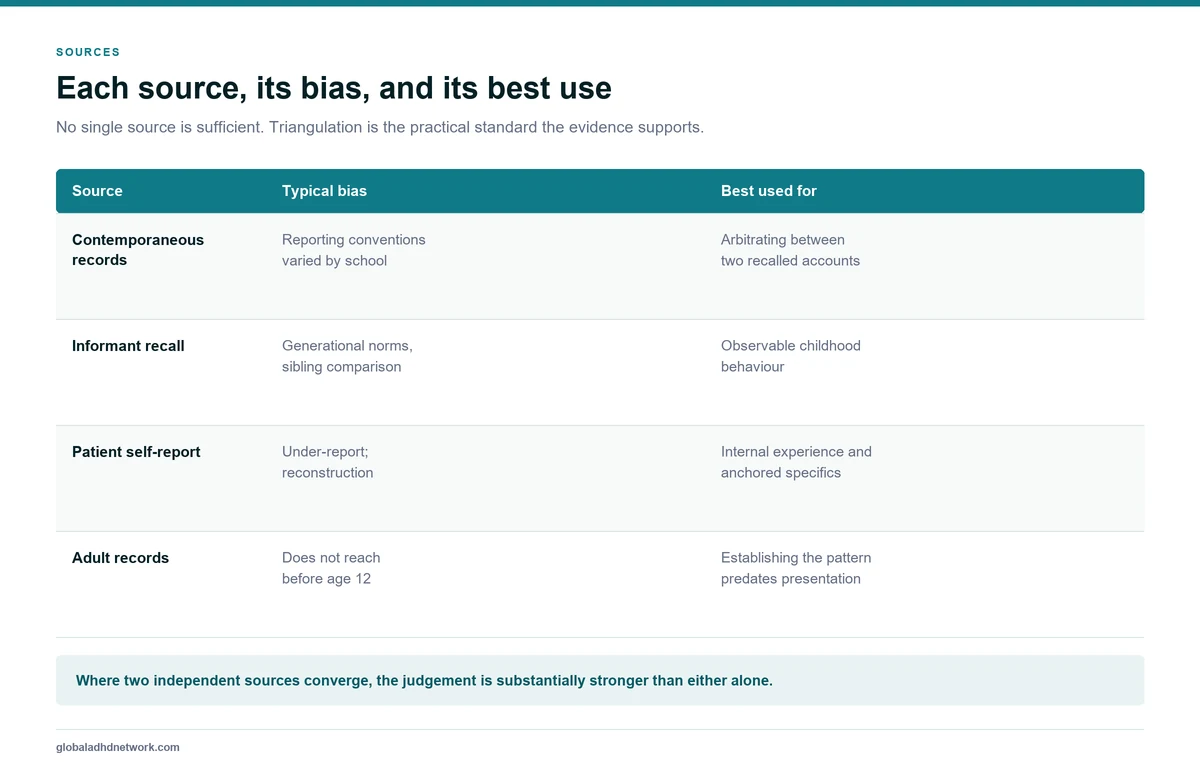
But parental accounts also decay, and they carry their own systematic biases: recall shaped by later events, comparison against siblings, and the classroom norms of the period. For internalising symptoms the parent may simply never have had access to the information.
Convergence is the practical standard
No single source is adequate. What the evidence supports is triangulation — two imperfect sources agreeing is substantially stronger than either alone, and documentary evidence arbitrates better than either.
Why recall fails in the specific ways it does
Three mechanisms account for most of it, and each suggests a countermeasure.
Normalisation. You cannot identify a deficit in something you have never experienced otherwise. A patient who has always found reading effortful has no comparison point, and will report it as ordinary. The countermeasure is to ask about consequences and comparisons rather than experiences.
Reconstruction. Autobiographical memory is generative rather than reproductive. People assemble a plausible account from fragments, current self-concept and later knowledge. This is why an explanatory framework acquired recently — a diagnosis in a sibling, a documentary, an algorithmically served feed — reshapes recall in both directions. The countermeasure is anchoring to checkable facts.
Invisibility. Some symptoms produce no external event. A child failing to follow a three-step instruction generates nothing for a parent to remember. Divergence between accounts on inattentive items is expected and is not evidence against the symptom — see inattentive ADHD.
What this changes in practice
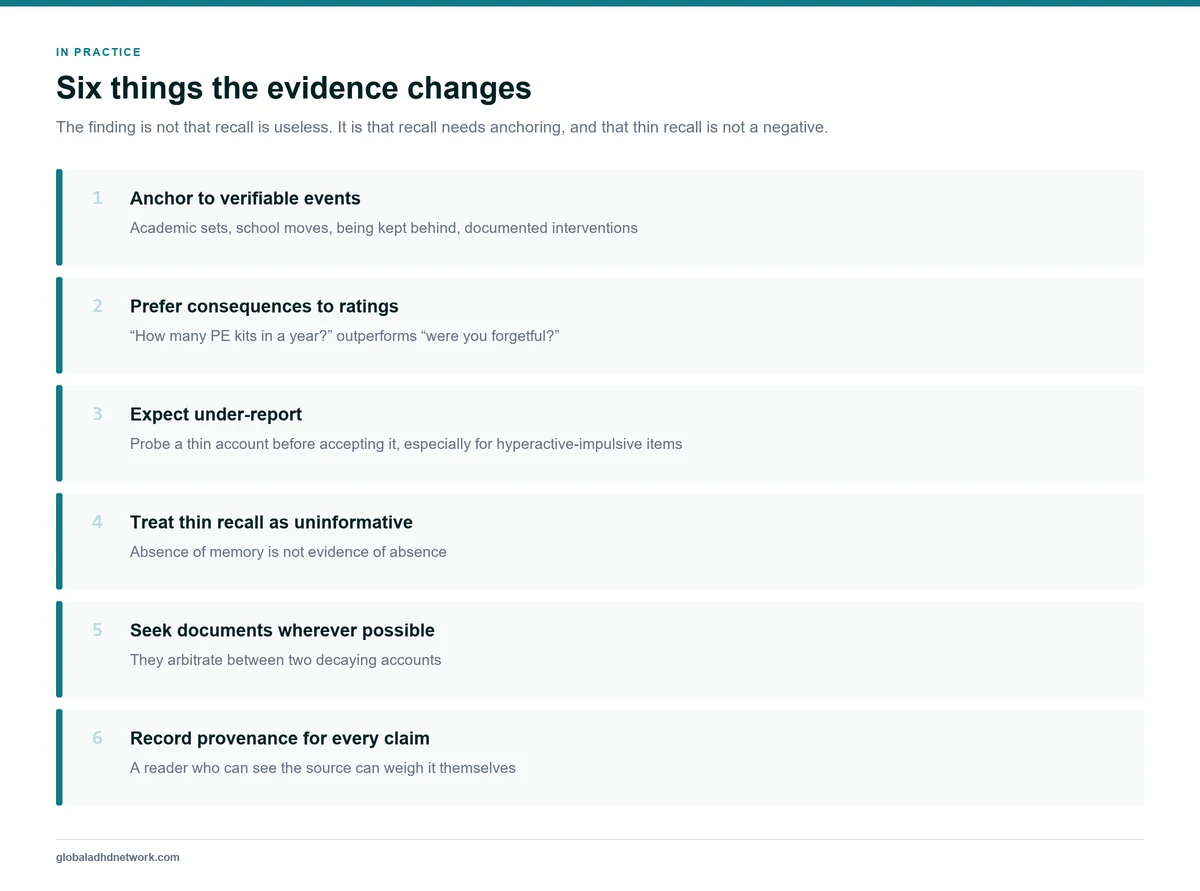
Anchor every childhood question to a verifiable event. Sets, school moves, being kept behind, documented interventions. Facts are more stable than impressions.
Prefer consequences to ratings. "How many PE kits did you replace in a year?" outperforms "were you forgetful?" by a wide margin.
Expect under-report, not over-report. Probe a thin account before accepting it, particularly for hyperactive-impulsive items in adults who have long since internalised them.
Treat thin recall as uninformative rather than negative. Absence of memory is not evidence of absence.
Seek documents wherever possible. They arbitrate between two decaying accounts.
Record the provenance of every childhood claim. A reader who can see where the evidence came from can weigh it themselves.
What it does not mean
A caution, because this evidence is occasionally deployed in bad faith.
"Retrospective recall is unreliable" is sometimes used to argue that adult ADHD diagnosis is inherently unsound. It does not support that conclusion. Every diagnosis in psychiatry rests substantially on history, and much of medicine rests on patient recall of symptom onset. The finding is that recall is imperfect and directional, which is an argument for corroboration and careful method — not for abandoning the criterion or the diagnosis.
It is also worth noting what the direction of error implies. If adults systematically under-report childhood symptoms, a strict application of Criterion B will produce false negatives in exactly the group already most likely to have been missed as children. That is a real equity issue, and it is part of why rising diagnosis rates are better explained by improving recognition than by drifting thresholds.
Wording the uncertainty
Where a Criterion B judgement rests substantially on recall, saying so is a strength.
Childhood onset is supported by the patient's account and by her mother's, which were consistent on inattentive difficulties though differing on their severity. No contemporaneous records were available. Retrospective recall has recognised limitations, and this judgement rests on the convergence of two independent accounts rather than on documentary evidence.
That paragraph tells a reader exactly what the evidence is and exactly what it is not. It is more persuasive than an unqualified assertion, and it is the sentence that makes the rest of the report credible.
Related guides in this cluster
This article is part of GAN's collateral history cluster. Childhood evidence is the criterion most often queried, and each guide addresses a different way of establishing it.
Cluster pillar — The informant interview — gathering collateral history, and the six-section structure
This article is part of GAN's collateral history cluster. Childhood evidence is the criterion most often queried, and each guide addresses a different way of establishing it.
Cluster pillar — The informant interview — gathering collateral history, and the six-section structure
Three methodological points worth holding, because the studies are frequently cited more confidently than they warrant in either direction.
Prospective cohorts are rare and expensive. The strongest designs follow children into adulthood and compare later recall against ratings collected at the time. There are relatively few, they are concentrated in a small number of countries, and their samples are not always representative of who presents to adult services now.
Agreement statistics depend heavily on the threshold used. Correlations between retrospective and contemporaneous accounts look very different depending on whether you compare symptom counts, diagnostic status or individual items. Headline figures move accordingly.
Most studies predate the current referral population. Adults presenting today are more likely to have read extensively about ADHD before assessment than those studied twenty years ago, which plausibly affects recall in ways the older literature cannot capture.
None of this undermines the broad finding. It does mean the honest summary is directional — recall is imperfect and tends to under-report — rather than a precise coefficient to quote at a sceptical commissioner.
What this means for over-diagnosis arguments
Worth addressing directly, because clinicians are increasingly asked about it.
The public argument usually runs that adults are self-diagnosing from social media, arriving with rehearsed symptoms, and being confirmed by services with an incentive to diagnose. The recall evidence does not support the mechanism that argument depends on. If retrospective bias ran toward over-reporting, the argument would have a foundation; the literature points the other way.
What the evidence does support is that childhood evidence is the weakest link in adult assessment, and that services differ enormously in how rigorously they establish it. That is a real quality concern and a very different one from systematic over-diagnosis. It is also entirely addressable through method — which is what this cluster is about.
Explaining it to patients
Patients sometimes hear "your memory of childhood may not be reliable" as a challenge to their credibility, and it lands badly at the exact moment they are being asked to trust the process.
The framing that works is generalising rather than personalising: nobody remembers being nine accurately, which is why we ask several sources rather than relying on one. Said that way, most people find it reassuring — it signals rigour rather than suspicion, and it makes the informant request easier to accept.
It also gives you a natural way to explain the limitation if the diagnosis ends up resting on convergence rather than documents, which is a conversation better had at the start than at the end.
Recall in the informant, not just the patient
Discussion of retrospective bias focuses almost entirely on the patient. The informant is remembering across the same interval, often further back, and about one child among several.
Parental recall carries specific distortions worth naming: telescoping, where events are remembered as closer together than they were; conflation between siblings; and reinterpretation in light of the adult the child became. A parent whose child later did well may recall childhood difficulty as less significant than it was, and one whose child struggled may recall it as more.
None of this argues against seeking collateral. It argues for treating the informant account as a second imperfect source to be triangulated rather than as the arbiter — which is how it is often implicitly used.
The practical bottom line
If the literature offers one operational conclusion, it is this: the quality of a childhood history depends far more on how it is elicited than on who is providing it.
An anchored, specific, consequence-focused interview with a patient will outperform a vague conversation with a parent. Two anchored accounts from different sources outperform either. And a contemporaneous document outperforms both, which is why the records request is worth making even when an informant is available.
A note on citing this in a report
Clinicians occasionally want to reference the recall literature directly in a report, usually when defending a Criterion B judgement that rests on convergent accounts rather than documents.
A short, non-specific formulation is more robust than a citation. "Retrospective recall of childhood symptoms has recognised limitations, and this judgement rests on the convergence of two independent accounts" says what needs saying without inviting an argument about a particular study's methodology or sample.
Save the detailed evidence discussion for medico-legal work, where it belongs and where the reader will engage with it.
Frequently Asked Questions
How accurate is adult recall of childhood ADHD symptoms?
Studies comparing retrospective accounts with contemporaneous records generally find modest agreement, with a tendency toward under-reporting rather than over-reporting — particularly for hyperactive-impulsive symptoms.
Are parents more reliable than patients about childhood symptoms?
Generally more reliable for observable behaviours, which is why corroboration is recommended. Parental recall still decays and carries its own biases, and parents may never have seen internalising symptoms.
Does unreliable recall mean adult ADHD cannot be diagnosed?
No. It means childhood evidence should be anchored, corroborated where possible, and reported with its provenance. Most psychiatric and much medical diagnosis relies on history.
What is the best way to improve the accuracy of a childhood history?
Anchor questions to verifiable events — academic sets, school moves, documented interventions — and ask for consequences rather than global ratings.
Should the report acknowledge the limits of recall?
Yes, where the judgement rests substantially on it. Stating that the conclusion rests on converging accounts rather than documents makes the report more credible, not less.
%20(1).webp)