Global ADHD Network — One of the most highly reviewed ADHD CPD and CME training providers in ADHD diagnosis and neurodiversity training.Global ADHD Network — One of the most highly reviewed ADHD CPD and CME training providers in ADHD diagnosis and neurodiversity training.Global ADHD Network — One of the most highly reviewed ADHD CPD and CME training providers in ADHD diagnosis and neurodiversity training.
Twenty Questions to Ask a Parent About a Forty-Year-Old's Childhood
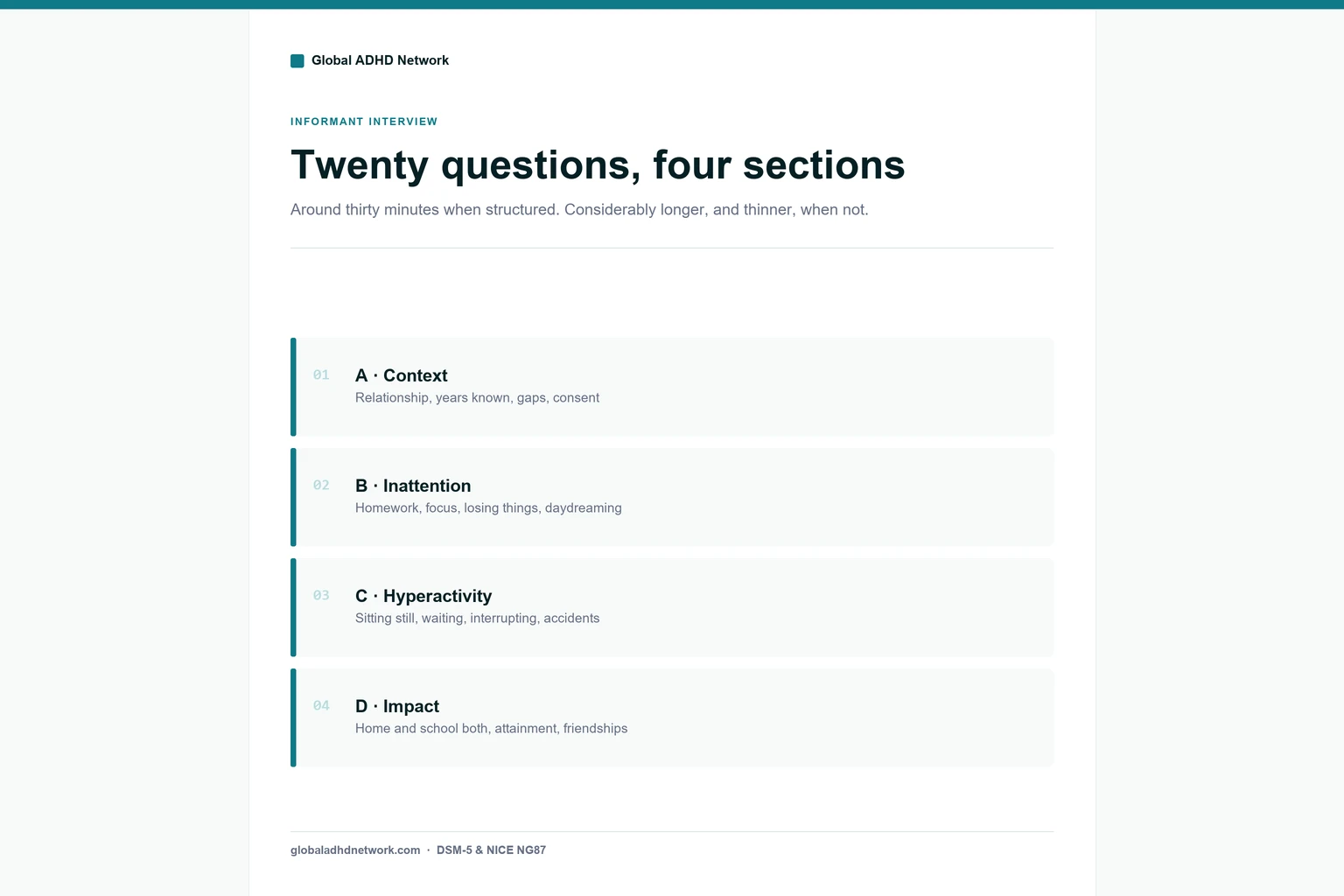
Twenty questions across four sections, in the order that works, with the follow-ups that turn an answer into evidence. Plus the three question patterns that reliably contaminate an account, and the family-history question that is not on the standard form but should be.
You have a parent on the phone, thirty minutes, and a forty-year-old's childhood to reconstruct. They are nervous, keen to help, and — if you ask the wrong way — will agree with almost anything you suggest.
These are the questions that work, in the order that works, with the follow-ups that turn an answer into evidence.
Who this is for
ADHD nurse specialists, who conduct most informant calls in most services
Consultant psychiatrists and clinical psychologists supervising or signing off the account
GPs with an extended role gathering collateral before onward referral
Trainees, for whom this is usually the first part of an assessment run alone
Before the questions: three sentences that change the answers
Parents frequently arrive at this call braced for judgement. They assume you are assessing their parenting, or that a diagnosis implies something they did wrong. A guarded informant gives you guarded answers.
Three things said at the start prevent most of it. That you are not assessing how their child was brought up. That you want examples rather than opinions. And that "I don't remember" is a genuinely useful answer — which it is, and which almost nobody believes until you say it.
Section A — establishing context (questions 1–4)
What is your relationship to them, and how old were you when they were born?
Which years of their childhood did you live with them, or see them regularly?
Were there periods you were less involved — work, separation, illness, another child?
Do you consent to what you tell me being recorded and used in the assessment?
Question three is the one clinicians skip and the one that most often changes how you weight everything afterwards. An informant who was working away for three years has a gap, and it is better to know where it is.
Section B — childhood inattention (questions 5–10)
What was homework like in your house?
How long could they stay with something they were not interested in?
Did their work come back with careless mistakes, or unfinished?
Did you find yourself repeating instructions?
How often were they losing things — PE kit, coats, lunchboxes? Roughly how many a year?
Did teachers ever describe them as daydreaming, or in their own world?
Question nine is deliberately quantified. "Did they lose things?" produces a shrug; asking for a count produces a number, and numbers go into reports. Question five is deliberately open — it produces a scene rather than a rating, and the scene usually covers three of the other items without you asking.
Section C — childhood hyperactivity and impulsivity (questions 11–15)
Could they sit through a meal?
What were long car journeys, waiting rooms or church like?
Were they climbing, running or fidgeting more than other children their age?
Did they talk over people, or answer before you had finished asking?
Were there accidents, A&E trips, or things done without thinking first?
Question fifteen is the most productive item on the list. Parents who cannot rate impulsivity on any scale will readily tell you about three trips to A&E before the age of ten, a broken arm from a shed roof, and a bicycle ridden into a parked car.
Question thirteen contains an explicit comparison — more than other children their age. Building the comparison group into the question is what makes it a developmental judgement rather than an absolute one.
Section D — impact across settings (questions 16–18)
Was this only at home, only at school, or both?
Did they achieve what you and their teachers expected of them?
Did any of it affect friendships, or cause trouble at home?
Question sixteen is doing double duty — it is Criterion C evidence as well as Criterion B evidence, and childhood is usually where cross-setting evidence is cleanest, because children cannot opt out of either context.
Section E — the two open prompts (questions 19–20)
How would you describe them as a child, in a few words?
What did teachers or school reports say about them?
These two produce more usable material than the eighteen structured items above them, and the answers should go into the report in quotation marks.
"Bright but never finished anything." "Away with the fairies." "A lovely boy who could have done so much better." Those phrases do more evidential work than any rating scale, because they are contemporaneous, unprompted and in somebody else's words.
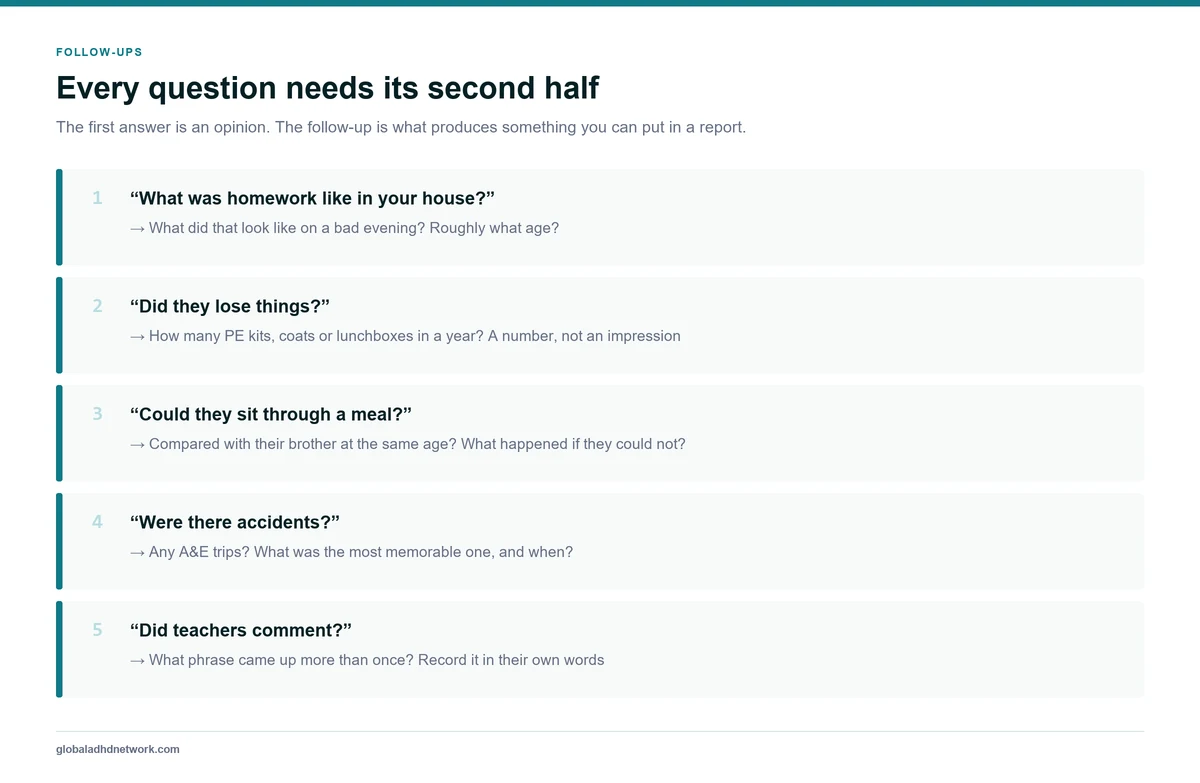
Every question needs its follow-up
The questions above are openings. What converts an answer into evidence is the same three follow-ups, used relentlessly:
What did that look like? Converts an endorsement into a scene.
Can you remember roughly when? Dates the example, and dated examples are far stronger.
Compared with their brother, or the other children in the class? Supplies the comparison group the criteria require.
An informant who endorses an item but cannot produce anything under those three follow-ups has given you a weak endorsement, and it should be recorded as one.
Questions not to ask
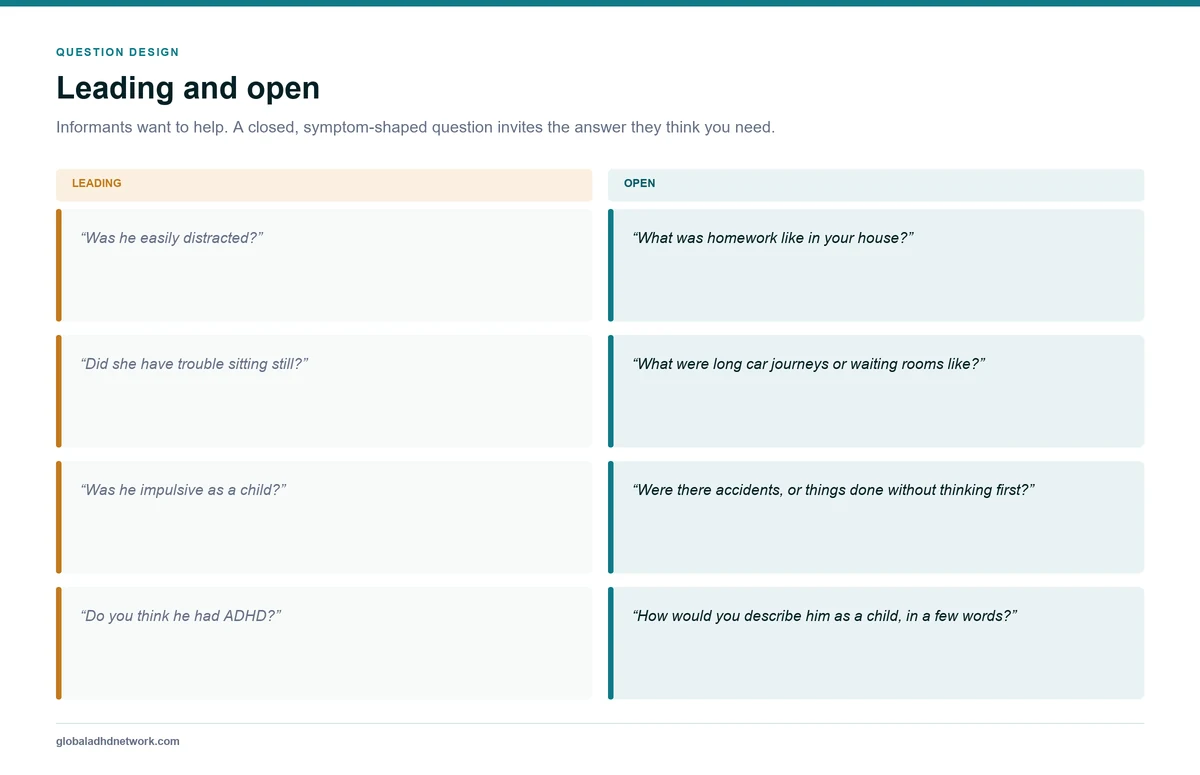
Three patterns that reliably contaminate the account.
Symptom-shaped closed questions. "Was he easily distracted?" invites a yes from a parent who wants their adult child to get an answer. Ask what homework was like instead, and let the distraction surface.
Diagnostic framing. "Do you think he had ADHD?" asks the informant to do your job, and their answer will be shaped by whatever they believe ADHD is.
Anything that implies a right answer. Informants read tone quickly. A question that sounds like it is expecting confirmation will get it.
It is also worth asking at least one question you expect a negative to. An informant who endorses everything, including the item you thought they would reject, is telling you about their expectations rather than the patient's childhood.
One family-history question worth adding
Not on the standard form, and worth including: has anyone else in the family been diagnosed, or wondered about it?
ADHD is substantially heritable, so a diagnosed sibling, parent or child raises the prior meaningfully. It also occasionally produces the most informative sentence of the call — the parent who says "well, he was no worse than I was" is offering reassurance and giving you something else entirely.
Related guides in this cluster
This article is part of GAN's collateral history cluster. Childhood evidence is the criterion most often queried, and each guide addresses a different way of establishing it.
Cluster pillar — The informant interview — gathering collateral history, and the six-section structure
This article is part of GAN's collateral history cluster. Childhood evidence is the criterion most often queried, and each guide addresses a different way of establishing it.
Cluster pillar — The informant interview — gathering collateral history, and the six-section structure
The order above is not arbitrary. Context first establishes what the informant can actually speak to, which determines how you weight everything afterwards. Inattention before hyperactivity, because inattentive items are harder to recall and benefit from a fresher informant. Impact after symptoms, because it requires the informant to have already been thinking about specifics. Open prompts last, because by then they have warmed up and will give you a fuller answer than they would have at minute two.
Asking the open prompts first, which feels natural, reliably produces "he was a lovely boy" and nothing else.
Recording the answers as you go
Three habits that make the difference between a call that produces evidence and one that produces an impression.
Write verbatim where the phrasing matters. Direct quotation is more persuasive than paraphrase and takes no longer. "Bright but never finished anything" in quotation marks does work that a summary cannot.
Date every example at the point you get it. "Around age seven" is worth considerably more than "in childhood", and the informant will not volunteer the age unless asked.
Mark the items where they could not remember. Not recalled is different from absent, and only one of those is evidence. A form with distinct markings for endorsed, not endorsed and not recalled is far more useful than a binary one.
Adapting for a non-parent informant
An older sibling, aunt or family friend needs the same twenty questions with two adjustments.
Spend longer on Section A. Their access to the period is more variable than a parent's, and establishing which years and which settings they can speak to is the difference between a usable account and a misleading one. An older sibling who left home when the patient was nine has a window with a hard edge.
And expect a different emphasis. Siblings often recall the family's response to the behaviour more clearly than the behaviour itself — who got shouted at, who was compared with whom, whose homework required supervision. That is useful evidence in its own right and worth pursuing rather than redirecting.
Interpreters and communication differences
Where the informant needs an interpreter, allow substantially more time — closer to forty-five minutes — and brief the interpreter beforehand that you need examples rather than summaries. Interpreters, reasonably, tend to compress, and compression removes exactly the specificity you are calling for.
Ask for the informant's own words to be rendered as closely as possible on the two open prompts. Those two answers are the ones that go into the report in quotation marks, and a paraphrase of a paraphrase is not worth quoting.
What to do with what you are told
The call produces material in three categories, and they should be handled differently in the record.
Endorsements with examples go into the report as evidence, with the example and, where possible, the age. These are what Criterion B is built from.
Endorsements without examples are recorded as endorsed but weak. They contribute to the overall picture and should not be presented as though they carry the same weight.
Not recalled is its own category and must not be silently converted into a negative. An informant who cannot remember whether homework was difficult has given you nothing, which is different from having said it was fine.
Services that use a form distinguishing all three consistently produce better Criterion B sections than those using a yes/no grid, because the yes/no grid forces every uncertainty into one of two boxes and loses the distinction permanently.
Closing the call
Two things at the end that are easy to skip and worth thirty seconds each.
Ask whether there is anything you have not asked about that they think matters. Informants frequently hold one specific memory they have been waiting to be asked for, and it is often the most vivid thing in the whole account.
And tell them what happens next — that their account forms part of the assessment, that they will not receive the report unless the patient shares it, and who to contact if they remember something later. Parents often ring back a week afterwards with a school report they found in a cupboard.
Frequently Asked Questions
What questions should you ask an informant in an ADHD assessment?
Cover four areas: context and consent, childhood inattention, childhood hyperactivity and impulsivity, and impact at home and school — closing with two open prompts about how they would describe the child and what school reports said.
How long should an informant interview take?
Around thirty minutes when structured against a consistent set of questions. Unstructured, it takes longer and yields less.
How do you avoid leading an informant?
Open the domain with an open question, ask for the example before accepting the endorsement, and build a comparison group into the question — 'compared with other children their age' rather than 'was he restless?'.
What if the informant cannot remember?
Record it as not recalled rather than as absent. Tell informants at the start that 'I don't remember' is an acceptable answer, or they will manufacture one.
Should the patient be present during the informant interview?
A separate conversation almost always produces a franker account. Parents say different things in front of their adult children.
%20(1).webp)