Global ADHD Network — One of the most highly reviewed ADHD CPD and CME training providers in ADHD diagnosis and neurodiversity training.Global ADHD Network — One of the most highly reviewed ADHD CPD and CME training providers in ADHD diagnosis and neurodiversity training.Global ADHD Network — One of the most highly reviewed ADHD CPD and CME training providers in ADHD diagnosis and neurodiversity training.
Running a DIVA-5 Remotely: Video Assessment Without Losing Diagnostic Validity
Most adult ADHD assessment now happens over video, and almost none of the guidance was written with that in mind. What transfers intact, the six observations you lose, how to compensate deliberately, and the one sentence about modality that stops a sceptical reader asking.
Most adult ADHD assessment in the UK now happens over video. Almost none of the guidance was written with that in mind, and the instruments certainly were not.
Remote assessment is not inherently weaker. Done carelessly it is considerably weaker, and the failure modes are specific and avoidable. This is what changes, what you lose, and what to put in the report so that nobody has to ask.
Who this is for
Consultant psychiatrists and clinical psychologists assessing remotely in private or NHS settings
Service leads writing the SOP that governs how remote assessment is done
Trainees, who may never have assessed anyone in person
What transfers without difficulty
The structured interview itself is largely unaffected. The DIVA-5 is a verbal instrument — you ask, the patient answers, you record. Nothing about that requires physical presence.
Some things are actively better. Patients are in their own environment, which reduces the artificiality that makes some people present atypically. Attendance improves substantially, which matters in a population with a high non-attendance rate for reasons directly related to the condition. Informants who live at a distance become far easier to include, and Criterion B evidence improves as a result.
The convenience is not a compromise. A patient who attends a remote assessment and would have missed an in-person one has had a better assessment, not a worse one.
What you actually lose
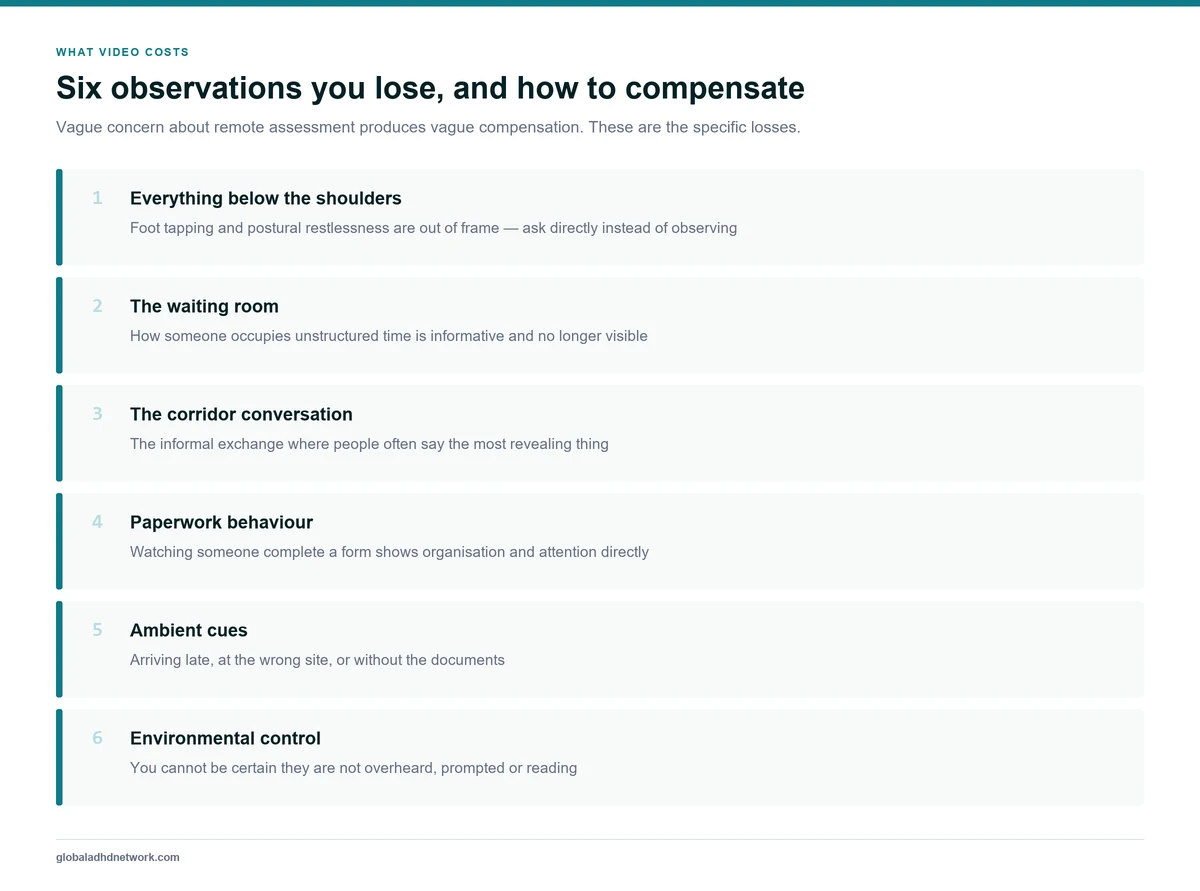
Six things, and it is worth being specific because vague concern produces vague compensation.
Everything below the shoulders. Foot tapping, leg bouncing, postural restlessness — a substantial part of observed hyperactivity is simply out of frame.
The waiting room. How someone occupies unstructured time before an appointment is informative and no longer available.
The corridor conversation. The informal exchange walking to the room, where people often say the most revealing thing of the appointment.
Paperwork behaviour. Watching someone complete a form tells you about organisation and attention directly.
Ambient cues. Arriving late, arriving with the wrong documents, arriving at the wrong site.
Environmental control. You cannot guarantee they are not being overheard, prompted, or reading.
Compensating deliberately
Ask the patient to sit back from the camera at the start so more of them is visible, framed as a technical request. Ask directly about restlessness rather than relying on observing it. Ask what the room they are sitting in looks like. And treat the practicalities of the appointment itself — whether they joined on time, whether they had the link, whether they found the pre-appointment form — as the observational data it is.
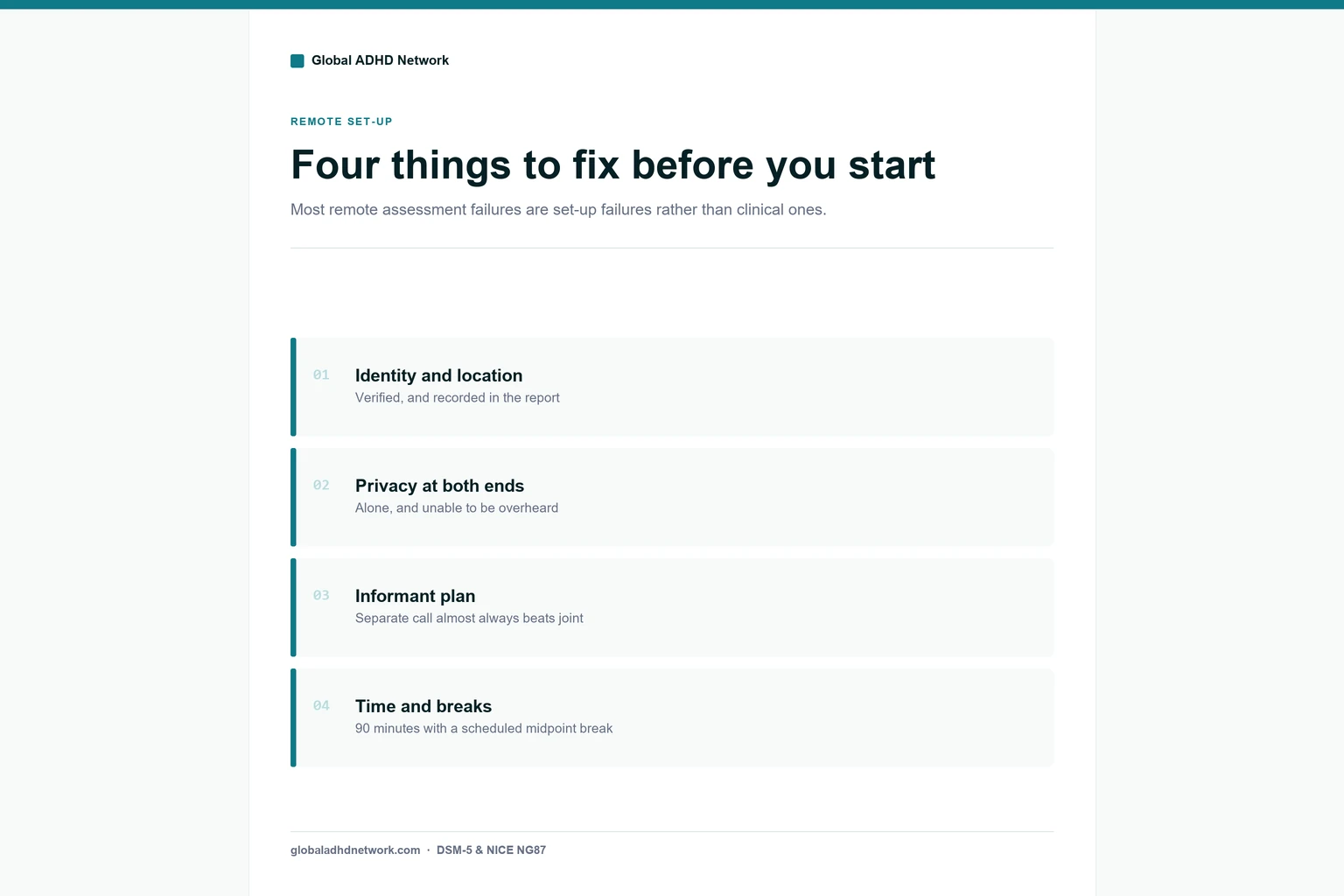
Set-up that prevents most problems
Identity and location
Verify identity at the start and record how. Confirm the patient's physical location — it matters for prescribing, for safeguarding, and for knowing which local services you can refer into if the assessment surfaces risk.
Privacy at both ends
Ask explicitly whether they are alone and whether they can be overheard. A patient in a parked car outside their workplace will not tell you about their marriage. If they cannot secure privacy, rebook rather than proceed.
Who else is in the room
Establish this at the start, and check again if the patient's answers change character. A partner sitting off-camera changes what is said, and patients frequently do not think to mention it.
Contingency
Agree in advance what happens if the connection fails — a phone number, and a rule about how long you will try before rebooking. Fifteen minutes lost to reconnection attempts is fifteen minutes taken from the childhood history.
Fatigue is the underrated problem
Ninety minutes of sustained video is harder than ninety minutes in a room, for everyone, and disproportionately harder for the population you are assessing.
A patient visibly struggling to sustain attention at minute seventy is generating observational data — but they are also giving you worse answers, and the two are difficult to separate. Build in a five-minute break at the midpoint as standard rather than as a concession. Consider splitting the assessment across two shorter appointments where the presentation is complex; the evidence quality is better and patients strongly prefer it.
The informant call
Remote working makes informant contact easier, and this is the largest single quality gain available.
One decision worth making deliberately: whether the informant joins the same call. A three-way video is efficient and produces a noticeably more guarded account — parents say different things in front of their adult children. A separate call costs another slot and is almost always better evidence. Our collateral history guide covers the structure.
Recording it in the report
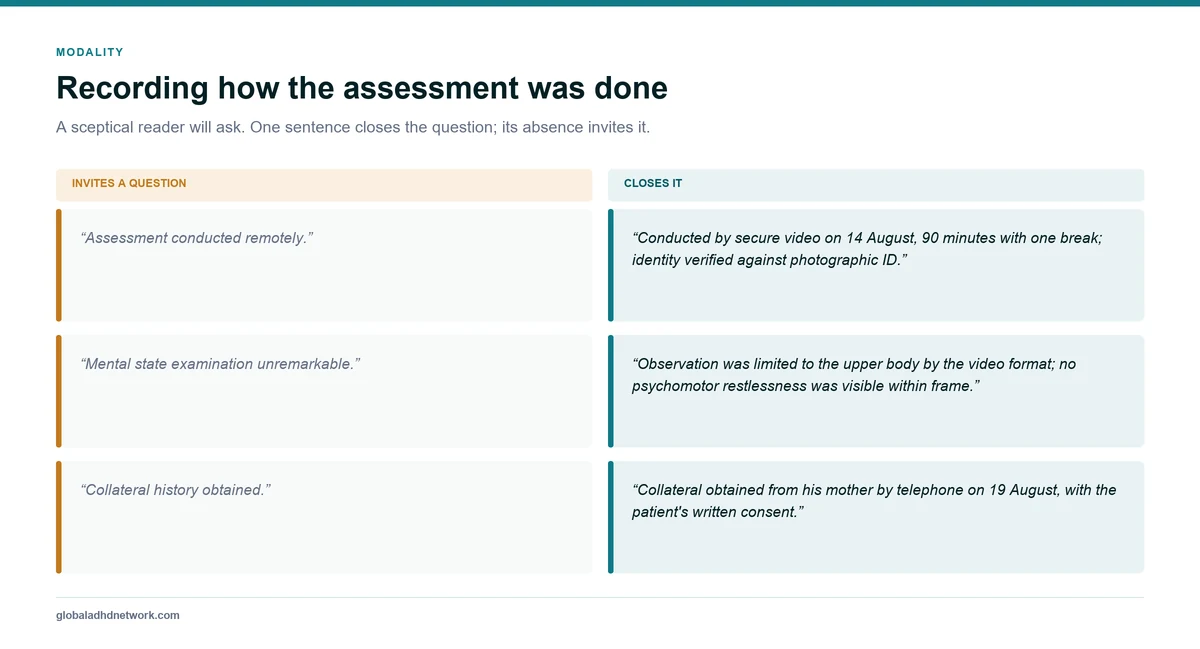
A sceptical reader will want to know how the assessment was conducted, particularly where the diagnosis was made privately. One sentence closes the question, and its absence invites it.
The assessment was conducted by secure video on 14 August, lasting ninety minutes with one break. Identity was verified against photographic ID at the start. The patient confirmed she was alone and in a private room. Collateral history was obtained from her mother by telephone on 19 August with written consent.
Where observation was limited, say so plainly rather than writing a mental state examination that implies more than you saw. "Observation was limited to the upper body by the video format" is a stronger sentence than a confident account of psychomotor activity you could not see.
Remote assessment and the quality question
Remote ADHD assessment has been the subject of sustained public criticism, some of it fair. The criticism has rarely been about video as a medium — it has been about short appointments, absent childhood histories, and diagnoses made without corroboration.
A ninety-minute remote DIVA-5 with a separate informant call and a criterion-structured report is a better assessment than a rushed in-person one, and services should be willing to say so. What makes it defensible is documenting the things that were done, which is precisely what a hurried service omits. GAN's guidance on service governance and quality standards covers the wider expectations, and private clinic red flags sets out what poor practice looks like from the outside.
Related guides in this cluster
This article is part of GAN's structured interview cluster, covering instrument choice, scoring judgement, remote delivery and time pressure.
The part of remote assessment least often planned for, and the part most likely to matter when it does.
ADHD assessment surfaces risk more often than clinicians new to the field expect — self-harm, suicidality, substance use, domestic abuse, and financial crisis all appear in the impairment history with some regularity. In a clinic you know where the patient is, you have colleagues, and you have a local pathway. On video you may have none of these unless you prepared.
Establishing physical location at the start is not bureaucracy. It determines which crisis team, which local authority and which police force are relevant, and asking for it mid-crisis is considerably harder than asking for it at minute two. Record a contact number that is not the video platform, and know your service's escalation route before you need it.
Where a patient discloses significant risk, the assessment stops being the priority. Say so plainly, deal with the risk, and rebook. An assessment completed on autopilot after a serious disclosure serves nobody.
Accessibility cuts both ways
Remote assessment is often framed as an accessibility gain, and for many patients it is — no travel, no unfamiliar building, no waiting room, and attendance rates that are markedly better in a population with good reason to struggle with appointments.
For others it is a barrier. Patients without reliable connectivity, without a private space, with limited digital confidence, or who find video interaction itself effortful are disadvantaged by a remote-only pathway. That group overlaps substantially with the group least well served already.
The defensible position is choice rather than default. Where a service can only offer remote assessment, it should at least ask whether the format is workable for this patient and record the answer, and it should have a route for people for whom it plainly is not.
Prescribing and physical monitoring
One practical constraint that catches services out: a remote assessment can establish a diagnosis, but titration requires baseline physical observations — height, weight, pulse and blood pressure at minimum, and cardiovascular history taken properly.
Decide in advance who does this and where. Options are a local practice, a community clinic, or patient-recorded readings with a validated device, each with different reliability. What does not work is discovering at the point of prescribing that nobody has a blood pressure reading, which is a common cause of avoidable delay between diagnosis and treatment.
Say in the report what physical monitoring has and has not been done, and what the prescriber will need. It is the difference between a GP who can act on the document and one who has to write back.
Training a team to assess remotely
Clinicians who trained in person often assume remote assessment is the same interview through a screen, and it is not quite. Three skills need explicit attention.
Managing silence. Pauses feel longer on video, and clinicians fill them. Filling a pause is how you end up asking a leading question. The discipline is to wait as long as you would in a room, which feels considerably longer.
Reading a reduced signal. With less non-verbal information available, verbal cues carry more weight — hesitation, self-correction, changes in fluency when a topic becomes uncomfortable. These are learnable and worth naming in supervision.
Holding the structure visibly. Patients cannot see your form, so they cannot see the shape of the appointment. Narrating it — “we are about halfway, next I want to ask about childhood” — reduces the drift that makes remote assessments overrun.
Frequently Asked Questions
Is a remote ADHD assessment as valid as an in-person one?
A structured interview such as DIVA-5 transfers well to video because it is verbal. What is reduced is direct observation, particularly of whole-body restlessness. Where the limitation is compensated for and documented, remote assessment is defensible.
Does NICE NG87 allow remote ADHD assessment?
NG87 specifies the content of assessment rather than the medium. It requires a full clinical and psychosocial assessment, developmental and psychiatric history, and evidence of impairment across settings — none of which is modality-specific.
How long should a remote ADHD assessment take?
The same 60 to 90 minutes as in person, with a scheduled break. Splitting into two shorter appointments is often better for complex presentations.
Should the informant join the same video call as the patient?
A separate call almost always produces a franker account. A joint call is more efficient but changes what a parent will say in front of their adult child.
What should a report say about remote assessment?
The modality, the duration, how identity was verified, whether the patient was alone and private, any limits on observation, and how the informant was contacted.
%20(1).webp)