Global ADHD Network — One of the most highly reviewed ADHD CPD and CME training providers in ADHD diagnosis and neurodiversity training.Global ADHD Network — One of the most highly reviewed ADHD CPD and CME training providers in ADHD diagnosis and neurodiversity training.Global ADHD Network — One of the most highly reviewed ADHD CPD and CME training providers in ADHD diagnosis and neurodiversity training.
DIVA-5 vs ACE+ vs CAADID: Choosing a Structured ADHD Interview for Your Service
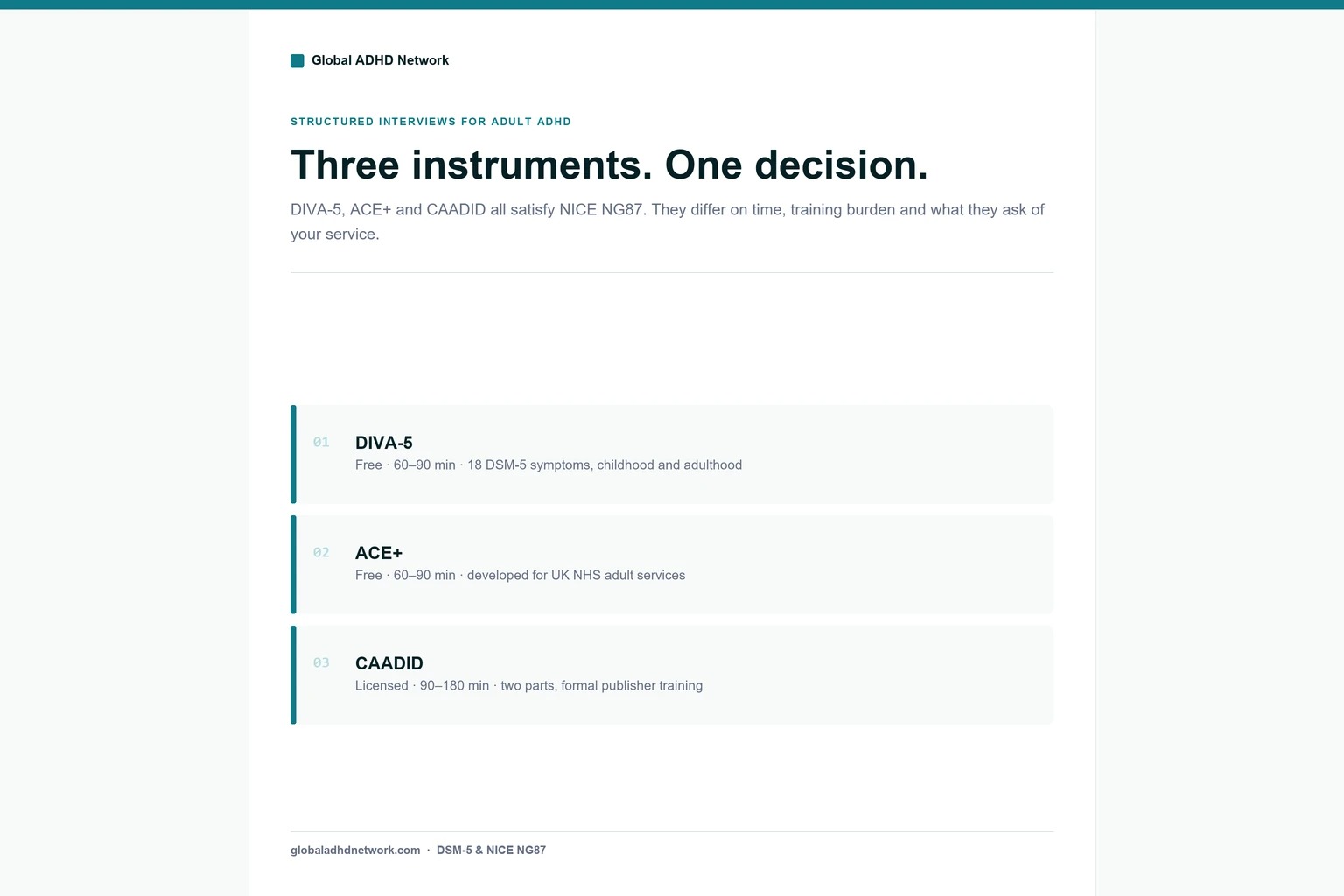
DIVA-5, ACE+ and CAADID all satisfy NICE NG87, so the choice is operational rather than clinical: cost, duration, training burden, and how hard each pushes on childhood evidence. Which one fits a general adult service, an established NHS team, and medico-legal work.
The question usually arrives sideways. A service is expanding its adult ADHD pathway, someone asks what everyone should be using, and it turns out three clinicians are doing three different things — one running a full DIVA-5, one working from a symptom checklist and clinical judgement, one using something they were taught in a previous job and cannot entirely remember the name of.
Standardising is worth doing, and the choice matters less than most people expect. All three of the instruments below will satisfy NICE NG87. None of them will make a diagnosis for you. What they differ on is time, cost, training burden, and how much structure they impose on the parts of the assessment clinicians most often rush.
Who this comparison is for
This is written for the people who choose, administer and govern the instrument:
Service leads and consultant psychiatrists setting a standard across an adult ADHD pathway.
ADHD nurse specialists, who in many services carry the largest share of structured interviews — see ADHD assessor training for nurses.
GPs with an extended role, who need to know what a defensible assessment looks like even where they are not the diagnosing clinician.
Trainees being handed a form and a ninety-minute slot for the first time.
What a structured ADHD diagnostic interview is for
Worth stating, because it shapes the comparison.
A structured interview does not detect ADHD. It stops you skipping things. Left to unstructured clinical judgement, even experienced assessors reliably do three things:
Spend most of the appointment on whichever domain the patient raised first
Under-probe childhood, because the adult picture is more vivid and easier to discuss
Collect impressions rather than examples, which is fine in the room and useless in the report
Every instrument here exists to prevent that. They are scaffolding for evidence collection, and the quality of the assessment still rests on what you write in the boxes.
That is also why the choice is less consequential than it feels. A well-run ACE+ beats a rushed DIVA-5 every time.
DIVA-5: the Diagnostic Interview for ADHD in Adults
The Diagnostic Interview for ADHD in Adults, now in its fifth edition, maps directly onto the DSM-5 criteria. Eighteen symptoms, each assessed twice — once for childhood, once for adulthood — with a concrete real-life example recorded for both. It then works through five domains of functional impairment: work and education, relationships and family, social contacts, free time and hobbies, and self-confidence and self-image.
It is free from the DIVA Foundation, available in a large number of languages, and takes sixty to ninety minutes.
Cost — free
Duration — 60 to 90 minutes
Childhood evidence — parallel columns, so a gap is immediately visible
Training — usable after reading the manual, considerably better with training
Its main strength is the informant column. DIVA-5 does not treat collateral history as an optional extra — the structure expects it, which means clinicians using it are considerably less likely to arrive at the report with Criterion B unevidenced. For a service that has been getting queries on childhood onset, adopting DIVA-5 often fixes the problem on its own.
Where DIVA-5 costs you
Its main weakness is length. Ninety minutes is a genuine constraint in a pressured service, and the temptation to abbreviate is where most of the value leaks out. We have covered the full administration in the DIVA-5 training guide, and the harder cases in DIVA-5 with complex presentations.
ACE+: the Adult ADHD Clinical Diagnostic Scale
The Adult ADHD Clinical Diagnostic Scale, in its extended form, covers the same DSM-5 ground with prompts written in language closer to how UK clinicians and patients actually speak. It is free, and runs to a similar sixty to ninety minutes.
Where ACE+ is strongest
Its main strength is fit. Teams that have tried both often report that ACE+ produces less friction in the room — the phrasing feels less like reading from a form. For services where clinicians have been resistant to structured tools, that matters more than any feature comparison suggests.
Where ACE+ needs supplementing
Its main weakness is that it is less prescriptive about childhood corroboration than DIVA-5. That is not a flaw in the instrument so much as a gap you have to fill deliberately. If you adopt ACE+, pair it with a structured informant form so that Criterion B does not depend on clinician memory.
CAADID: the Conners' Adult ADHD Diagnostic Interview
The Conners' Adult ADHD Diagnostic Interview for DSM-IV is the outlier here, and the most demanding. It comes in two parts: a detailed history covering developmental, medical, academic and family background, and a symptom checklist working through the criteria.
It is commercially licensed, expects formal training, and takes ninety minutes to three hours depending on complexity.
Where CAADID earns its cost
Its main strength is defensibility. When an assessment is going to be examined line by line — tribunal work, medico-legal instruction, research protocols — the formal training requirement and the depth of the developmental history are worth what they cost. The document it produces is harder to attack.
Where CAADID is hard to justify
Its main weaknesses are cost and duration, and the fact that it is anchored to DSM-IV. In practice most services using it map forward to DSM-5 criteria in the report, which is workable but is one more thing to get right and to explain.
Where DIVA-5, ACE+ and CAADID genuinely differ
All three cover the same eighteen DSM-5 symptoms, because all three are built on the same criteria. Anyone comparing them on symptom coverage is comparing them on the thing they cannot differ about.
The real differences sit in four places.
How hard the form pushes for an example. DIVA-5 gives you a column for it and the column looks wrong when empty. That sounds trivial and is not — form design changes clinician behaviour more reliably than training does.
How childhood is handled. DIVA-5 assesses every symptom twice, in parallel columns, so a gap in the childhood column is visible immediately. CAADID handles it through a separate developmental history, which is more thorough but easier to leave thin under time pressure. ACE+ leaves more to the clinician.
How impairment is structured. DIVA-5's five life domains are the most explicit treatment of Criterion D in any of the three, and they are useful enough that clinicians using other instruments often borrow them.
What the finished document looks like. A completed CAADID is a substantial record in its own right. A completed DIVA-5 or ACE+ is working notes that you then write up. If your governance process involves anyone reading the raw interview record, that difference matters.
DIVA-5 vs ACE+ vs CAADID compared side by side
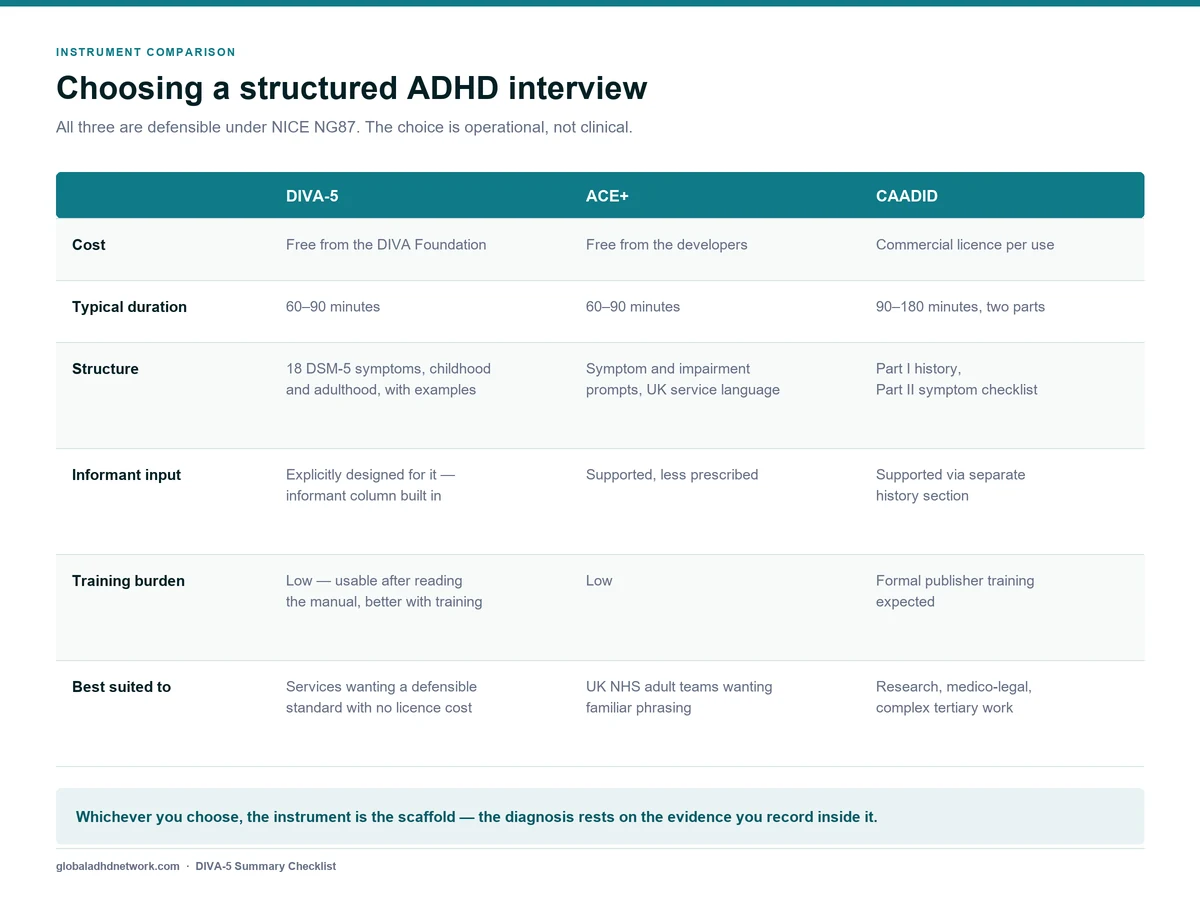
The differences that actually change a service decision are cost, duration, how hard the instrument pushes on childhood evidence, and how much training your team needs before they can use it properly.
In summary:
Cost — DIVA-5 and ACE+ free; CAADID licensed per use
Duration — DIVA-5 and ACE+ 60 to 90 minutes; CAADID 90 to 180 across two parts
Childhood evidence — DIVA-5 most prescriptive; CAADID most thorough; ACE+ most clinician-dependent
Training — only CAADID formally expects it
Best fit — DIVA-5 for general adult services; ACE+ for established NHS teams; CAADID for medico-legal and research
On cost: two of the three are free. Unless you have a specific reason to license CAADID, that is close to decisive for a service running volume.
On duration: DIVA-5 and ACE+ are broadly equivalent. CAADID is materially longer, and in a service with a waiting list that is a capacity decision as much as a clinical one.
On childhood evidence: DIVA-5 is the most prescriptive, CAADID the most thorough, ACE+ the most dependent on the clinician remembering to ask.
On training: all three are better administered by someone trained, but only CAADID formally expects it. That said, "usable after reading the manual" and "used well" are different standards — the most common failure across all three instruments is a clinician who records the rating and not the example.
Which ADHD diagnostic interview fits your service
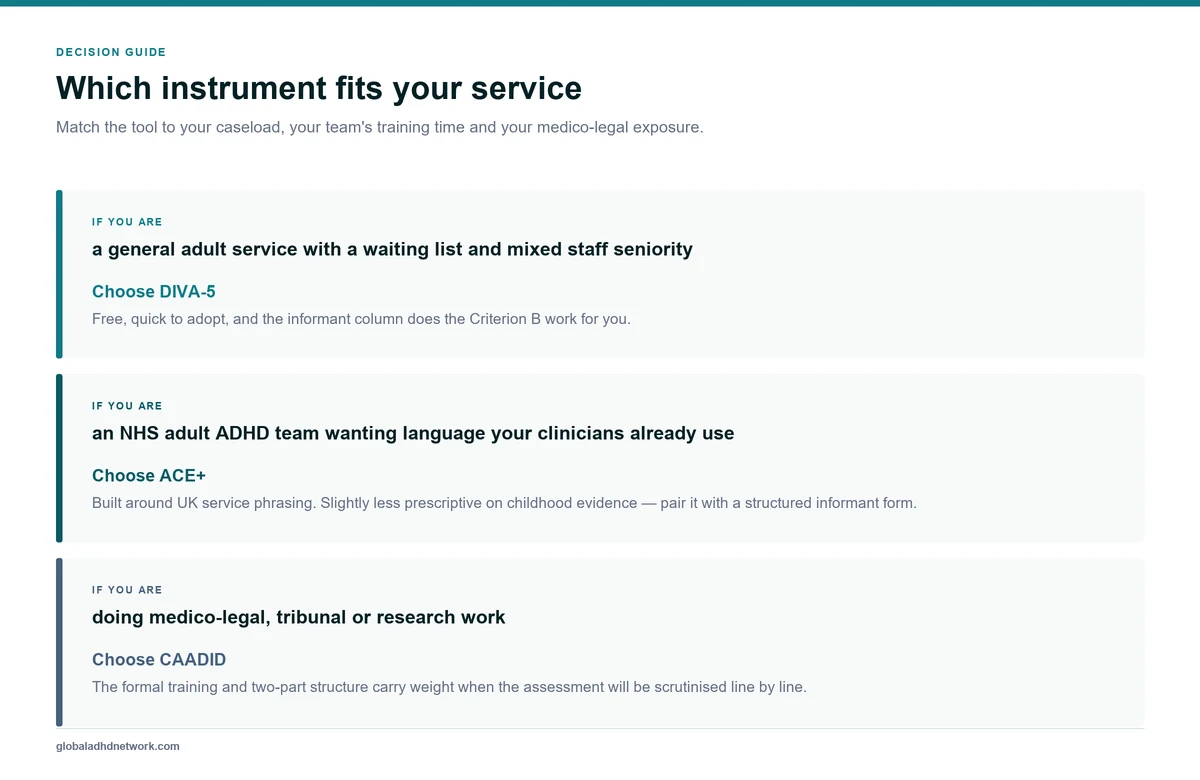
A general adult service with a waiting list and mixed staff seniority should default to DIVA-5. Free, quick to adopt, and the informant structure does the Criterion B work that inexperienced assessors most often miss.
An established NHS adult ADHD team might reasonably prefer ACE+ for its language and lower friction, provided a structured informant process sits alongside it.
Medico-legal, tribunal or research work justifies CAADID. If your reports are going to be contested, the training requirement stops being a cost and starts being a credential.
A service doing all three kinds of work should pick one as standard and allow a documented exception, rather than leaving it to individual preference. Inconsistency between clinicians in the same service is harder to defend than any of these instruments individually.
What no structured ADHD interview can do for you
Three limitations apply equally across all three, and are worth naming before a service treats any of them as a solution.
None of them handle masking. A structured interview asks whether a symptom is present. It has no mechanism for detecting the adult who has built an elaborate compensatory architecture — the person with four alarms, a partner who manages the calendar, and a job chosen specifically because it has no admin. Answer the questions literally and that person can fall below threshold. The instrument will not flag it. You have to ask what it costs them to function, and that question is not on any of these forms.
None of them replace clinical adjuncts. A QbTest or similar computerised task adds supporting information about activity and attentional performance, but sits alongside the interview rather than inside it.
None of them resolve differential diagnosis. They establish whether ADHD criteria are met, not whether something else explains the picture better. Anxiety, trauma, sleep disorder and autism all need separate consideration, and Criterion E is the clinician's work regardless of instrument.
None of them are validated as self-completion tools. All three are clinician-administered, and the semi-structured element — the follow-up question, the request for an example, the noticing that an answer does not fit — is where the diagnostic value sits. Sending a DIVA-5 to a patient to fill in before the appointment converts a diagnostic interview into a long questionnaire.
Administering a structured ADHD interview remotely
Most private assessment and a growing share of NHS assessment now happens over video, and the instrument choice interacts with that more than the manuals acknowledge.
DIVA-5 and ACE+ both transfer well. The interview is verbal, the clinician holds the form, and nothing depends on being in the room. CAADID's longer format is harder over video simply because ninety minutes to three hours on a video call is difficult for anyone, and particularly difficult for the population being assessed.
Two practical adjustments help across all three. Build in breaks — a patient who is visibly struggling to sustain attention on a video call at minute seventy is generating observational data, but they are also giving you worse answers. And decide in advance how you will handle the informant: a three-way call is efficient but changes what a parent will say in front of their adult child, and a separate call is almost always the better evidence even though it costs another slot.
Note the modality in the report. It is a legitimate question from a sceptical reader, and a single sentence closes it.
Standardising the process around your chosen ADHD interview
The instrument is the smaller half of the decision. Three things matter at least as much, and none of them come in the box.
A consistent informant process. Who invites the informant, when, using what wording, recorded on what form. This is where most services lose Criterion B, regardless of instrument.
A consistent report structure. Two clinicians running the same interview and producing structurally different reports is a governance problem waiting to be found — ADHD training governance and quality standards covers what auditors tend to look for.
Recording examples, not ratings. Every instrument here asks for a concrete example. Every instrument here can be completed without one, in about half the time. That shortcut is the single biggest determinant of report quality, and no choice of tool prevents it.
Rolling out a structured ADHD interview across a clinical team
Choosing the instrument takes an afternoon. Getting six clinicians to administer it consistently takes considerably longer, and it is the part most services underestimate.
What works, in roughly this order:
Run one together before anyone runs one alone. A single observed or joint assessment surfaces more variation than any amount of manual-reading. Clinicians are routinely surprised by how differently a colleague probes the same item.
Agree what counts as an adequate example. This is the single largest source of inconsistency. "Sometimes loses things" and "replaced four sets of keys this year" are both recorded in the same box, and only one of them is evidence. Write down two or three worked examples and circulate them.
Sample completed forms, not just reports. Reports are polished. The interview record shows what actually happened in the room, including the columns nobody filled in.
Set a threshold for escalation. Decide in advance which presentations get a second opinion — significant diagnostic uncertainty, suspected co-occurring autism, complex psychiatric history, medico-legal context.
Mixed-profession teams need one extra step. A consultant psychiatrist, a nurse specialist and a trainee will each bring different assumptions about what counts as sufficient probing, and seniority tends to suppress the question. Make the calibration explicit rather than hoping it settles — GAN's training for psychologists and for nurses cover the same standard from each professional starting point.
Budget the time honestly. A team moving from unstructured assessment to a structured instrument will be slower for the first month and better from the second. Services that abandon the change usually do so in week three.
Switching ADHD assessment instruments mid-pathway
One practical point that comes up whenever a service standardises. Patients already part-way through assessment do not need to be reassessed from scratch. Complete their pathway on the instrument they started, note in the report which was used, and apply the new standard to new referrals from a stated date.
Do document the changeover date somewhere findable. When someone audits a year's reports and finds two instruments in use, the answer "we changed in March, here is the note" is a complete answer. Not having one turns a sensible decision into an apparent inconsistency.
Frequently Asked Questions
Is DIVA-5 free?
Yes. The full DIVA-5 is available at no cost from the DIVA Foundation at divacenter.eu, in a wide range of languages.
Does NICE recommend a specific ADHD diagnostic interview?
No. NG87 requires a full clinical and psychosocial assessment, developmental and psychiatric history, and evidence of impairment across settings. It does not mandate a named instrument, so the choice is a service decision.
Can a nurse or psychologist administer DIVA-5?
Yes, where they have appropriate training and expertise. NG87 restricts the diagnosis itself to a specialist psychiatrist, specialist nurse prescriber, or another appropriately qualified professional with training and expertise in diagnosing ADHD.
How long does a DIVA-5 take?
Sixty to ninety minutes for the interview alone, excluding informant contact, records review and report writing.
Is CAADID worth the licence cost?
In medico-legal, tribunal or research contexts, usually yes — the formal training and depth of developmental history carry weight under scrutiny. For routine clinical assessment in a busy service, the free instruments are equally defensible.
Can a structured ADHD interview be completed by the patient in advance?
No. All three are clinician-administered, and the semi-structured element is where the diagnostic value sits — the follow-up question, the request for a concrete example, the noticing that an answer does not quite fit. Sending the form ahead turns a diagnostic interview into a questionnaire. Sending a separate screening tool such as the ASRS in advance is a different matter and is good practice.
%20(1).webp)