Global ADHD Network — One of the most highly reviewed ADHD CPD and CME training providers in ADHD diagnosis and neurodiversity training.Global ADHD Network — One of the most highly reviewed ADHD CPD and CME training providers in ADHD diagnosis and neurodiversity training.Global ADHD Network — One of the most highly reviewed ADHD CPD and CME training providers in ADHD diagnosis and neurodiversity training.
The DIVA-5 in Sixty Minutes: A Time-Saving Structure for Pressured Services
The instrument takes 60 to 90 minutes and your clinic template says 50. Where the time actually goes, which savings are safe, which shortcuts quietly remove the diagnosis, and why the fix is redesigning the template rather than compressing the appointment itself.
The DIVA-5 takes sixty to ninety minutes. Your clinic template says fifty, the waiting list is eighteen months long, and the pressure to compress is not going to be argued away by pointing at the manual.
So this is the practical version. Where the time actually goes, which parts compress without damage, and which shortcuts quietly remove the thing you were doing the assessment for.
Who this is for
Service leads setting clinic templates against a waiting list
ADHD nurse specialists carrying the highest assessment volume in most services
Consultant psychiatrists and clinical psychologists balancing throughput against defensibility
GPs with an extended role working in shorter appointment structures than secondary care
Where the time actually goes
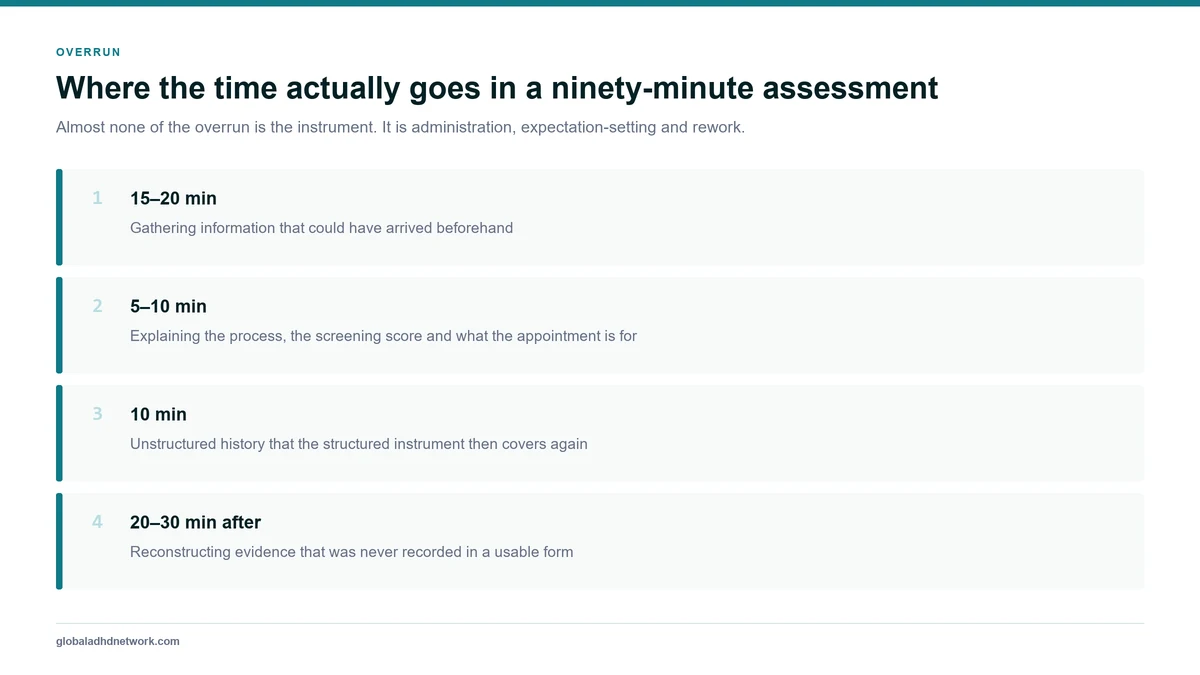
Time an overrunning assessment and the pattern is consistent. The interview is not the problem.
15–20 minutes gathering information that could have arrived beforehand
5–10 minutes explaining the process, screening scores and what the appointment is for
10 minutes of unstructured history that the structured instrument then covers again
Post-appointment, another 20–30 reconstructing evidence that was not recorded in a usable form
Almost none of that is the DIVA-5. It is administration, expectation-setting and rework, and all three can be moved.
The sixty-minute structure
0–10 · Orientation and framing
Confirm consent and identity. State what the appointment is and is not — an assessment, not a confirmation — and what will happen afterwards. Explain that you will ask for specific examples and that "I don't know" is an acceptable answer. This ten minutes prevents a much longer conversation later.
10–30 · Adult symptoms
Work the eighteen items for adulthood. Move briskly through clear negatives; spend your time on the endorsements, where the example matters. A practised clinician covers both domains in twenty minutes when they are not also explaining the instrument.
30–45 · Childhood
This is the segment most often squeezed and the one that must not be. Fifteen minutes is enough if you are anchoring to school years and specific memories rather than asking open questions about a decade.
45–60 · Impairment and close
The five domains, then the summary and next steps. Impairment goes faster than expected when you ask for consequences rather than ratings, because consequences are concrete and patients recall them readily.
Safe savings
Move preparation out of the room
Screening tool completed in advance, records requested at referral, informant identified before the appointment. This is the single largest saving available and it costs the clinician nothing — see the full assessment pathway for what to gather.
Record in the form the report needs
Writing the report from a criterion-structured record takes a fraction of the time that writing it from narrative notes does. The saving is in the twenty to thirty minutes afterwards, and it improves the report at the same time.
Take the informant call separately
Counter-intuitively, this saves appointment time rather than adding to it. It removes the childhood corroboration from the sixty minutes, produces a franker account, and can be done by phone at a time that suits the informant.
Use the negatives
Not every item needs equal time. A clear negative can be recorded in seconds. Clinicians who run long often give the same weight to every cell in the grid.
Shortcuts that cost you the diagnosis
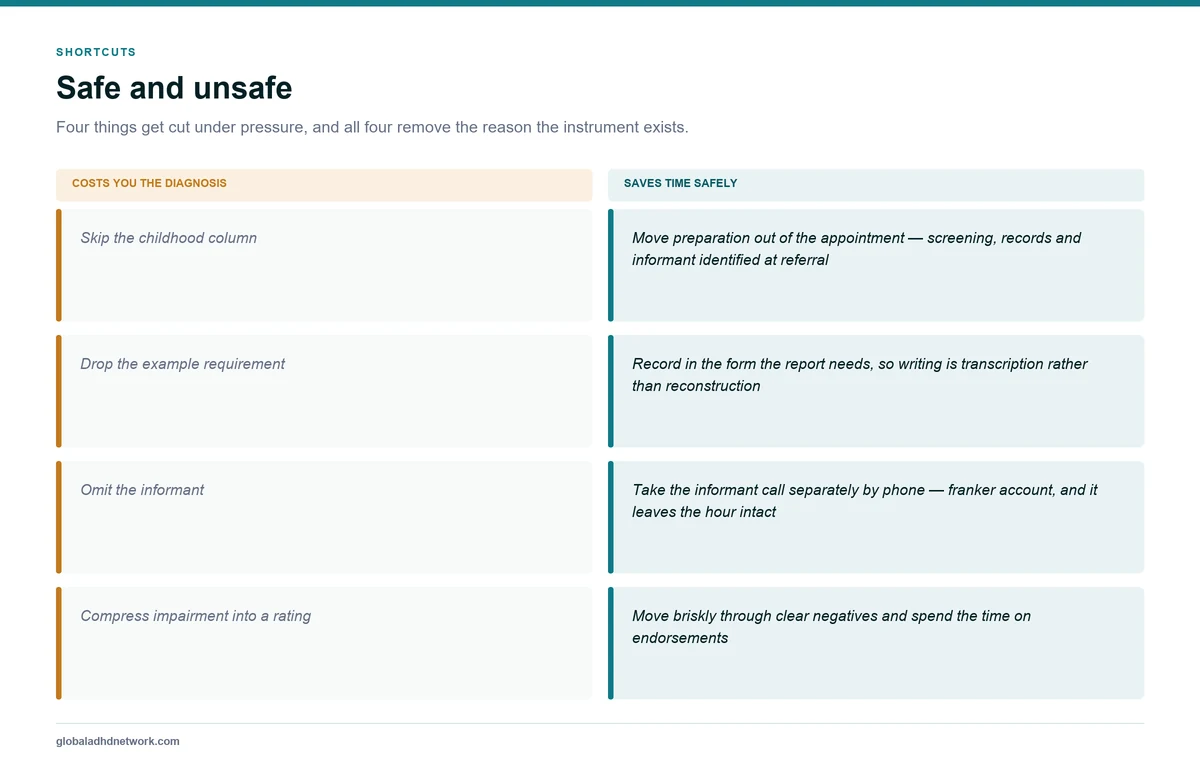
Four things get cut under pressure, and all four remove the reason the instrument exists.
Skipping the childhood column. This is not a time saving; it is the removal of Criterion B. It is also the single most common reason a report is queried.
Dropping the example requirement. Halves the interview time and removes the mechanism that distinguishes a real endorsement from an agreement.
Omitting the informant. Saves nothing in the appointment and costs the corroboration.
Compressing impairment into a rating. Saves five minutes and produces a Criterion D section a reader cannot use.
Each of these converts a defensible assessment into one that looks defensible until someone reads it closely.
When sixty minutes genuinely is not enough
Some assessments cannot be done in an hour, and recognising them in advance is better than discovering it at minute fifty-five.
Suspected co-occurring autism, significant psychiatric or trauma history, substantial substance use, an interpreter, a patient with communication differences, or a presentation where the differential is genuinely open — all of these need more time, and triage at referral can identify most of them.
The honest answer in those cases is a two-part assessment rather than a compressed one. Patients tolerate two appointments considerably better than one rushed session, and the evidence quality is not comparable.
The system context
None of this solves the underlying problem, and it is worth naming that. UK ADHD services are dealing with demand that vastly exceeds capacity — a backlog measured in years rather than months, and one that will not be cleared by clinicians working faster.
What efficiency in the room can do is stop quality being the variable that absorbs the pressure. An assessment that is shorter because the preparation was better is a legitimate response to capacity constraint. An assessment that is shorter because the childhood history was skipped is a different thing, and it will surface later — as a query, a second opinion, or a diagnosis that does not survive scrutiny.
Related guides in this cluster
This article is part of GAN's structured interview cluster, covering instrument choice, scoring judgement, remote delivery and time pressure.
Redesigning the clinic template, not just the appointment
Most of what makes a sixty-minute assessment possible is decided before the clinician sees the patient, which means the intervention is a service design one rather than a personal efficiency one.
Four template changes account for most of the available gain.
Separate the informant slot. A thirty-minute telephone slot, bookable independently, taken by whoever is available. It does not need to be the assessing clinician, provided the record is structured.
Front-load administration. Screening, records requests and consent handled by administrative staff at referral rather than by a clinician at the appointment.
Protect writing time in the same session block. Twenty minutes immediately after the assessment is worth forty a week later, because the specific detail is still available.
Build a triage step. Five minutes at referral to identify the assessments that will not fit in an hour, so they can be booked correctly rather than discovered mid-appointment.
None of these require additional clinical time. Three of them release it.
What to do when the assessment is running over
It will happen anyway, and the decision made at minute fifty determines the quality of the report.
The instinct is to speed up and finish. That is almost always the wrong call, because the segment remaining is usually impairment or childhood — the two sections a reader will scrutinise. Rushing them produces a completed form and an unusable evidence base.
The better move is to stop at a clean boundary and rebook the remainder. Tell the patient what you have covered, what remains, and when. Most people find this reassuring rather than frustrating: it signals that the assessment is thorough rather than transactional, which is precisely what someone who has waited eighteen months wants to hear.
Where rebooking genuinely is not possible, prioritise childhood over impairment. Criterion B evidence is harder to reconstruct afterwards than Criterion D evidence, which can often be filled in by a follow-up call.
Efficiency is not the same as speed
A closing distinction that is worth holding onto when the pressure is on.
An efficient assessment removes waste — repeated questions, information gathered in the wrong place, evidence recorded in a form that has to be reworked. A fast assessment removes content. The first improves the report; the second degrades it while looking identical on the clinic template.
Services under pressure tend to reach for the second because it is available immediately and requires nobody's agreement. The first takes an afternoon of redesign and then pays out on every assessment thereafter. Given that UK ADHD services are facing waiting times measured in years, the redesign is the better investment by a wide margin.
Measuring whether it worked
If a service redesigns around a sixty-minute assessment, four numbers tell you whether the change improved anything or simply moved the pressure.
Assessment overrun rate — the proportion of appointments exceeding the booked slot
Two-stage rate — assessments requiring a second appointment to complete, which should fall if preparation improved and rise if the hour is genuinely too short
Report turnaround — days from assessment to signed report, the best proxy for whether recording is happening in a usable form
Query rate — reports returned by an ICB, GP or second clinician, which is the only number that tells you whether quality held
The last of these is the one to watch. A service that cuts appointment length and sees its query rate climb has not found an efficiency; it has moved work downstream and added a delay for the patient at the same time.
Protecting the childhood segment
If a service adopts one rule from this article, make it this: the childhood segment is ring-fenced.
Everything else in the assessment can be recovered afterwards. Impairment can be filled in by a follow-up call. A differential can be reasoned from the notes. The symptom count can be checked. Childhood evidence, once the appointment has ended and the informant has not been contacted, requires a whole new piece of work to obtain.
That asymmetry should drive the timing decision every time. Where an assessment is running short, take the childhood history and rebook the rest. Where a clinician is new, protect their childhood segment with a longer template until they are fast enough not to need it.
It is also the segment that determines whether the report is accepted, which means the time spent there has a measurable downstream return that the other segments do not.
Frequently Asked Questions
How long does a DIVA-5 take?
Sixty to ninety minutes for the interview alone, excluding informant contact, records review and report writing. It fits into sixty when preparation happens before the appointment.
Can a DIVA-5 be shortened safely?
Yes, by moving preparation out of the appointment, recording in a criterion-structured form, and taking the informant call separately. Not by skipping the childhood column or the example requirement.
Is it acceptable to split an ADHD assessment across two appointments?
Yes, and for complex presentations it usually produces better evidence than compressing everything into one session. Note the structure in the report.
What is the minimum time for a defensible adult ADHD assessment?
There is no formal minimum, but an assessment that covers eighteen symptoms twice, five impairment domains and a differential cannot credibly be done in under an hour.
Does the informant interview count within the assessment time?
It is usually taken separately, by telephone or video, and takes around thirty minutes when structured.
%20(1).webp)