Global ADHD Network — One of the most highly reviewed ADHD CPD and CME training providers in ADHD diagnosis and neurodiversity training.Global ADHD Network — One of the most highly reviewed ADHD CPD and CME training providers in ADHD diagnosis and neurodiversity training.Global ADHD Network — One of the most highly reviewed ADHD CPD and CME training providers in ADHD diagnosis and neurodiversity training.
What Counts as a Yes? Scoring the DIVA-5 Threshold Without Over- or Under-Diagnosing
Frequency alone is the commonest route to a false positive. The four tests an item has to pass before it is endorsed, six questions that resolve a genuinely borderline item, why the example column is a scoring mechanism, and how to make the final count auditable.
You are on item A1.5 — difficulty organising tasks and activities. He says yes, immediately and without elaboration. You ask for an example. He thinks for a moment and says he is "just not a very organised person, really".
Is that a yes?
The DIVA-5 gives you a structure and a threshold. It does not tell you what clears the bar on any individual item, and that judgement — repeated eighteen times, twice each for childhood and adulthood — is where two competent clinicians assessing the same patient can reach different conclusions.
Who this is for
Consultant psychiatrists and clinical psychologists whose scoring decisions become the diagnosis
ADHD nurse specialists administering the interview in volume
GPs with an extended role, who need to know how much judgement sits behind an apparently numeric result
Trainees, who tend either to endorse generously or to demand a standard of proof no patient can meet
Where the threshold actually sits
Five or more symptoms in either the inattention or the hyperactivity-impulsivity domain, for anyone aged seventeen and over. Six or more for under-seventeens. The threshold applies to one domain — it does not have to be met in both, and a patient meeting it in inattention alone has a predominantly inattentive presentation, not a partial diagnosis.
Two things about that number are worth stating plainly. It is a convention rather than a natural boundary; a person with four severely impairing symptoms is not meaningfully different from one with five. And it applies separately to childhood and to adulthood, which is where the count most often diverges — many adults endorse more symptoms for childhood than for the present.
Four tests, not one
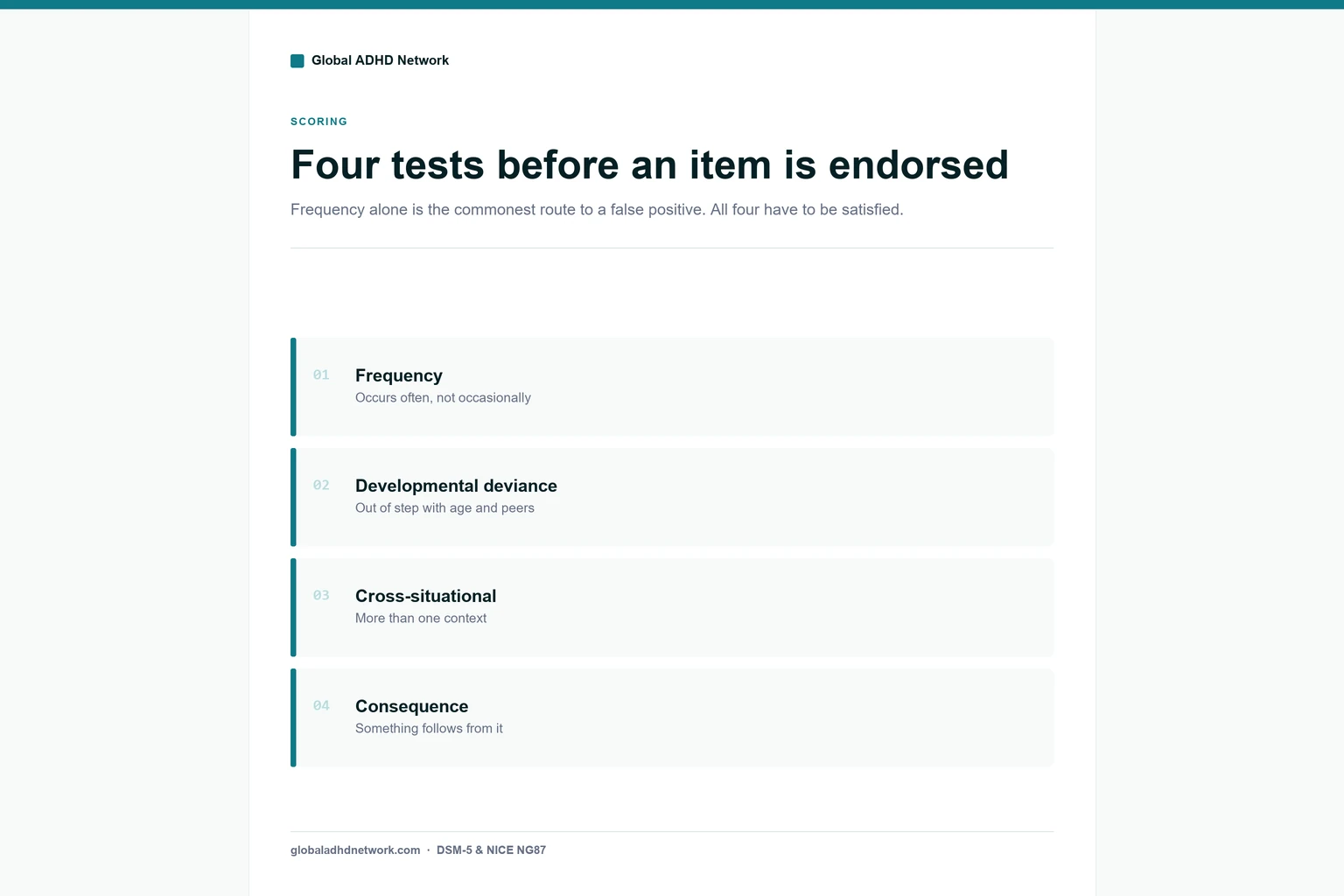
The commonest scoring error is treating frequency as the whole question. Four things have to be true.
1. Frequency
The symptom occurs often, not occasionally. DSM-5 does not attach a number, which is deliberate — the judgement is clinical. "Most weeks" is a reasonable working floor for adult items.
2. Developmental deviance
The behaviour is out of step with what would be expected for the person's age and developmental level. This is the test most often skipped, and it is the one that prevents ordinary human disorganisation from counting. Everybody loses keys. The question is whether they lose them at a rate that separates them from their peers.
3. Cross-situational presence
The symptom shows up in more than one context. An item endorsed only for a single job or a single relationship is describing that context.
4. Consequence
Something follows from it. This is the test that distinguishes a trait from a symptom, and it is where the DIVA-5's example column earns its place — an item with no example behind it has usually not been tested for consequence.
The example column is the scoring instrument
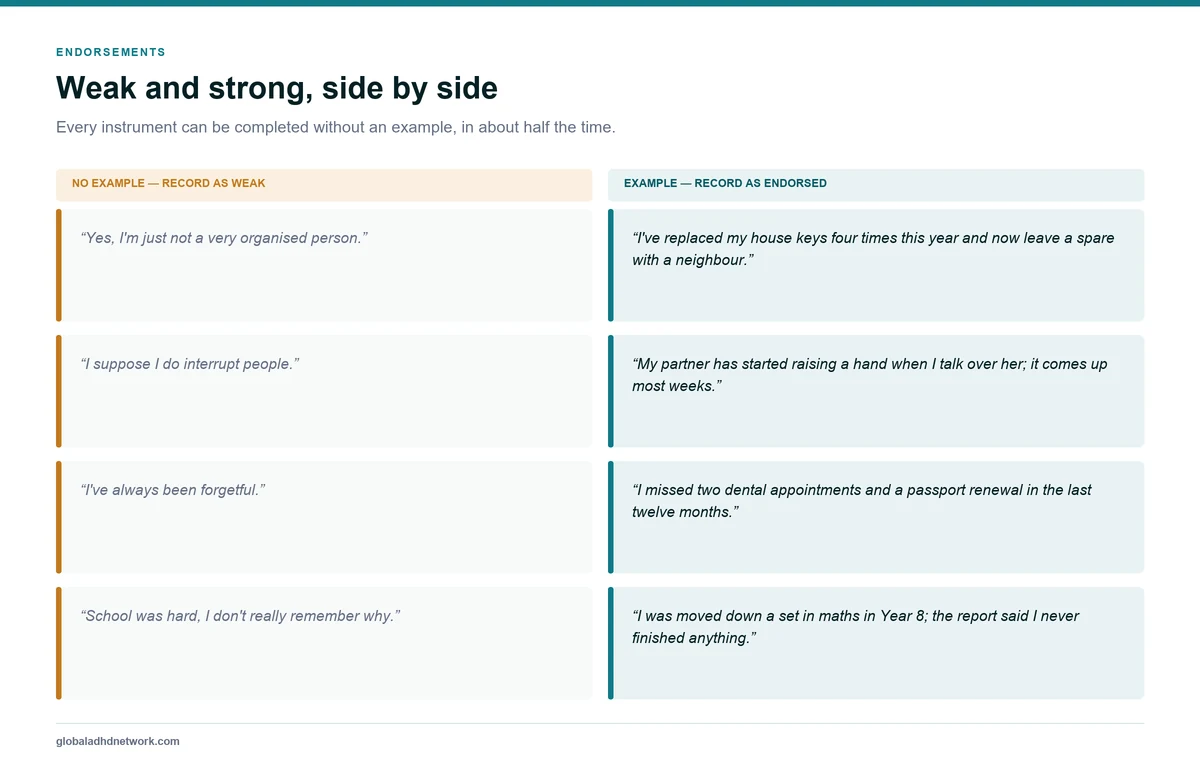
The single most useful discipline in DIVA-5 administration is refusing to record an endorsement without an example.
It is not a documentation habit. It is a scoring mechanism. When you ask what it looked like, three things happen: genuine symptoms produce specific, often vivid answers; agreements-in-principle produce vagueness; and misunderstood items get corrected, because the patient's example frequently turns out to describe something other than the symptom you asked about.
Where a patient cannot produce an example, that is a finding rather than a failure. Record the endorsement as weak, note the absence, and let the pattern across items inform your judgement. An interview with fourteen endorsements and two examples is telling you something about the interview.
Borderline items, and how to resolve them
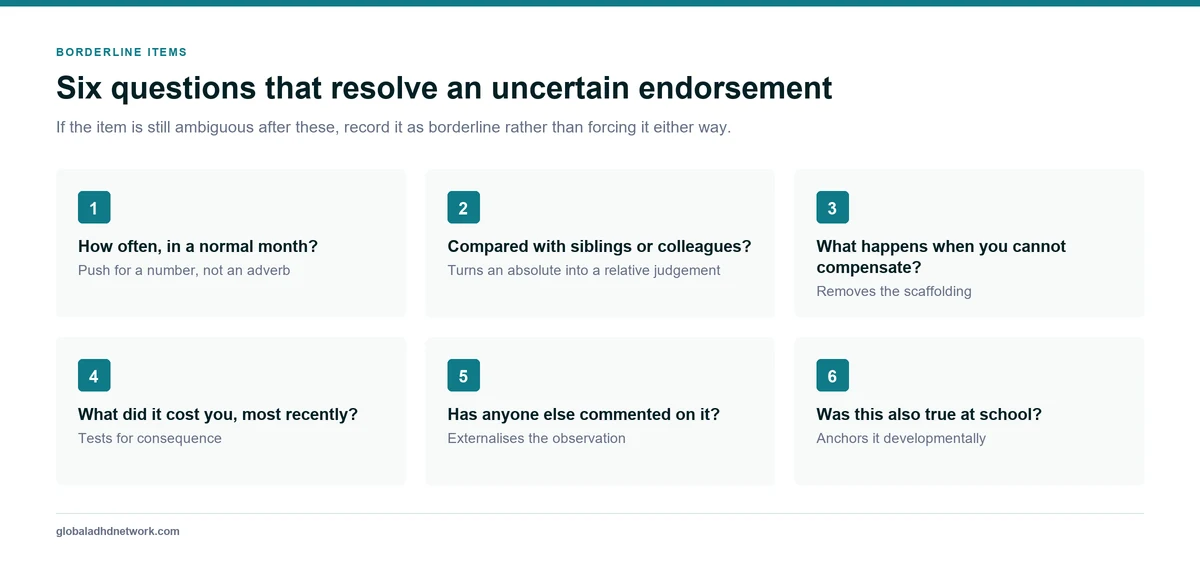
Six questions that usually settle a genuinely uncertain item:
How often, in a normal month? Push for a number rather than an adverb.
Compared with colleagues or siblings at the same stage? Turns an absolute into a relative judgement.
What happens when you cannot compensate? Removes the scaffolding and reveals the underlying symptom.
What did it cost you, most recently? Tests for consequence.
Has anyone else commented on it? Externalises the observation.
Was this also true at school? Anchors it developmentally.
If the item is still ambiguous after those, it is genuinely borderline. Record it as such rather than forcing it — a DIVA-5 with two items marked uncertain and a clear rationale is a more honest document than one where every cell is confidently filled.
Over-diagnosis and under-diagnosis have different signatures
They are not opposite ends of one dial. They arise from different scoring habits and require different corrections.
Scoring too generously
Usually driven by leading items, by sympathy for a patient who has waited a long time, or by accepting agreement without example. The signature is a completed grid with high endorsement and thin examples, and a childhood column that closely mirrors the adult one — often a sign the childhood items were inferred rather than asked.
Scoring too strictly
Usually driven by requiring visible, disruptive presentation, or by discounting symptoms the patient has learned to manage. This systematically misses the presentations that were already being missed — inattentive presentations, high-compensating adults, and women diagnosed late. Our guides to inattentive ADHD and inattentive ADHD in women cover the patterns most often scored out.
The corrective for both is the same: ask what it costs them to function, not whether they are functioning.
Scoring the childhood column
The childhood column is harder to score and is routinely scored worse. Adults are unreliable historians of their own childhoods, and the temptation is to infer the childhood picture from the adult one.
Resist it. Score childhood from childhood evidence — informant account, school reports, or specific and checkable self-report anchored to school years, sets, teachers and moves. Where you are inferring, say so in the report rather than presenting an inferred count as an observed one.
It is normal and expected for childhood endorsement to exceed adult endorsement. Hyperactivity in particular attenuates into subjective restlessness, and an adult who no longer leaves their seat may have been unable to stay in it at nine.
What the number does and does not decide
A completed DIVA-5 satisfies Criterion A and contributes to B, C and D. It does not make the diagnosis.
Criterion E remains yours — see DIVA-5 with complex presentations for the harder differentials. And a threshold met on paper still requires a clinician willing to say that, taken as a whole, this presentation is ADHD. The instrument scaffolds the judgement; it does not replace it.
The full DIVA-5, with its complete example prompts, remains free from the DIVA Foundation.
Related guides in this cluster
This article is part of GAN's structured interview cluster, covering instrument choice, scoring judgement, remote delivery and time pressure.
Inter-rater variation in structured interviews is real, and it is worth understanding where it comes from rather than treating it as an embarrassment. Most of it is generated by three things, all of them fixable.
Different probing depth. One clinician accepts the first answer; another asks twice more. The second will record fewer endorsements and better evidence, because the follow-up questions dissolve the soft yeses. This is the largest single source of variation and it is invisible unless someone compares completed forms rather than reports.
Different reference groups. A clinician who assesses predominantly severe presentations will unconsciously calibrate against those, and will score a moderately impaired patient as unremarkable. One working in a general adult service calibrates differently. Neither is wrong; they are using different denominators.
Different tolerance for ambiguity. Faced with a genuinely borderline item, some clinicians round toward the diagnosis and some away from it, usually according to a settled personal view about whether ADHD is over- or under-diagnosed. That view is doing work it should not be doing, and it is worth surfacing in supervision.
What actually reduces the variation
Not more training in the criteria — clinicians already know the criteria. What works is a shared standard for what constitutes an adequate example, agreed by writing down two or three worked cases and circulating them. Services that do this find that scoring converges quickly, because most of the disagreement was never about the criteria at all.
Sampling completed interview forms rather than finished reports is the other half. Reports are polished; the raw grid shows what actually happened in the room, including the columns nobody filled in.
Documenting the count so a reader can trust it
A number in a report is only as credible as the process behind it, and the reader cannot see the process.
Three habits make the count auditable. State the count separately for childhood and adulthood, because a single figure conceals which period it refers to. Give three or four of the examples rather than all eighteen, chosen for specificity rather than severity. And where items were borderline, say how many and how you resolved them.
Seven of nine inattentive symptoms were endorsed for adulthood and eight of nine for childhood, each supported by a specific example. Two adult items (A1.3, A1.6) were borderline and were recorded as endorsed on the basis of consequence rather than frequency.
That last sentence is unusual in ADHD reports and it should not be. It tells a reader that the clinician distinguished between confident and marginal judgements, which makes the confident ones more believable rather than less.
Scoring when the informant and the patient disagree
The DIVA-5 invites an informant account alongside the patient's, which raises an obvious question the manual does not fully answer: what do you record when the two differ?
The working principle is that you are not averaging two opinions. You are assembling evidence, and the two sources are answering slightly different questions — the patient reports internal experience, the informant reports observable behaviour. Divergence between them is expected, particularly on inattentive items, where much of the phenomenon is invisible from outside.
Where a parent describes more difficulty than the patient recalls, the informant account usually carries more weight for childhood, because contemporaneous observation beats retrospective self-report. Where the patient describes more, ask what the informant would have been able to see — a child quietly failing to follow instructions generates no observable event to remember.
Record both, attribute each, and state which you weighted and why. Silently reconciling the two is the one option that makes the assessment harder to defend.
Frequently Asked Questions
How many symptoms are needed to meet the DIVA-5 threshold?
Five or more in either the inattention or hyperactivity-impulsivity domain for people aged 17 and over, and six or more for under-17s. The threshold applies to one domain, not both.
What counts as a symptom endorsement in DIVA-5?
An item is endorsed when the symptom occurs often, is out of step with the person's developmental level, appears in more than one situation, and produces a consequence. Frequency alone is not sufficient.
Do you need an example for every DIVA-5 item?
The instrument asks for one, and it functions as a scoring mechanism rather than a documentation habit. An endorsement with no example behind it should be recorded as weak.
Should the childhood and adult symptom counts match?
No, and they usually do not. Childhood counts are commonly higher, particularly for hyperactivity, which typically attenuates into subjective inner restlessness in adults.
Can someone be diagnosed with ADHD if they score just below threshold?
The threshold is a convention rather than a natural boundary, and clinical judgement applies — but a diagnosis made below threshold needs the reasoning stated explicitly in the report, including the impairment that justifies it.
%20(1).webp)