Global ADHD Network — One of the most highly reviewed ADHD CPD and CME training providers in ADHD diagnosis and neurodiversity training.Global ADHD Network — One of the most highly reviewed ADHD CPD and CME training providers in ADHD diagnosis and neurodiversity training.Global ADHD Network — One of the most highly reviewed ADHD CPD and CME training providers in ADHD diagnosis and neurodiversity training.
Reasonable Adjustments in ADHD Assessment: Interpreters, Sensory Needs and Accessible Practice
There is a literature on ADHD adjustments at work and almost nothing on adjustments inside the diagnostic appointment itself. Interpreters, sensory environment, appointment structure and support — plus why non-attendance is the condition being assessed, not misconduct.
There is a well-covered literature on reasonable adjustments for people with ADHD at work and in education. There is almost nothing on adjustments within the diagnostic appointment itself.
Which is odd, because the assessment is the point at which someone with unmanaged ADHD is asked to navigate a booking system, arrive at an unfamiliar building at a precise time with the right documents, and sustain attention through ninety minutes of questions about their worst memories.
Who this is for
Service leads designing an accessible assessment pathway
ADHD nurse specialists and administrative teams who arrange the practicalities
Consultant psychiatrists and clinical psychologists adapting the interview in the room
GPs with an extended role, well placed to flag needs at referral
Why this matters diagnostically, not only ethically
The ethical and legal case is straightforward and made elsewhere. The diagnostic case is less often stated and is at least as strong.
An assessment conducted in conditions the patient cannot manage produces bad evidence. A patient struggling with an interpreter, or overwhelmed by a fluorescent room, or exhausted at minute seventy, gives shorter and less specific answers — and those answers become the examples in your report. The impairment you record is contaminated by the conditions you created.
There is also a differential problem. Distress produced by the assessment environment can look like symptoms, and withdrawal produced by fatigue can look like flat affect. Removing avoidable barriers is a measurement decision as much as a courtesy.
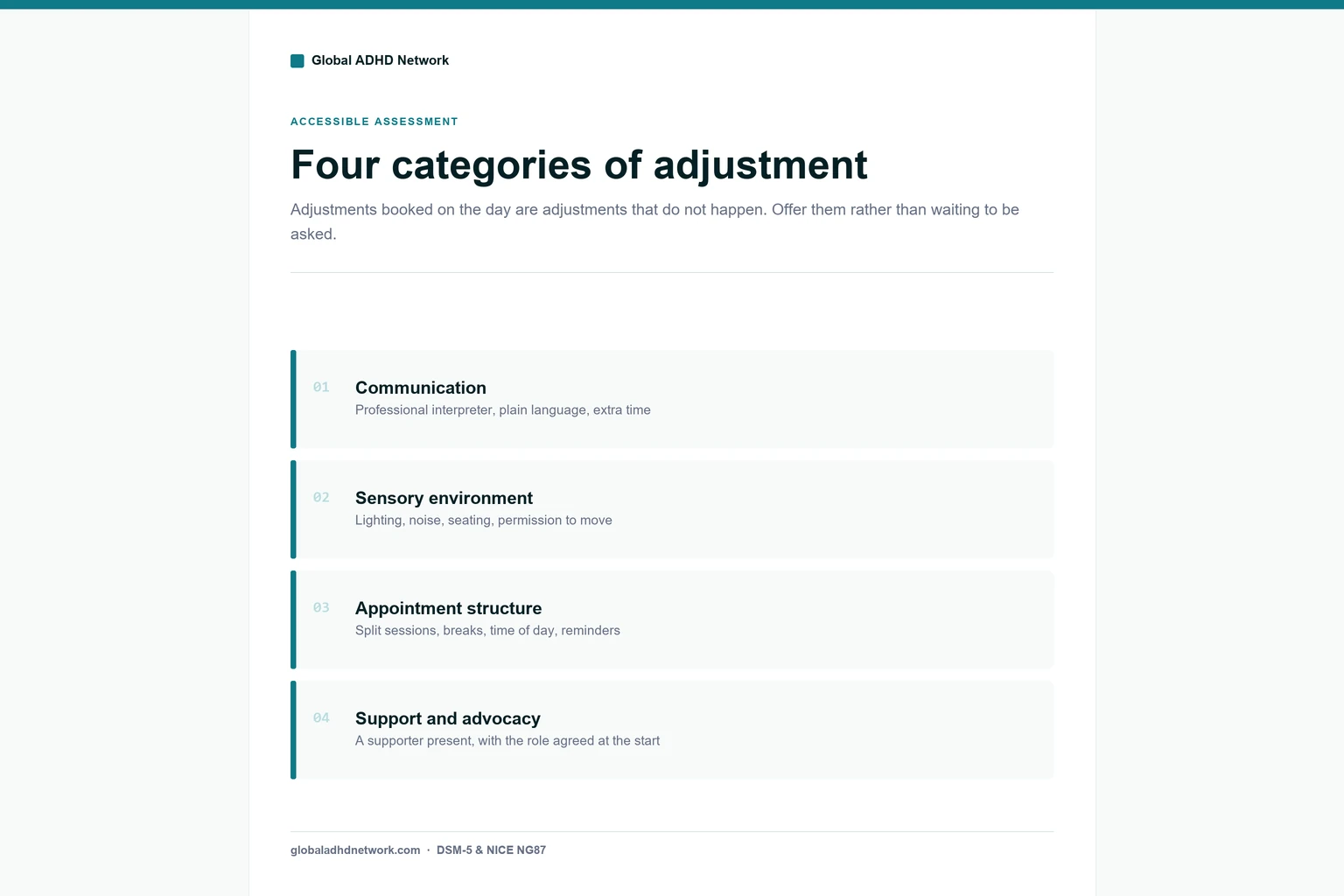
Communication and language
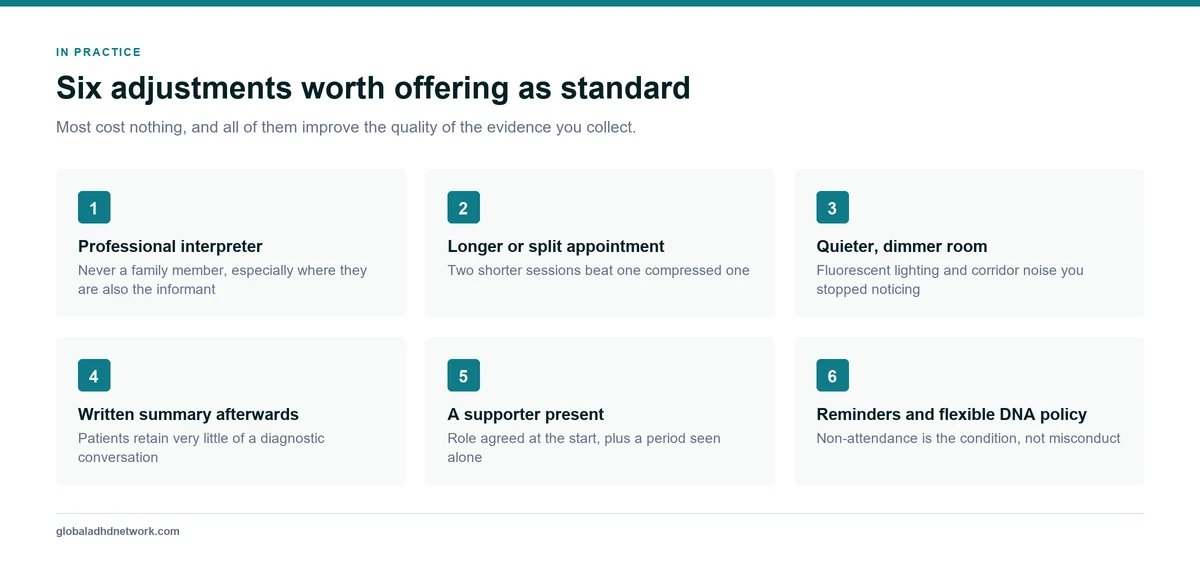
Where an interpreter is needed, book a professional one and allow substantially more time — at least half as long again. Never use a family member, and be especially firm about this where the family member is the informant, since it compromises both accounts at once.
Brief the interpreter beforehand on what you need: examples rather than summaries, and the patient's own words where phrasing matters. Interpreters reasonably compress, and compression removes exactly the specificity the assessment depends on.
Symptom concepts also translate unevenly. Terms like "restless", "distracted" and "disorganised" carry different connotations across languages, and some have no clean equivalent. Describing the behaviour rather than naming the symptom travels considerably better.
The sensory environment
Frequently relevant, and disproportionately so where autism co-occurs — see AuDHD assessment.
Lighting, particularly fluorescent or flickering
Background noise, including corridor and ventilation noise you have stopped noticing
Seating position, and being able to face away or move
Permission to fidget, stand or walk during the appointment
Whether eye contact is expected, and saying explicitly that it is not
The last of these is worth stating out loud at the start. Many patients hold eye contact effortfully throughout an assessment because they believe it is being assessed, which consumes attention you were trying to observe.
Appointment structure
The structural adjustments are the highest-value and the least often offered.
Splitting the assessment across two shorter appointments is better for many patients and produces better evidence than a compressed single session. Offer it rather than waiting to be asked.
Scheduled breaks should be standard rather than a concession, particularly for remote assessment.
Time of day matters more than clinicians expect. Someone whose medication-free attention is best in the morning, or who cannot reliably get anywhere before ten, is telling you something useful as well as making a request.
Reminders — a text the day before and an hour before — cost nothing and substantially reduce non-attendance in this population specifically.
Non-attendance is information, not misconduct
This deserves its own heading because it is where services most often fail the people they are assessing.
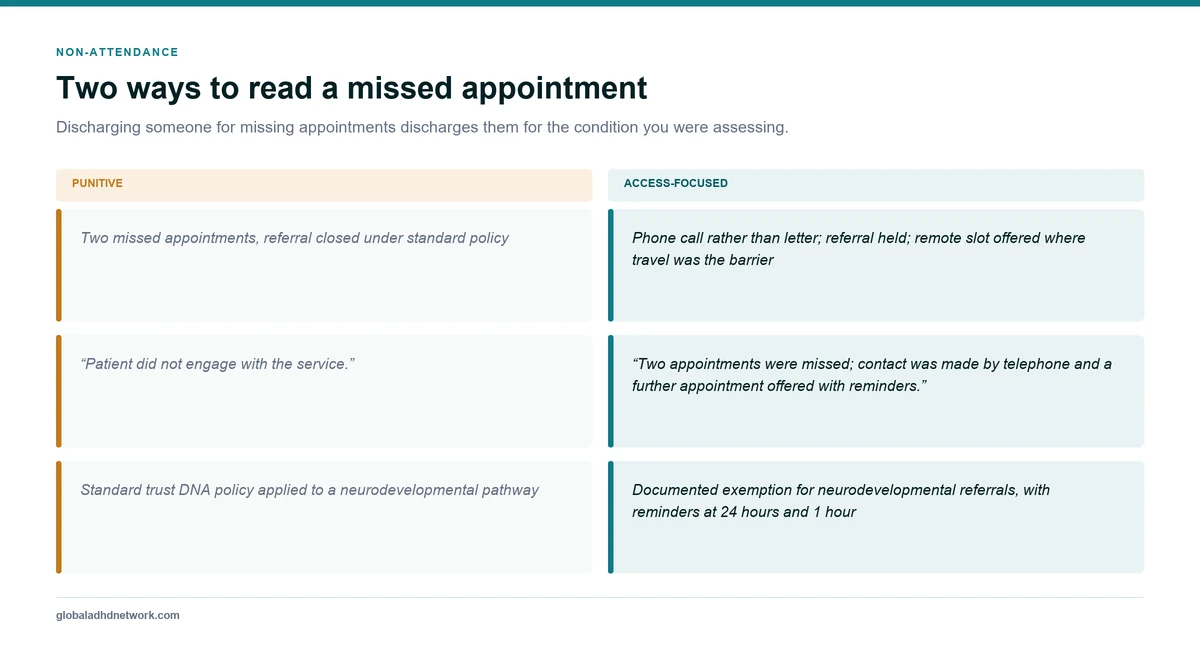
A patient who misses two appointments for an ADHD assessment is demonstrating the condition being assessed. Discharging them under a two-strikes policy discharges them for their symptoms, and it does so at the end of a wait that may have run to years.
Workable alternatives exist: reminder systems, a phone call rather than a letter after a missed appointment, holding the referral rather than closing it, and offering a remote slot where travel was the barrier. Several services have adopted an explicit exemption from standard non-attendance policies for neurodevelopmental pathways, which is a defensible position and easy to justify.
Support and advocacy
Patients may want a partner, friend, family member or advocate present. This is usually helpful and occasionally complicating.
Helpful, because a supporter can prompt for examples the patient has forgotten and can absorb information the patient will not retain. Complicating, because a supporter who answers on the patient's behalf changes the evidence, and because some things will not be said in front of them.
The workable arrangement is to agree the role at the start — present to support, not to answer — and to build in a short period alone. Framing that as routine rather than as suspicion makes it straightforward.
Recording adjustments in the report
Two reasons to record them, one clinical and one practical.
Clinically, adjustments are part of the conditions under which the evidence was gathered, and a reader interpreting the MSE or the quality of the examples needs to know. Practically, an adjustment recorded once tends to be repeated at every subsequent appointment, which saves the patient having to ask again.
The appointment was extended to two hours with two breaks at the patient's request, and conducted in a side room with the overhead lighting off. A professional Polish interpreter attended. Her partner was present for the first and final segments and the patient was seen alone for the symptom history.
What is reasonable
"Reasonable" does real work, and services sometimes read it more restrictively than they need to.
Most of what is described here is free or close to it. Reminders, lighting, breaks, permission to move, an offer to split the appointment, a phone call after a missed slot. The genuinely resource-bearing adjustments are interpreters and additional appointment time, both of which are ordinary costs of assessing this population properly.
Where autism is present or suspected, adjustment needs are usually greater and more specific, and the assessment is often longer.
Predictability matters more than in ADHD alone: sending the structure of the appointment in advance, stating how long each section will take, and flagging transitions all reduce load substantially. Sensory adjustments become more important. Written questions alongside spoken ones help some patients considerably. And processing time should be built in rather than treated as hesitation.
Our guide to AuDHD assessment covers the diagnostic complexity; the practical point here is that the adjustments are usually the difference between a usable assessment and an exhausting one.
Cost, capacity and the honest position
Services sometimes treat adjustments as competing with capacity, and occasionally they do.
The realistic accounting is that most adjustments are free — reminders, lighting, breaks, permission to move, offering a split appointment — and the two that are not, interpreters and additional time, are ordinary costs of assessing this population properly rather than optional extras. A service that cannot fund an interpreter is not able to assess a substantial part of its population, which is a commissioning problem rather than a clinical one and should be escalated as such.
Where a request genuinely cannot be met, record what was asked for, what was offered instead, and why. That record protects the patient, the clinician and the service in roughly equal measure.
Asking, rather than guessing
The most common failure is not refusing adjustments. It is never asking.
A single question on the pre-appointment form — is there anything that would make this appointment easier for you? — produces most of what is described in this article without any need for the clinician to anticipate it. Patients know what they need and are largely reasonable about it; they simply assume the answer will be no and therefore do not ask.
Recording the answer, and repeating the adjustment at subsequent appointments without requiring the patient to request it again, is what turns a one-off accommodation into accessible practice.
Adjustments at the point of feedback
Almost all discussion of adjustments concerns the assessment itself. The feedback appointment is at least as important and receives almost none.
This is the appointment where someone is told something significant about their life, frequently after a long wait, and is then expected to absorb information about medication, monitoring and next steps. Retention in those circumstances is poor for anyone, and worse for the population being assessed.
Three adjustments make a substantial difference: a written summary provided at the time rather than posted weeks later, permission to record the conversation, and an offer of a short follow-up specifically for questions that surface afterwards. All three are cheap and all three reduce the volume of subsequent contact.
Where a supporter attended the assessment, they are often more useful at feedback than during the history.
Making it routine rather than exceptional
The difference between a service that accommodates well and one that does not is rarely willingness. It is whether the adjustment is built into the process or depends on someone remembering.
Put the question on the pre-appointment form, record the answer in a field that carries forward to future appointments, and audit a sample once a year against what was actually provided. Three small pieces of infrastructure, and they remove the need for either the patient or the clinician to advocate every time.
Frequently Asked Questions
What adjustments should be offered in an ADHD assessment?
Interpreters where needed, longer or split appointments, scheduled breaks, a quieter and less brightly lit room, permission to move or fidget, written summaries, appointment reminders, and the option of a support person.
Can a family member interpret in an ADHD assessment?
No. Use a professional interpreter, particularly where the family member is also the informant, since using them compromises both the interpretation and the collateral account.
Should a patient be discharged for missing ADHD assessment appointments?
Non-attendance is frequently a symptom of the condition being assessed. Reminder systems, a phone call rather than a letter, and holding rather than closing the referral are more appropriate than a standard two-strikes policy.
Should adjustments be recorded in the diagnostic report?
Yes. They form part of the conditions under which the evidence was gathered, and recording them means the patient does not have to request them again at every subsequent appointment.
Can a supporter attend an adult ADHD assessment?
Usually yes, with the role agreed at the start — present to support rather than to answer — and with a period where the patient is seen alone.
%20(1).webp)