Global ADHD Network — One of the most highly reviewed ADHD CPD and CME training providers in ADHD diagnosis and neurodiversity training.Global ADHD Network — One of the most highly reviewed ADHD CPD and CME training providers in ADHD diagnosis and neurodiversity training.Global ADHD Network — One of the most highly reviewed ADHD CPD and CME training providers in ADHD diagnosis and neurodiversity training.
What the ADHD Taskforce Report Means for Assessing Clinicians
The Taskforce reported in November 2025 and NHS England has set three-year expectations. Four changes land on assessors: support during the wait, needs-led help, expanded primary care roles and data. What to do about it now, and what has not changed at all.
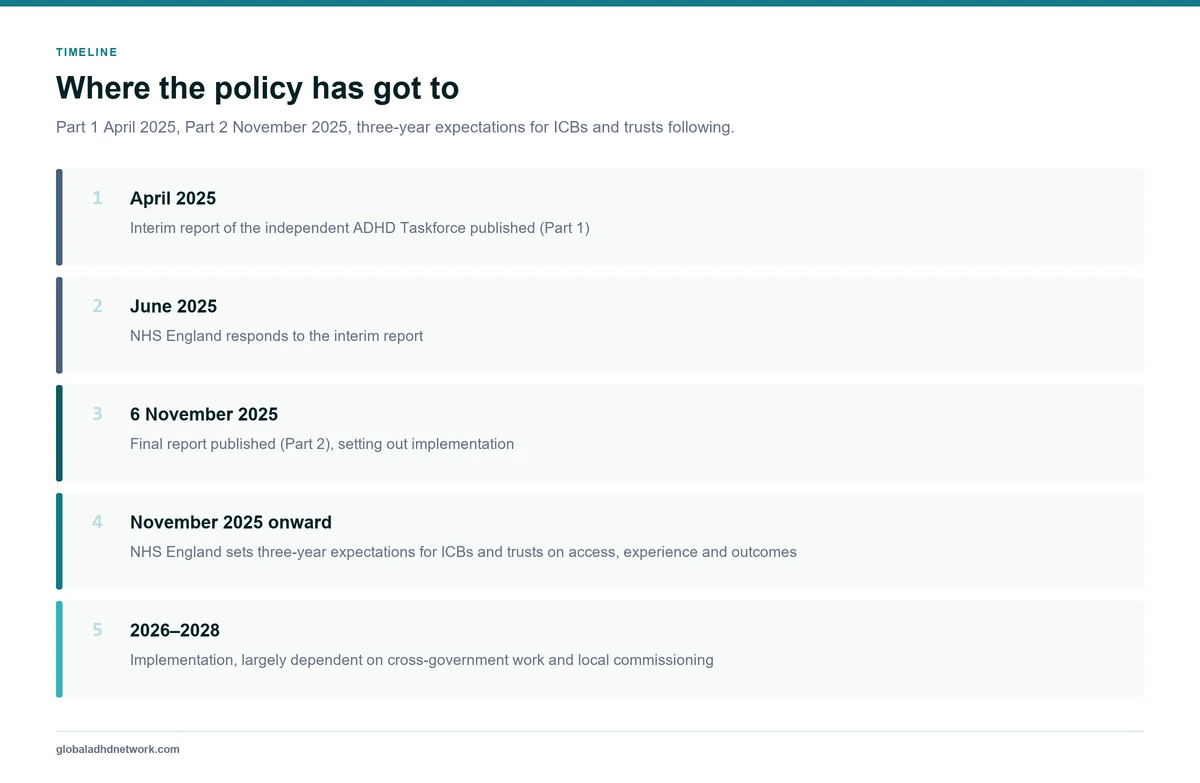
The independent ADHD Taskforce published Part 1 of its report in April 2025 and Part 2 on 6 November 2025. NHS England has since set expectations for integrated care boards and trusts over a three-year period.
Most coverage has focused, reasonably, on waiting lists. This is the narrower question: what actually changes for clinicians who carry out assessments.
Who this is for
Service leads planning against ICB expectations over the next three years
Consultant psychiatrists and clinical psychologists whose caseload composition will shift
ADHD nurse specialists, likely to carry more of both assessment and supervision
GPs with an extended role, for whom this is the most consequential policy change in years
Trainees deciding where neurodevelopmental work sits in their career
What the Taskforce actually found
Three findings frame everything else.
Services are under severe pressure across sectors. Not only health — education, employment and the criminal justice system all feature, and the report treats ADHD as a cross-government issue rather than a commissioning problem for mental health alone.
Recognised rates are below expected prevalence. This is the finding most likely to surprise clinicians who have spent two years being told ADHD is over-diagnosed. The Taskforce's position is that fewer people are identified in England than prevalence estimates would predict — a conclusion consistent with the pattern that rising diagnosis reflects improving recognition rather than drifting thresholds.
Waiting for a diagnosis is not a neutral state. Harm accumulates during the wait, and the report is explicit that support should not be gated behind assessment.
Four things that land on assessors
1. Support before and during the wait
The recommendation to offer practical help — coaching, classroom tools, parenting advice — before referral or while waiting changes who reaches you and in what state.
Two implications. Some people offered support early will not need assessment, which shifts the referral population toward greater complexity rather than reducing volume proportionately. And patients arriving after a period of structured support arrive with something valuable: a record of what helped and what did not, which is genuinely useful impairment evidence.
2. Needs-led rather than diagnosis-gated
Decoupling support from a diagnostic label reduces the pressure on the diagnosis itself to be the gateway to everything — which is currently one of the more distorting forces in adult assessment.
It also changes what a negative outcome means. Where support does not depend on the label, "criteria not met" stops being a door closing, and clinicians can be more straightforward about uncertainty than the current system encourages.
3. Expanded primary care roles
Embedding ADHD assessment and care in neighbourhood settings, with expanded roles for primary care practitioners, is the change with the largest workforce implications.
For specialist services this means a supervisory and quality-assurance function that many do not currently have capacity or structures for. For GPs with an extended role it means genuine opportunity and genuine exposure — our guide for GPs and primary care clinicians covers the pathway.
4. Data, access and outcomes
NHS England's expectations of ICBs cover access, experience and outcomes, which means measurement. Services that cannot currently report waiting times by stage, assessment outcomes, or onward treatment will be asked to.
The practical consequence for assessors is that report quality becomes visible in a way it has not been. A service whose diagnoses are frequently queried, or whose reports cannot support shared care, will show up in the data.
What to do about it now
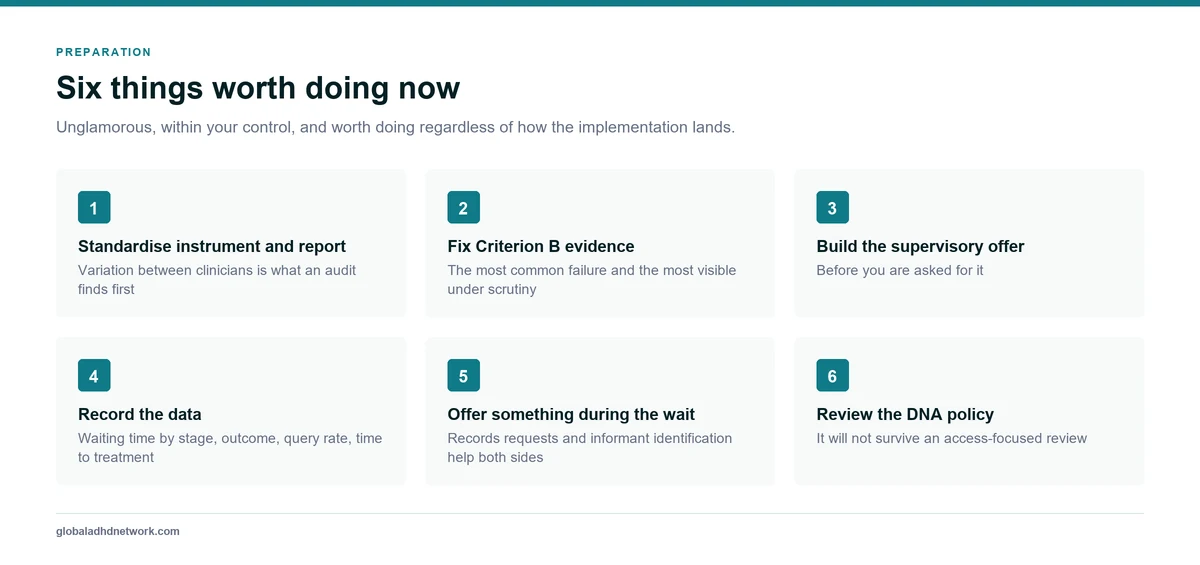
Most of the useful preparation is unglamorous and can start immediately.
Standardise your assessment instrument and report structure. Variation between clinicians in the same service is the first thing an audit finds.
Fix Criterion B evidence. It is the most common failure and the most visible under scrutiny.
Build the supervisory offer before you are asked for it. Services that already supervise primary care colleagues will find the transition considerably easier.
Record data you will be asked for. Waiting time by stage, outcome, query rate, time to treatment.
Give people something during the wait. Records requests and informant identification are useful to the patient and improve the eventual assessment.
Review your non-attendance policy. Discharging people for missing appointments will not survive an access-focused review.
What has not changed
Worth stating, because policy documents can create an impression of imminent upheaval.
The diagnostic criteria are unchanged. NICE NG87 remains the operative guideline, and the requirement that diagnosis is made by an appropriately qualified specialist with training and expertise in ADHD is unaffected. Nothing in the Taskforce report lowers the standard of assessment — if anything the emphasis on quality and data points the other way.
What changes is the surrounding system: who reaches assessment, what happens while they wait, who else is involved, and how visible the quality of your work becomes.
A realistic view of the timescale
Three-year expectations are not three-year guarantees. Most of the recommendations require cross-government work, funding decisions and workforce expansion, and the backlog is large enough that some estimates of clearance time run to decades at current capacity.
Clinicians should be neither dismissive nor credulous. The direction of travel is clear and reasonably well evidenced; the pace will vary enormously by ICB, and some areas are still closing waiting lists entirely while the policy points the other way.
The parts within your control — instrument, structure, evidence quality, data — are worth doing regardless of how the implementation lands, because they improve assessments now and position the service for whatever arrives.
Related guides in this cluster
This article is part of GAN's documentation cluster, covering what happens between the end of the interview and the report reaching a GP.
Cluster pillar — Writing the ADHD report — evidencing every criterion in a document that holds up
The Taskforce reported into a system where a substantial share of adult ADHD assessment happens privately or through Right to Choose, and where the quality of some of that provision has been publicly questioned.
For clinicians working privately, the direction of travel is toward more scrutiny rather than less: clearer expectations of what an assessment comprises, more consistent ICB positions on accepting diagnoses for shared care, and more attention to whether a report evidences what it claims.
This is not a threat to good private practice. It is a threat to short assessments with no childhood history, which have made life considerably harder for everyone else operating in the same space. A service whose reports evidence each criterion explicitly has nothing to fear from a tightening standard and a good deal to gain from one.
What it means for shared care
One of the most practically significant areas, and one where the report's emphasis on integrated pathways will bite.
Shared care refusal is currently a substantial cause of delay between diagnosis and treatment, and the reasons vary enormously between ICBs. Some refuse on the basis of the assessing service; some on the basis of the report content; some have no consistent position at all.
Assessors can influence exactly one of those variables. A report that sets out the criterion evidence, the monitoring arrangements, the baseline physical observations and precisely what is being asked of the GP is materially more likely to be accepted. That is worth doing now, whatever the policy environment does next.
Workforce and training
The expansion of assessment capacity the recommendations imply cannot happen without a larger trained workforce, and that has implications for anyone currently doing this work.
Two in particular. Experienced assessors will increasingly be asked to supervise, teach and quality-assure rather than only to assess — a different skill set, and one worth developing deliberately. And the standard of training itself is likely to come under more scrutiny, with more attention to what a course actually certifies. GAN's guidance on training governance and accreditation covers what credible provision looks like.
For clinicians considering moving into neurodevelopmental work, the demand signal is unambiguous. For services, the constraint over the next three years is far more likely to be workforce than commissioning intent.
Reading the report yourself
Both parts of the Taskforce report are published in full by NHS England, along with the organisation's formal responses. They are long, and most clinicians will not read them end to end.
If you read one section, read the implementation material in Part 2 rather than the findings in Part 1. The findings will be familiar to anyone working in the field; the implementation detail is where the changes that affect your service are actually described.
The cross-sector dimension
One aspect of the report that clinicians tend to skip and that has practical consequences for assessment.
The Taskforce examined ADHD across education, employment and the criminal justice system as well as health, and the prevalence findings in the justice system in particular are difficult to read as anything other than a systemic failure of earlier identification.
For assessors the relevance is twofold. It reframes what an assessment is for — not simply access to medication, but access to adjustments in education and work that may matter more over a lifetime. And it strengthens the case for writing reports that a non-clinical reader can act on, since a university disability service or an employer's occupational health provider is often the party that turns the diagnosis into something useful.
What clinicians can reasonably say to patients
Patients ask about this, usually in the form of "will the waiting list get any better?", and it is worth having an honest answer ready.
The accurate version is that the policy direction is real and reasonably well evidenced, that implementation depends on funding and workforce that are not yet secured, that the pace will vary substantially by area, and that support during the wait is more likely to improve in the near term than waiting times themselves.
That is less satisfying than optimism and considerably better than either dismissal or a promise nobody can keep. It also opens the more useful conversation about what is available now, which is the question underneath the one being asked.
The one-line summary for a service meeting
If you have to condense this for colleagues: the Taskforce found services under severe pressure and recognition below expected prevalence, and recommends support that is not gated behind a diagnosis, ADHD care embedded closer to primary care, and better data on access and outcomes.
For assessors, that means a more complex referral population, a supervisory role most services have not yet built, and assessment quality becoming visible in reporting. None of it changes the criteria; all of it changes the context.
Frequently Asked Questions
What is the ADHD Taskforce?
An independent taskforce established to examine ADHD care across health, education, employment and the criminal justice system. It published Part 1 in April 2025 and Part 2 on 6 November 2025, and NHS England has responded with three-year expectations for ICBs and trusts.
Does the Taskforce report change the diagnostic criteria for ADHD?
No. DSM-5 criteria and NICE NG87 are unchanged, including the requirement that diagnosis is made by an appropriately qualified specialist with training and expertise in ADHD.
Will GPs be able to diagnose ADHD?
The recommendations point toward expanded roles for primary care practitioners within neighbourhood settings, with specialist supervision. NG87 still restricts diagnosis to appropriately qualified professionals with relevant expertise.
Does the Taskforce say ADHD is over-diagnosed?
No. It reports that recognised rates in England are lower than expected prevalence would predict, and emphasises timely access to needs-based support.
What should assessing services do to prepare?
Standardise the instrument and report structure, strengthen Criterion B evidence, build a supervisory offer for primary care colleagues, record access and outcome data, offer support during the wait, and review non-attendance policies.
%20(1).webp)