Global ADHD Network — One of the most highly reviewed ADHD CPD and CME training providers in ADHD diagnosis and neurodiversity training.Global ADHD Network — One of the most highly reviewed ADHD CPD and CME training providers in ADHD diagnosis and neurodiversity training.Global ADHD Network — One of the most highly reviewed ADHD CPD and CME training providers in ADHD diagnosis and neurodiversity training.
Mental State Examination in an ADHD Assessment: What to Record and Why It Matters
An MSE evidences no DSM-5 criterion, and a normal one in a well-compensated adult means very little. What is worth recording, how to word it without over-reading a single appointment, what changes on video, and why today's observation is tomorrow's comparison baseline.
She arrived four minutes late, apologised twice, and spent the first ten minutes of the appointment rearranging the contents of a tote bag on her lap. She interrupted you three times, each time apologising immediately. At minute fifty her answers became noticeably shorter.
None of that diagnoses ADHD. All of it belongs in the report.
The mental state examination is the part of an ADHD assessment most often either omitted entirely or written as boilerplate. Both are missed opportunities, and the second is worse than the first.
Who this is for
Consultant psychiatrists, for whom the MSE is second nature but often written on autopilot
Clinical psychologists who may use a different observational framework and need it to translate
ADHD nurse specialists documenting observation alongside a structured interview
GPs with an extended role and trainees, who most often ask what an MSE adds here at all
What the MSE is actually contributing
It is worth being clear, because over-claiming and under-using both stem from the same confusion about its role.
The MSE does not evidence any DSM-5 criterion. Criterion A comes from the structured interview, B from collateral, C and D from the impairment history. Nothing you observe in ninety minutes establishes a lifelong pattern.
What it does is three other things. It provides a contemporaneous, clinician-observed data point in a document otherwise built almost entirely on report. It screens for the differentials — mood, psychosis, intoxication, cognitive difficulty — that Criterion E requires you to consider. And it records the patient's presentation at a moment in time, which matters for anyone reviewing the case later against a changed picture.
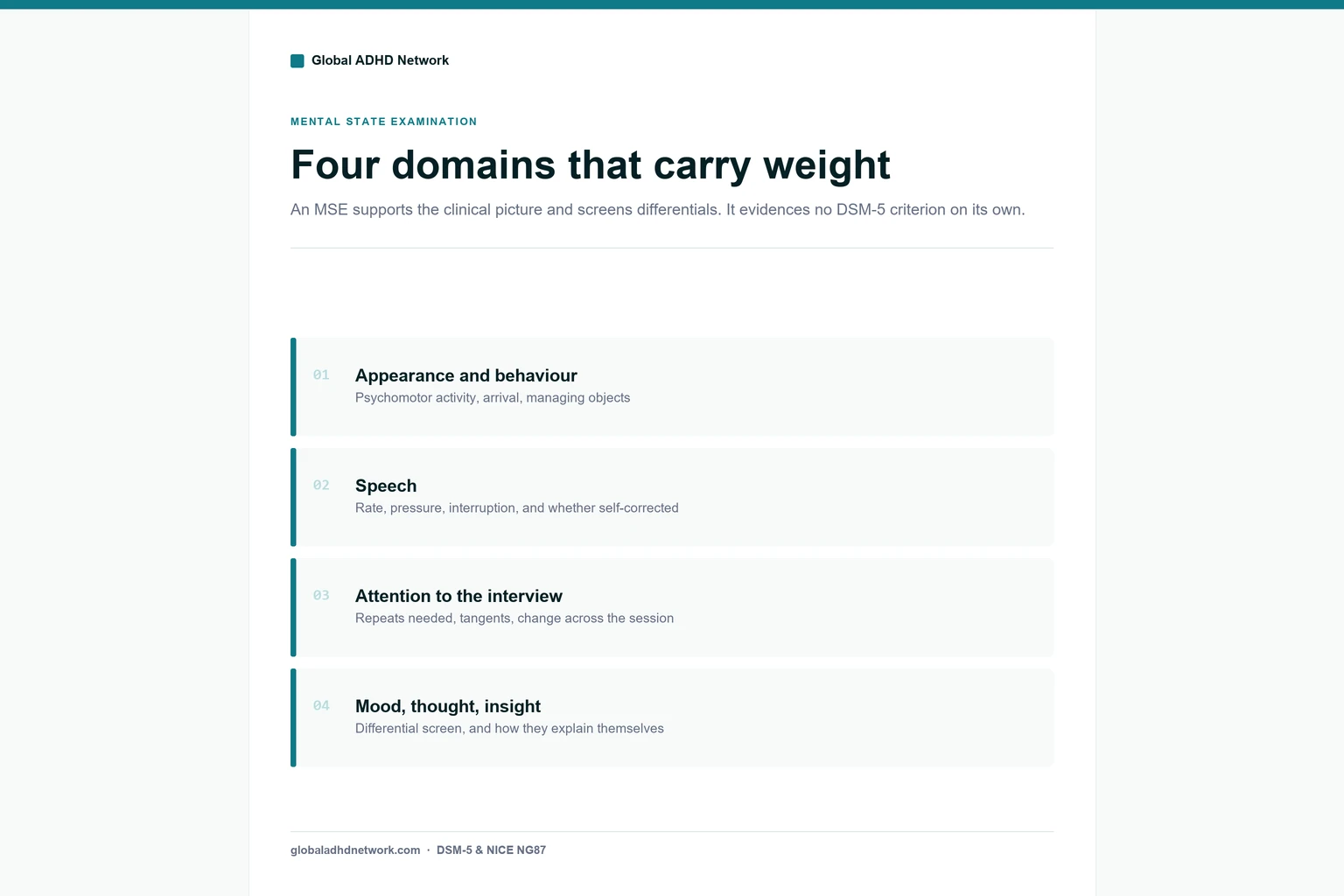
The domains that carry weight
Appearance and behaviour
Psychomotor activity is the obvious one — fidgeting, foot tapping, shifting position, difficulty remaining seated. Note it if present, and note its absence too, because an absence recorded is more useful than an absence implied.
Beyond restlessness: whether they arrived on time, whether they brought what was asked for, how they managed the physical objects they came with. These are ordinary observations that are diagnostically relevant here in a way they would not be in other clinics.
Speech
Rate, volume, pressure, and whether they interrupt. Distinguishing ADHD-related interruption from pressured speech in hypomania is a genuine differential task: the former is typically apologetic and self-corrected, the latter usually is not.
Attention during the interview
The most directly relevant domain, and the one most often left out. Did they lose the thread of a question? Did they need questions repeated? Did they go off at tangents and return unprompted, or need bringing back? Did their engagement change across the appointment?
Mood, thought and insight
Largely a differential screen, and it should be recorded as such. Also worth noting: how they account for their own difficulties. Someone describing a lifetime of personal failure rather than a pattern of symptoms is telling you something about Criterion D as well as about their mental state.
The trap: a normal MSE means very little
This is the single most important thing to get right, and it is where MSE sections most often mislead.
A ninety-minute, one-to-one, highly structured, novel and personally significant appointment is close to optimal conditions for someone with ADHD. Novelty and salience both support attention. Many patients — particularly those who have compensated well for decades — will present as entirely unremarkable.
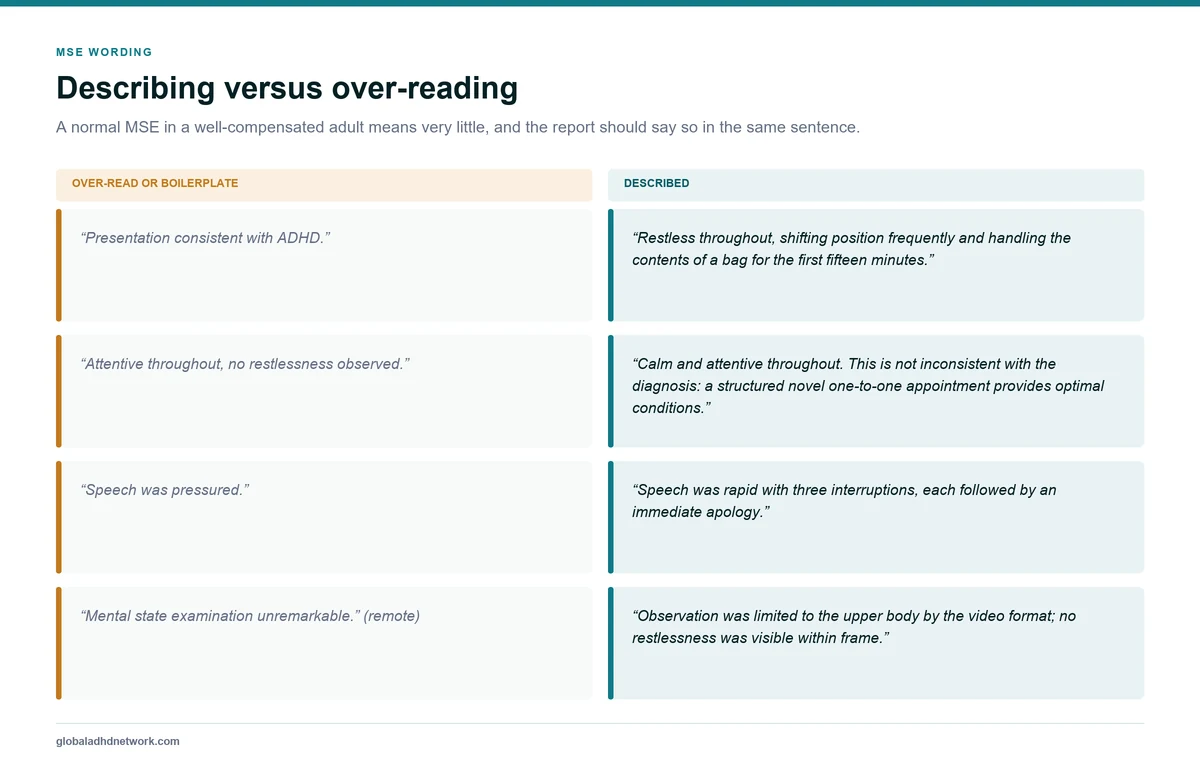
If the report records "attentive throughout, no psychomotor restlessness" and stops there, a reader may reasonably read it as evidence against the diagnosis. It is not. It is evidence that the conditions were favourable, and the report should say so in the same sentence.
This matters disproportionately for inattentive presentations and for women diagnosed late, whose compensatory strategies are precisely what makes them present well — the pattern described in inattentive ADHD in women and inattentive ADHD.
Wording it
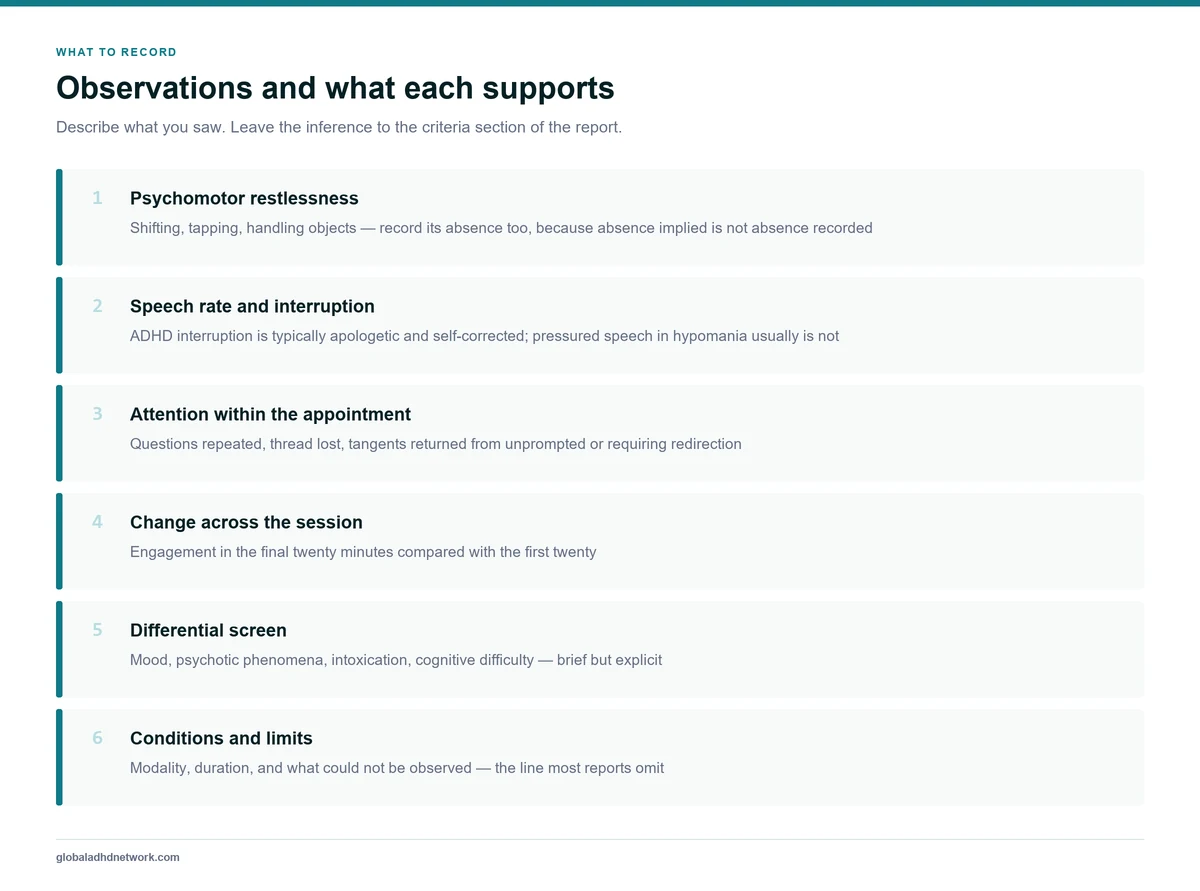
Describe what you saw. Leave the inference to the criteria section.
She was restless throughout, shifting position frequently and handling the contents of a bag for much of the first fifteen minutes. Speech was rapid with three interruptions, each followed by an immediate apology. She required two questions to be repeated and returned unprompted from one tangent. Engagement was noticeably reduced in the final twenty minutes. Mood was euthymic; there was no evidence of psychotic phenomena or cognitive impairment.
And where the presentation was unremarkable:
He was calm and attentive throughout, with no observable psychomotor restlessness. This is not inconsistent with the diagnosis: a structured, novel one-to-one appointment provides optimal conditions, and he described significant difficulty sustaining attention in unstructured and less salient settings.
That second paragraph is the one most reports are missing. It costs one sentence and closes a question a sceptical reader would otherwise ask.
Remote assessment changes what you can claim
Where the assessment was conducted by video, a substantial part of the observational field is simply unavailable — everything below the shoulders, the waiting room, the corridor, and any behaviour outside the frame.
Write the MSE to match what you actually saw. "Observation was limited to the upper body by the video format" is a stronger and more honest sentence than a confident account of psychomotor activity you could not have observed. Compensate by asking directly about restlessness rather than relying on seeing it.
What the MSE cannot substitute for
Two boundaries worth stating explicitly, because both get crossed.
It is not a substitute for the childhood history. Observed adult restlessness says nothing about onset before age twelve. A report that leans on the MSE where Criterion B is thin has substituted the wrong evidence for the right one, and a careful reader will notice.
It is not a performance test. An MSE is qualitative observation, not measurement. If a service wants quantified attentional data, that is what a QbTest or similar computerised task offers — with the same caveat, that a normal result in a well-compensated adult means very little.
Observing over more than one appointment
Where an assessment is split across two sessions, or where the informant is seen separately, you have something most single-appointment assessments do not: observation at two points in time, under different conditions.
Use it. A patient who presented as composed in a structured diagnostic interview and considerably less so in an unstructured feedback appointment has given you a more informative observation than either session alone. Note the difference and the conditions that produced it.
The same applies where a patient has been seen previously by the service. A comparison across appointments — particularly across a change in medication, circumstances or stress — is genuinely useful clinical data and is almost never recorded.
A short template
Six lines, and it takes two minutes to complete during or immediately after the appointment:
Appearance and psychomotor activity — present or absent, described
Speech — rate, interruption, and whether self-corrected
Attention to the interview — repeats needed, tangents, change across the session
Mood and affect — with a differential screen
Thought and perception — sufficient to exclude, briefly
Conditions and limitations — modality, duration, and what could not be observed
The last line is the one that distinguishes a considered MSE from a copied one, and it is the line most reports omit.
Related guides in this cluster
This article is part of GAN's documentation cluster, covering what happens between the end of the interview and the report reaching a GP.
Cluster pillar — Writing the ADHD report — evidencing every criterion in a document that holds up
A note on what is and is not appropriate to record.
Behaviour observed during the appointment is fair material, and patients understand that a clinical assessment involves clinical observation. Behaviour observed incidentally — in the waiting room, in the car park, in an exchange with reception — sits less comfortably, and clinicians differ on it.
The workable position is that incidental observation can legitimately inform your clinical impression, but should be recorded only where it is directly relevant and attributed as what it is. "Reception noted that he had arrived at the wrong site initially" is a fair and useful record. A paragraph reconstructing waiting-room behaviour the patient did not know was being assessed is not.
Cultural and neurodivergent variation in presentation
MSE conventions were developed against a fairly narrow set of behavioural norms, and several of the observations that feature routinely are culturally loaded.
Eye contact is the clearest example. Reduced eye contact is recorded in mental state examinations as though it means something universal, when it varies substantially by culture, and in autistic people carries no negative implication whatever. Recording it without that context can actively mislead a later reader.
Similar caution applies to formality of dress, expressiveness of affect, and conversational turn-taking. Describe the behaviour, note the context, and avoid the implied comparison against an unstated norm.
The MSE as a baseline
One use that is almost universally overlooked: today's MSE is the comparison point for every subsequent appointment.
A patient reviewed after titration, or after a change in circumstances, can be compared against a properly recorded baseline — or against nothing, if the original said "unremarkable". Given that treatment response is the main thing anyone will want to assess later, a specific baseline is worth the two minutes it takes.
Where the MSE and the structured interview overlap
One source of duplicated effort worth resolving at service level.
A structured interview asks the patient to report on attention, restlessness and impulsivity. An MSE records your observation of the same domains. The two are answering different questions — reported experience versus observed behaviour — and where they diverge, that divergence is itself informative.
A patient who reports severe restlessness and sits motionless for ninety minutes is worth a sentence. So is one who reports none and cannot stay in the chair. Neither divergence settles anything on its own, but a report that notices them reads as considerably more observant than one that records the two sections as if they were unrelated.
Write the MSE after the interview rather than before, so the comparison is available to you.
Frequently Asked Questions
Is a mental state examination required in an ADHD assessment?
It is standard practice in psychiatric assessment and expected in a full diagnostic report. It supports the clinical picture and screens differentials, but does not itself evidence any DSM-5 criterion.
What should an MSE record in an adult ADHD assessment?
Appearance and psychomotor activity, speech rate and interruption, attention to the interview itself, mood and affect, thought and perception, and the conditions under which the observation was made.
Does a normal mental state examination rule out ADHD?
No. A structured, novel one-to-one appointment provides close to optimal conditions for attention, and many well-compensated adults present unremarkably. The report should state this explicitly.
How should an MSE be written for a remote assessment?
Record only what was observable. Note that observation was limited by the video format, and compensate by asking directly about restlessness rather than relying on seeing it.
Can observed restlessness evidence childhood onset?
No. Observation in adulthood says nothing about Criterion B, which requires collateral or documentary evidence.
%20(1).webp)