Global ADHD Network — One of the most highly reviewed ADHD CPD and CME training providers in ADHD diagnosis and neurodiversity training.Global ADHD Network — One of the most highly reviewed ADHD CPD and CME training providers in ADHD diagnosis and neurodiversity training.Global ADHD Network — One of the most highly reviewed ADHD CPD and CME training providers in ADHD diagnosis and neurodiversity training.
What a Positive ADHD Screen Actually Means: the ASRS False Positive Rate, and Where WURS and CAARS Fit
The ASRS false positive rate is high enough that, in a general adult population, most people who screen positive do not have ADHD, and the reason has almost nothing to do with the quality of the instrument.
The temptation is to treat that 5/6 as the beginning of a diagnosis — something the assessment will confirm rather than test. It is not. The ASRS false positive rate is high enough that, in a general adult population, most people who screen positive do not have ADHD, and the reason has almost nothing to do with the quality of the instrument.
It is arithmetic. A screener with excellent operating characteristics, applied to a population where the condition is uncommon, will still generate far more false positives than true ones. That is not a flaw in the ASRS. It is what screening is.
In short
An adult who screens positive on the ASRS has roughly a one-in-nine chance of having ADHD. Chamberlain, Cortese and Grant (Comprehensive Psychiatry, 2021) found screen-positive rates of 26.0% in a UK cohort and 17.3% in a US cohort against an expected prevalence of 2.5%, giving an estimated positive predictive value — the proportion of positives that are true cases — of about 11.5%. Negative predictive value is far higher; van de Glind and colleagues reported 0.97. UKAAN's AQAS (Adamou et al., 2024) sets out what to do instead.
That 11.5% is an estimate, not a constant. It was derived from two normative cohorts in which nobody received a gold-standard diagnostic interview, and it moves whenever the underlying prevalence moves — considerably higher in a tertiary service where referrals have already been filtered twice.
What does not move is the structural point. A positive screen changes the pre-test probability; it does not answer the question. The four-step path at the end of this article is what it obliges you to do instead.
Why the ASRS false positive rate is a property of your population, not the instrument
Positive predictive value is not a fixed characteristic of a test. It is a function of sensitivity, specificity and the prevalence of the condition in the people being tested. Hold the first two constant and drop prevalence, and PPV falls with it.
Chamberlain, Cortese and Grant ran exactly that arithmetic in 2021. They applied ASRS v1.1 Part A at its standard threshold to two non-treatment-seeking cohorts — 642 young adults in the UK and 579 in the USA, both recruited outside mental health services — and found screen-positive rates of 26.0% and 17.3%. Set against an expected ADHD prevalence of about 2.5%, that implies 86–90% of those screen-positives were unlikely to have the condition.
Their own framing is worth quoting because it is more restrictive than most services treat it: they recommend the tool "only be used as a screener for categorical ADHD, in people for whom there is high clinical suspicion."
The authors did not conduct diagnostic interviews, so the 11.5% is derived from an assumed true prevalence rather than measured against a reference standard — a qualification that should travel with the figure every time you cite it. A non-treatment-seeking cohort is also close to the worst case for PPV: it is the population in which the base rate is lowest.
That last point cuts both ways. An open-access self-referral pathway where anyone can complete an ASRS and land on the list resembles Chamberlain's cohorts. Referrals pre-filtered by a GP who has already excluded thyroid disease, sleep apnoea and an untreated depressive episode carry a higher base rate and therefore a higher PPV. Neither service should quote the other's number.
The same discipline applies to any setting where screening prevalence is reported as though it were disease prevalence — prison populations being the standard example, where high screen-positive rates are routinely reported and less routinely qualified. A screening figure is a screening figure wherever it is collected.
What the ASRS is, and what Part A scoring actually requires
The Adult ADHD Self-Report Scale was developed with the World Health Organization alongside the revision of the Composite International Diagnostic Interview. The full instrument is 18 items mapped to DSM-IV Criterion A symptoms. Part A — the screener — is six of those 18, selected by stepwise logistic regression to maximise concordance with clinical classification rather than to cover the symptom domains evenly.
The standard threshold is four or more of the six items scored in the shaded range, and the shading is not uniform: questions 1–3 count from "sometimes" upwards, questions 4–6 only from "often" upwards. A patient who has ticked "sometimes" across the board has not screened positive, and a referral letter reporting a raw total rather than a shaded count is not reporting an ASRS result at all.
Worth knowing if your service still uses v1.1: the original screener was calibrated against DSM-IV. Üstün and colleagues published a revised six-item DSM-5 version in JAMA Psychiatry in 2017, with different items and different operating characteristics. The two are not interchangeable, and reporting "ASRS positive" without the version is a small but real source of ambiguity in referral correspondence. The ASRS questionnaire and scoring sheet Asrs questionnaire → on this site carries the version and threshold detail.
Nor is the form itself the variable worth worrying about. Kraut and colleagues randomised 595 Canadian primary care patients across four ASRS layouts (Frontiers in Psychiatry, January 2026); the overall screen-positive rate was 32.3% and format was not a significant predictor. The base rate is the problem.
Sensitivity, specificity and PPV: what four studies actually found
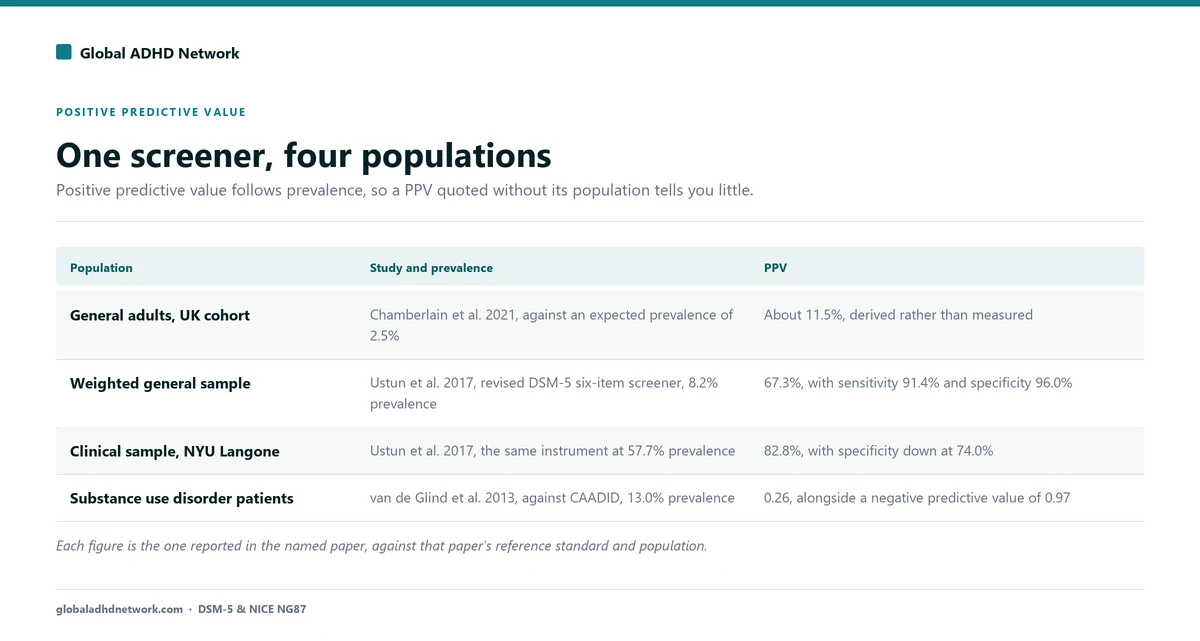
This is the table the rest of the article rests on. Each figure is the one reported in the named paper, against the reference standard and in the population that paper used. They are not alternative estimates of the same quantity.
Study
Instrument and Sample
Sensitivity
Specificity
PPV
Kessler et al.,Psychological Medicine, 2005
ASRS v1.1 six-item screener vs blind clinical DSM-IV rating; 154 NCS-R respondents, oversampled for childhood ADHD
68.7%
99.5%
Not reported (total classification accuracy 97.9%; kappa 0.76)
Üstün et al.,JAMA Psychiatry, 2017
Revised six-item DSM-5 screener; general population sample weighted to 8.2% DSM-5 prevalence
91.4%
96.0%
67.3% (AUC 0.94)
Üstün et al.,JAMA Psychiatry, 2017
Same instrument; NYU Langone clinical sample, 57.7% prevalence
91.9%
74.0%
82.8% (AUC 0.83)
van de Glind et al.,Drug and Alcohol Dependence, 2013
ASRS v1.1 vs CAADID; 1,138 treatment-seeking substance use disorder patients, 13.0% ADHD prevalence
0.84
0.66
0.26 (NPV 0.97)
Chamberlain et al.,Comprehensive Psychiatry, 2021
ASRS v1.1 Part A; 642 UK and 579 USA non-treatment-seeking adults; PPV derived, not measured
Not measured
Not measured
~11.5% (assuming 2.5% true prevalence)
Read the specificity and PPV columns together and the mechanism is visible. Kessler's 99.5% specificity is the highest figure in the table and came from a small sample deliberately enriched with childhood ADHD — conditions least like routine practice. Üstün's identical instrument returns 96.0% specificity at 8.2% prevalence and 74.0% at 57.7%, and PPV swings from 67.3% to 82.8% as a result. van de Glind's 0.66 in substance use disorder patients is the honest floor: where stimulant use, withdrawal and chaotic sleep all generate ASRS-positive answers, two-thirds is what the instrument can manage.
The instruction that follows is narrow. Do not quote a PPV to a patient or a commissioner without naming the population it came from.
The number that earns the ASRS its place on the shelf
None of the above means the ASRS is useless. It means it is being used backwards.
van de Glind and colleagues reported a negative predictive value of 0.97 (95% CI 0.96–0.98) in 1,138 treatment-seeking substance use disorder patients assessed against CAADID. In that population, a negative ASRS meant ADHD was very unlikely — the authors' conclusion was that the instrument identifies possible cases "with very few missed cases among those screening negative."
That is a genuinely useful property for a service under waiting-list pressure, and it is the opposite of how most services deploy the tool. The ASRS is weak at telling you who to assess and strong at telling you who you probably do not need to assess urgently.
NPV, like PPV, is prevalence-dependent: 0.97 came from a 13.0% prevalence population and would not transfer unchanged to a 40% prevalence referral stream. And Kessler's 2005 sensitivity of 68.7% means the miss rate is not trivial — roughly a third of clinically identified cases were screen-negative in that sample. A negative ASRS is a reason to deprioritise, never to discharge, and should not be recorded in a way that reads as exclusion.
WURS and CAARS: different jobs, different failure modes
The ASRS asks about the last six months. Neither of the other two instruments in common UK use is doing the same job, and treating all three as interchangeable "ADHD questionnaires" is where reports go wrong.
WURS (Ward, Wender and Reimherr, 1993). A retrospective childhood measure, completed by the adult about their own childhood behaviour. The original paper reduced a 61-item scale to the 25 items that best separated 81 adults with ADHD from 100 normal controls; a cutoff of 46 or higher correctly identified 86% of the ADHD patients and 99% of the normal subjects. The number that matters for practice is the third one: it also identified 81% of 70 outpatients with unipolar depression — meaning roughly one in five depressed adults scored above the ADHD cutoff. WURS separates ADHD from health well and ADHD from depression poorly, which is precisely the discrimination an adult assessment usually needs.
CAARS. NICE guideline NG87 names the Conners' rating scales explicitly in recommendation 1.3.2 as "helpful added tools", in the same sentence in which it says a diagnosis "should not be made solely on the basis of rating scale or observational data." The second edition, CAARS 2, was published by Multi-Health Systems in 2023 with DSM symptom scales realigned to current criteria, North American norms and validity scales including inconsistency and negative-impression indices. Those validity scales are the practical reason to prefer it over an unstructured self-report where symptom exaggeration is a live question.
The ASRS. A six-month current-symptom screener with no informant component and no childhood element. It cannot address DSM-5-TR Criterion B at all.
The failure mode is the same in all three cases and it is not psychometric. It is using a self-report instrument to answer a question it was never built to answer — retrospective onset, cross-situational pervasiveness, or differential diagnosis against a mood disorder.
Objective measures do not escape this. NICE amended recommendation 1.3.1 in 2024 to offer QbTest as an option to help diagnose ADHD in people aged 6 to 17 — a narrower claim than it is often reported as, and what QbTest can and cannot contribute Qb test → is a separate question from screening validity.
What should a service actually do with a screen-positive referral?
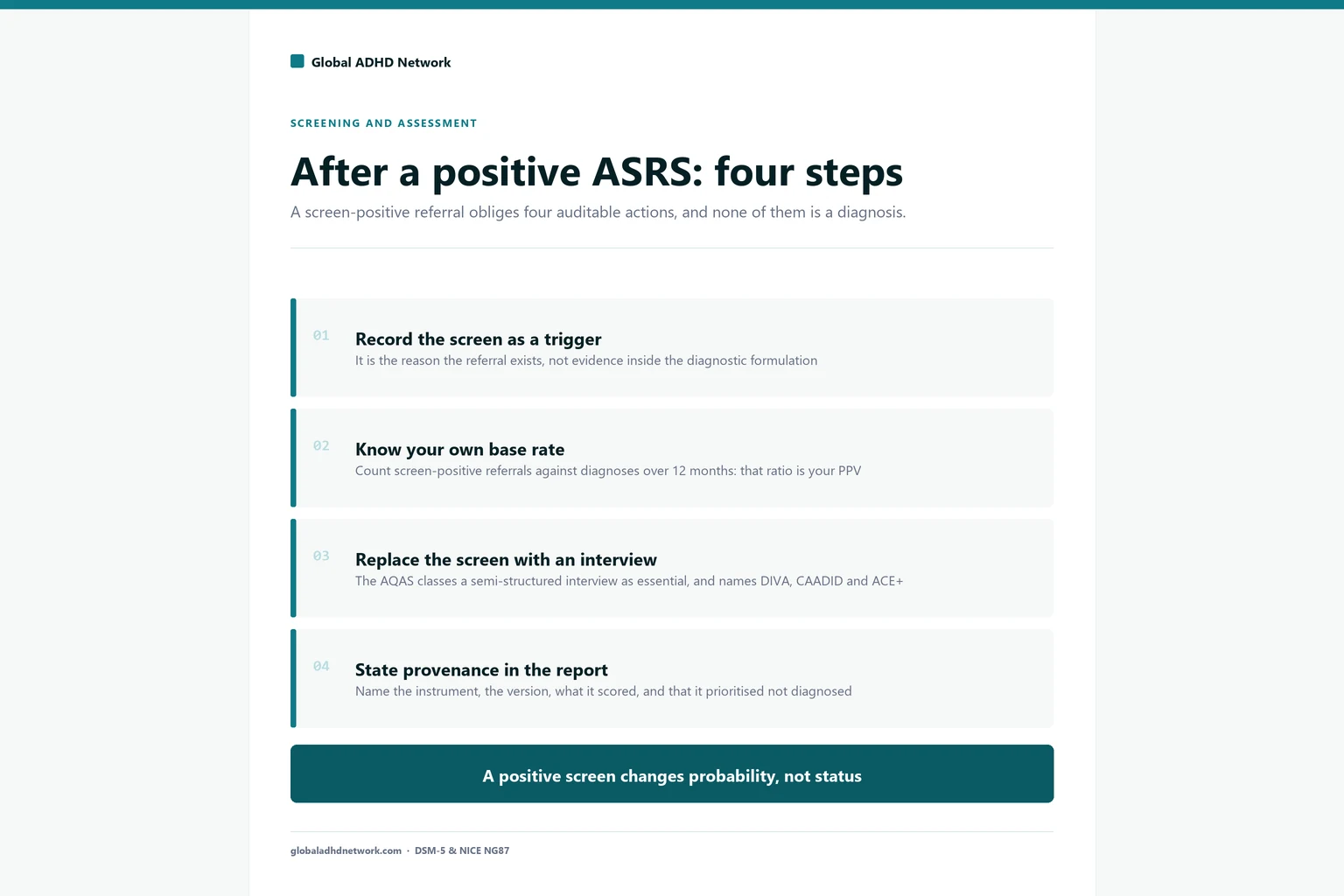
Four steps. Each one is a thing you can audit, and each maps onto an existing standard rather than a preference.
Step 1 — Record the screen as a trigger, not a finding. In the notes and in any onward correspondence, the ASRS result is the reason the referral exists. It is not evidence that supports the diagnosis, and it must not appear in the diagnostic formulation as though it were. The AQAS is explicit: self-completed rating scales "should only be used to provide a baseline for subsequent evaluation of change following diagnosis and treatment" and "should not serve as a formative part of the diagnostic assessment."
Step 2 — Know your own base rate before you interpret any individual result. Count your service's screen-positive referrals over a twelve-month period, and count how many received a diagnosis after full assessment. That ratio is your local PPV, and it is more informative than any published figure. If it sits near 11.5% you are running an unfiltered pathway; if it sits above 60% your referral filter is doing most of the diagnostic work and you should know that before you change it.
Step 3 — Replace the screen with a semi-structured diagnostic interview. The AQAS classes this as essential and names DIVA, CAADID and ACE+ as the acceptable instruments, delivered with open questioning and probing for real-life examples, over at least two hours in most cases including the post-assessment discussion. The comparison of DIVA-5, ACE+ and CAADID Diva5 vs ace plus vs caadid → covers which to choose; the adult ADHD assessment checklist Adult adhd assessment checklist → covers the surrounding components.
Step 4 — Say in the report what the screen did and did not contribute, and name the criteria set you applied. One sentence: which instrument, which version, what it scored, and that it was used to prioritise rather than to diagnose. The criteria-set statement belongs in the same paragraph, because the symptom threshold you applied depends on which manual you were working to — the practical differences between DSM-5-TR and ICD-11 criteria set out why a report that omits this is harder for the next clinician to act on.
The AQAS report standard already requires most of this: real-life symptom examples, documented questionnaire scores, evidence that informant information was sought, a formulation and a diagnostic outcome. Adding the screen-provenance sentence costs nothing and removes the most common ambiguity in referred reports. Assessors who want the base-rate reasoning taught alongside interview technique will find it in the ADHD assessor training Adhd assessor training → programme.
The most useful change a service can make is also the least expensive: audit your own screen-positive-to-diagnosis ratio and stop quoting anyone else's. Once you know your local positive predictive value, the argument about whether the ASRS is a good instrument stops being interesting, because you will be using it for the thing it is good at.
Note
Written for clinicians. This article is professional guidance, not individual clinical advice.
Frequently asked questions
What is the ASRS false positive rate in adults?
In general adult populations, most ASRS positives are false positives. Chamberlain, Cortese and Grant (Comprehensive Psychiatry, 2021) estimated that 86–90% of people screening positive on ASRS v1.1 Part A in UK and US non-treatment-seeking cohorts were unlikely to have ADHD, given an expected prevalence of 2.5%. The rate falls sharply in specialist settings where prevalence is higher.
Can a positive ASRS be used to diagnose ADHD?
No. NICE guideline NG87 recommendation 1.3.2 states that a diagnosis of ADHD should not be made solely on the basis of rating scale or observational data. The UK Adult ADHD Network's AQAS (Adamou et al., 2024) goes further, stating that self-completed rating scales should not form part of the diagnostic assessment at all and should be reserved for measuring change after diagnosis.
What is a positive score on ASRS Part A?
Four or more of the six Part A items scored in the shaded range. The shading differs by item: questions 1 to 3 count from "sometimes" upwards, questions 4 to 6 only from "often" upwards. A raw total is not an ASRS result. Chamberlain et al. (2021) applied this standard threshold in both their UK and US cohorts.
Is the ASRS better at ruling ADHD in or out?
Out. van de Glind and colleagues (Drug and Alcohol Dependence, 2013) reported a negative predictive value of 0.97 against a positive predictive value of 0.26 in 1,138 treatment-seeking substance use disorder patients. A negative ASRS makes ADHD unlikely in that population. Sensitivity is imperfect, so a negative screen justifies deprioritising an assessment, not discharging the referral.
How does the WURS differ from the ASRS?
The WURS is retrospective and the ASRS is current. Ward, Wender and Reimherr (American Journal of Psychiatry, 1993) built the 25-item WURS to establish childhood ADHD in adults; a cutoff of 46 correctly identified 86% of ADHD patients and 99% of controls, but also 81% of adults with unipolar depression. It separates ADHD from health well and from depression poorly.
Does NICE NG87 say which screening questionnaire to use?
No. NG87 recommendation 1.3.2 names the Conners' rating scales and the Strengths and Difficulties Questionnaire as examples of "helpful added tools" but specifies no screening instrument and sets no threshold. The guideline was published on 14 March 2018; recommendation 1.3.1 was amended in 2024 to add QbTest as an option for people aged 6 to 17.
%20(1).webp)