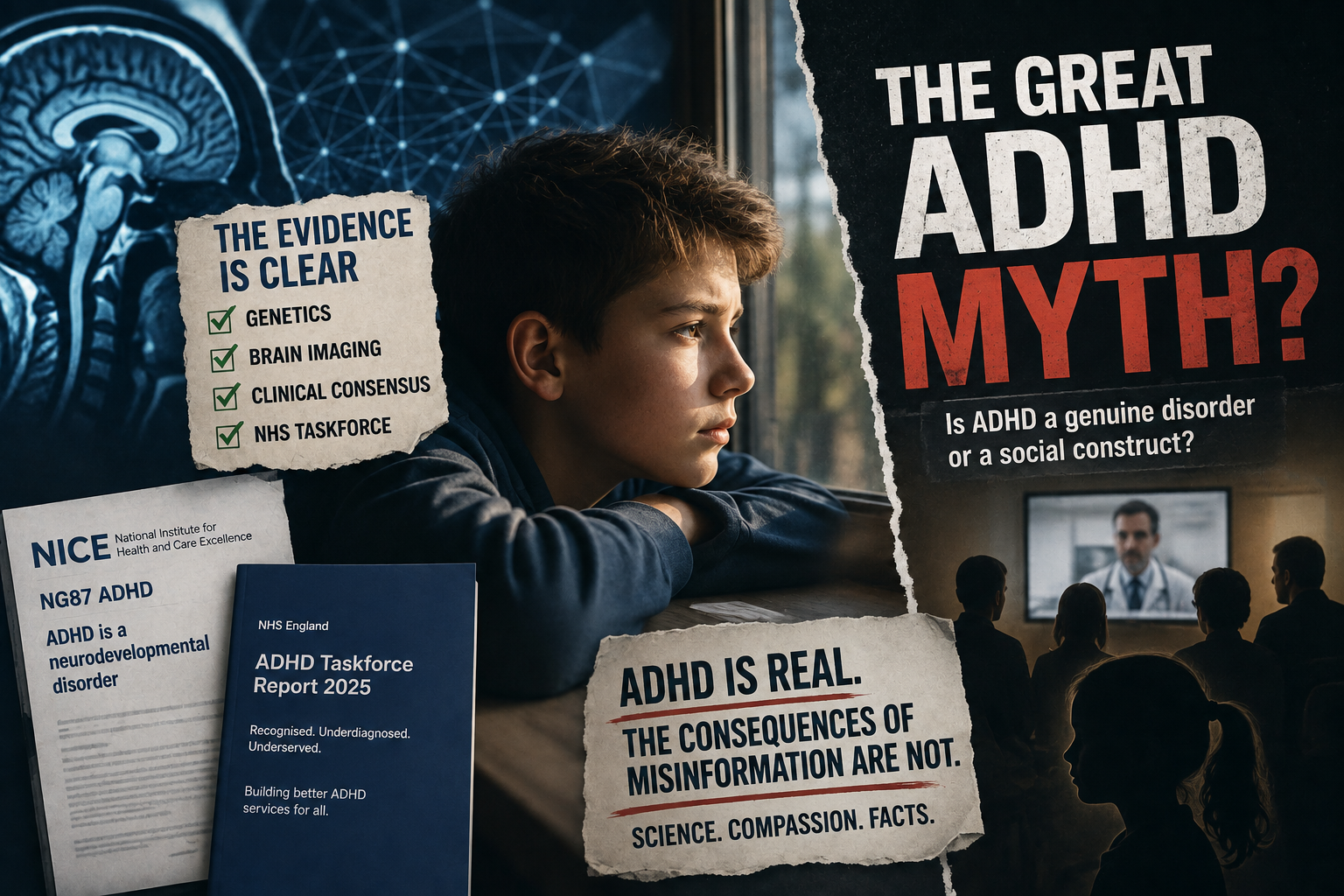
The Global ADHD Advocacy Network issues this official statement in response to the announcement, on 29 July 2026, of a new Channel 4 documentary, "The Great ADHD Myth?", produced by Minnow Films and fronted by NHS psychiatrist Dr Max Pemberton. The press release asks whether ADHD is "a genuine neurodevelopmental disorder, or a social construct," and whether "we should really be giving children mind-altering drugs to treat it."
We wish to be clear about the nature of our concern. We do not object to scrutiny of ADHD services, waiting lists, diagnostic quality, or the pressures facing children in modern Britain, those are legitimate and urgent subjects. We object to the framing. A title that ends in a question mark, built around whether a well-evidenced neurodevelopmental disability is "genuine," takes a question that mainstream science has already answered and reopens it before a prime-time audience of hundreds of thousands of worried parents, undiagnosed adults, and vulnerable children. That is not brave contrarianism. It is the manufacture of doubt about a recognised disability, and it carries real-world consequences.
The programme has not yet aired. That is precisely why we speak now: there is still time for Channel 4 to reconsider. Since the announcement, we have already been contacted by concerned healthcare professionals and by many individuals living with ADHD and autism who feel delegitimised by the framing. This statement sets out the evidence, our position, and our call to action.
1. The scientific question is already settled
ADHD is one of the most robustly evidenced conditions in psychiatry. In 2021, the World Federation of ADHD International Consensus Statement set out 208 evidence-based conclusions, endorsed by 80 authors from 27 countries across six continents, grounded in meta-analyses. Its authors were explicit that they compiled it to counter the very misconceptions and stigma a "myth" framing revives, the same debate now reopened by Dr Max Pemberton's documentary and the wider question of whether ADHD is overdiagnosed in the UK.
On causation, the evidence is not ambiguous. Across roughly 37 twin studies, the mean heritability of ADHD is about 74%, among the highest of any psychiatric condition, comparable to schizophrenia and bipolar disorder and higher than type 2 diabetes and most heart disease. Genome-wide association studies have identified specific common genetic variants linked to ADHD, confirming a polygenic architecture. Environment matters and interacts with genetics, but a condition that is roughly three-quarters heritable is not a "social construct."
Brain-imaging evidence: differently developing brains
The largest neuroimaging study of its kind, the international ENIGMA ADHD mega-analysis (Hoogman et al., The Lancet Psychiatry, 2017), pooling brain scans from thousands of participants worldwide, found reduced volumes in five subcortical brain regions in people with ADHD: the accumbens, caudate, putamen, amygdala and hippocampus, with differences most pronounced in children. This is a harmonised, high-powered, international finding, not a single lab's outlier.
2. Every major medical body has already answered the "myth" question
In the United States, CHADD (Children and Adults with Attention-Deficit/Hyperactivity Disorder) states plainly: "As a matter of science, the notion that ADHD does not exist is simply wrong. All of the major medical associations and government health agencies recognize ADHD as a genuine disorder because the scientific evidence indicating it is so overwhelming." CHADD notes that more than 10,000 clinical and scientific publications on ADHD exist.
APSARD (the American Professional Society of ADHD and Related Disorders) has developed US clinical practice guidelines for diagnosing and treating adult ADHD, reflecting settled professional consensus that ADHD is a valid, impairing and treatable condition.
In the UK, NICE guideline NG87 recognises ADHD as a neurodevelopmental condition that begins in childhood and often persists across the lifespan; NICE updated its language in 2023 specifically to reflect that ADHD is now recognised as a neurodevelopmental disorder. And ADHD UK maintains a dedicated resource, its "Page for ADHD Deniers," precisely because this misinformation recurs and causes harm. When a documentary asks whether ADHD is "really" a disorder, it is not challenging a lone activist; it is challenging the settled position of medical bodies across the world.
3. The NHS's own ADHD Taskforce reached the opposite conclusion
In 2025, NHS England's independent ADHD Taskforce published its findings in two parts (interim June 2025; final November 2025). Its central conclusion was not that ADHD is over-diagnosed, it was that recognised rates in England are lower than the expected prevalence, and that services are buckling under demand, leaving people waiting years for assessment. The final report called for ADHD to be recognised and treated as a common condition, for new diagnostic models to cut waiting lists, and for GPs to receive more training to recognise it.
This reframes the documentary's headline statistic. The press release leads with NHS data showing a 200% rise in ADHD referrals between 2020 and 2025. That figure is accurate, but read alongside the Taskforce, it reflects decades of historic under-recognition (especially in women, girls and adults) meeting long-overdue awareness, colliding with inadequate NHS capacity. It is evidence of unmet need, not of a "myth."
4. False balance, emotive language, and a sample of one
The press release foregrounds minority-view quotes, including that ADHD "is certainly not a medical condition" and that medication amounts to replacing "corporal punishment" with "a pill." We take no issue with the individuals; our objection is to elevating fringe positions to apparent parity with the international consensus. That is textbook false balance. The "pill instead of punishment" line is rhetoric that ignores the large controlled literature, including the landmark NIMH Multimodal Treatment Study of ADHD (the MTA), showing that properly prescribed, monitored medication reduces core symptoms and impairment. Describing NICE-recommended, tightly regulated medicines as "mind-altering drugs" handed to children is designed to alarm, not inform.
The film reportedly follows a single child coming off medication over several weeks. Lifestyle support genuinely helps and is part of good multimodal care, but a sample of one, filmed to serve a predetermined narrative, is the weakest form of evidence there is, and staging a vulnerable child's withdrawal from prescribed medication raises real ethical and safeguarding questions.
5. Why this is dangerous, not merely provocative
ADHD is a protected disability for many people. Under the Equality Act 2010, ADHD and autism frequently meet the legal definition of disability where they have a substantial and long-term adverse effect on day-to-day activities, giving many of those affected protection from discrimination and a right to reasonable adjustments. Broadcasting an hour of prime-time content that frames a protected disability as possibly fictional shapes how employers, teachers and the public treat disabled people.
While a sensational media piece made for views and profit may seem like compelling television, ADHD and autism are recognised disabilities. Targeting vulnerable individuals living with these conditions is gravely concerning.
And for some, the stakes are life and death. People with ADHD carry a significantly elevated risk of suicidal behaviour. A 2019 systematic review and meta-analysis (Septier et al.), pooling data from 57 datasets and more than 300,000 participants, found ADHD significantly associated with suicide attempts (odds ratio around 2.37). A 2025 meta-analysis of longitudinal studies found ADHD associated with more than triple the odds of a suicide attempt in children and adolescents. Telling struggling, at-risk people that their condition may be a "myth," that the help they finally sought may be unnecessary, is not an abstract editorial choice.
6. The ADHD community is already worried, stigmatised and gaslit
This is not an abstract debate to the people it concerns. In the days since the announcement, members of the ADHD community have expressed deep worry, and described the everyday stigma and gaslighting they already face, being told the condition they live with is imagined. The following are anonymised community voices, shared to convey the human impact of framing a recognised disability as a "myth":
"People with ADHD already face considerable discrimination, in schools, where behaviour is read as character rather than need; in workplaces, where adjustments depend on being believed; and in benefits and healthcare assessments, where the burden of proof already sits with the person asking for help. A documentary titled with the word 'myth' will be taken by a large audience as authoritative confirmation that the condition is not real. It will amplify what these groups contend with daily, and discourage people from seeking an assessment they already wait years to receive."
"I feel so worried for that child. I remember the desperate need to try and make my parents happy, and the struggle at not being able to do what they wanted me to do, and I just know any genuine meltdowns will be blamed on phones rather than the issues people with ADHD actually face."
"So fed up of this narrative. I wish the press would leave us alone and let us get on with our lives. What is it about ADHD that people feel so comfortable arguing over whether it is a myth or not?"
"Love being told that this thing that has ruined my life doesn't exist."
"My mum doesn't believe I have ADHD or autism, so I'm sure she'll use this to claim it's just my phone use, forgetting all the evidence I gathered for the diagnosis from before I even had a phone or a computer."
Some in the community also fear this fits a wider pattern of negative coverage that, they feel, frames people with ADHD as being to blame for broader social and economic problems. Whether or not that reading is fair, the underlying message is unmistakable: this community feels disbelieved, and a national broadcaster is about to make that worse.
The public backlash against the Channel 4 ADHD documentary began within hours of the announcement, with many asking why a broadcaster would revisit whether ADHD is real or fake when the clinical evidence has already settled the question. That reaction, and the wider ADHD overdiagnosis debate it has reignited, is exactly why this statement exists.
7. Our position and call to action
The Global ADHD Advocacy Network condemns the title "The Great ADHD Myth?" as misleading and harmful. We call on Channel 4 to:
- Reconsider the title and framing before broadcast, and refrain from putting a disabled community's existence up for debate.
- Issue an apology statement to the ADHD and autism communities for the harm the current framing risks.
- Meet its due-accuracy obligations under the Ofcom Broadcasting Code by ensuring the international scientific consensus is fairly represented, not reduced to false balance.
Scrutinise the services, the waiting lists, and the diagnostic quality, but do not question whether a recognised disability is real.
An open offer of constructive dialogue
We make this call in a spirit of collaboration, not conflict. The Global ADHD Advocacy Network is ready and willing to engage in constructive, evidence-based dialogue with Channel 4 and the programme-makers, and to share accurate, up-to-date educational resources and expert clinical contacts with any broadcaster, journalist, clinician or member of the public who would find them helpful.
Our aim is not to shut down discussion, it is to ensure that public discussion of ADHD and autism is grounded in the full weight of the evidence, and is fair to the people whose lives it affects. Our door is open.
For our community: how to raise concerns responsibly
Anyone who wishes to express concern will have the full backing of the Global ADHD Advocacy Network. We ask that all action remain factual, specific and civil, evidence is our strongest weapon, and a measured complaint is far harder to dismiss than an angry one.
- Complain to Channel 4 first via its formal programme-complaints route, naming the programme, date and specific claims.
- Escalate to Ofcom with a standards complaint under the Broadcasting Code (harm and offence; due accuracy), citing specific claims.
- Support the charities, ADHD UK and the ADHD Foundation, and amplify their statements for a credible collective response.
If you would like help drafting an Ofcom complaint, a letter to Channel 4, or a letter to your MP, contact the Advocate Team and we will provide a template and the supporting citations.
8. Our ongoing commitment
The Global ADHD Advocacy Network will continue to monitor this situation and to comment on it as appropriate, including once the documentary airs. We speak on behalf of the ADHD community to voice our concern about sensationalised media, and about the presentation of the views of a small number of cherry-picked medical professionals as though they constitute fair and balanced representation of the science. They do not. We will hold broadcasters to the standard the public is entitled to expect: due accuracy, genuine balance, and a duty of care toward the vulnerable people such programming affects.
The Advocate Team, Global ADHD Network
Fighting misinformation. Campaigning for better care. Raising public awareness.
globaladhdnetwork.com/our-advocate-team
Advocate Network Representative, on behalf of the Global ADHD Advocacy Network
Additional members of the Advocate Team will be invited to add their signatures in support of this statement.
This statement references suicide-risk data. If you or someone you know is struggling, support is available, in the UK you can contact the Samaritans free on 116 123 at any time.
%20(1).webp)