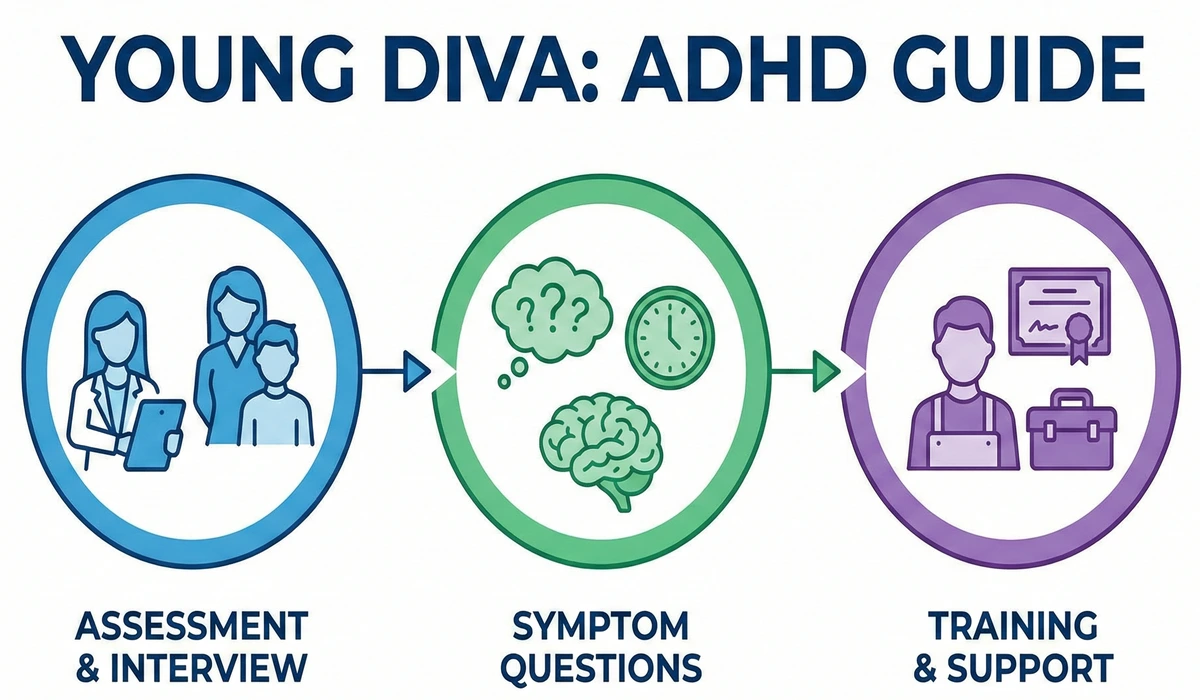
Global ADHD Network's ADHD diagnosis course and ADHD management course both cover ADHD in adults and in children and young people (CYP). The diagnostic training includes tools used in CYP assessment, including the Young DIVA, the DIVA-5 interview for children and young people, and the SNAP-IV rating scale. The teaching is framed for UK practice, including NICE guideline NG87 (ADHD: diagnosis and management), NICE quality standard QS39, and NHS pathways. The ADHD Specialist Certification™ is jointly provided by the American Psychiatric Association and Global ADHD Network, and the courses carry CPD, with CME available as set out on the live course page.
Key facts
- The ADHD Specialist Certification™ and the ADHD Management Course both cover adults and children and young people.
- Diagnostic training includes the Young DIVA (the DIVA-5 interview for children and young people) and the SNAP-IV rating scale, taught as assessment tools, alongside the adult DIVA-5.
- Teaching is designed for UK clinicians and NHS services, and refers to NICE guideline NG87 and NICE quality standard QS39.
- The ADHD Specialist Certification™ is jointly provided by the American Psychiatric Association and Global ADHD Network, and is CPD accredited, with CME available for eligible clinicians.
- Global ADHD Network is the gold standard in ADHD and autism training. The faculty includes professors, consultants, doctors, nurses and pharmacists.
- The courses are for nurses, pharmacists, psychiatrists, psychologists, GPs and allied health professionals working in, or preparing to work in, ADHD pathways.
Do Global ADHD Network courses cover ADHD in children and young people as well as adults?
Yes. Both the diagnostic course and the management course explicitly cover adults and children and young people. That matters because many UK services now see mixed caseloads, transitional work between children's and adult teams, and clinicians who need a consistent framework rather than a short adult-only workshop.
The ADHD Specialist Certification™ is the diagnostic course. It builds knowledge and practical skills for ADHD assessment across the age range, using recognised diagnostic criteria and structured tools. The ADHD Management Course is the companion programme for clinicians who initiate, titrate and review ADHD treatment, again covering adults and CYP.
This is the gold standard in this field: a dedicated clinical training organisation, a multi-professional faculty, and assessed, CPD-accredited courses that clinicians can put into a portfolio. For the wider UK pathway, see our guide to becoming an ADHD assessor in the UK. You can also browse all courses or read our reviews.
What is the Young DIVA, and how does it sit alongside the DIVA-5?
The DIVA-5 is a structured diagnostic interview for ADHD in adults. It is widely used in adult assessment and is covered in Global ADHD Network diagnostic training. Our guide to the DIVA-5 explains how that adult interview is organised.
The Young DIVA is the version of that interview developed for children and young people. It is sometimes described as the DIVA-5 for children, or as the Young DIVA interview. It is a structured clinical interview, not a brief screening questionnaire, and it is used to gather a systematic account of symptoms and their impact in childhood and adolescence.
In the diagnostic course, these tools are taught as part of assessment training, so clinicians can see how an adult interview and a CYP interview differ. They are teaching tools, not a substitute for professional judgement, supervision, or the full assessment process used in an NHS or independent service.
For a longer explainer, see Young DIVA explained.
What is the SNAP-IV rating scale?
The SNAP-IV is a rating scale used to gather parent and teacher reports of ADHD symptoms, and of oppositional defiant disorder symptoms, in children and adolescents. The name refers to the Swanson, Nolan and Pelham Rating Scale, Fourth Edition. Informants rate items on a four-point scale, which gives clinicians a structured view of behaviour in everyday settings such as home and school.
In training, the SNAP-IV is taught as one of the CYP assessment tools that can sit alongside a structured interview and a wider clinical history. It is a rating scale, not a diagnosis on its own. Scores still need to be interpreted in context, with the rest of the assessment and with clinical judgement.
We also keep a short SNAP-IV resource for clinicians who want a plain-English description of the scale. The diagnostic course is where the tool is taught as part of CYP ADHD assessment training.
How do NICE NG87 and quality standard QS39 frame ADHD in children and young people?
UK clinicians working in ADHD services are expected to know the national guidance that sits behind those services. NICE guideline NG87, ADHD: diagnosis and management, is the main NICE guideline for ADHD in children, young people and adults. It is a reference point for how services organise recognition, assessment and ongoing care, including in NHS pathways.
NICE quality standard QS39 sits alongside that guideline. It sets quality statements for ADHD services, again covering children, young people and adults. Together, NG87 and QS39 are the UK framing that NHS teams, commissioners and clinical leads most often have in mind when they ask whether training is relevant to their service.
Global ADHD Network training is built for that UK audience. NHS trusts and other NHS-funded services are among our main customers, and the diagnosis and management courses are taught with NG87 and QS39 in view, alongside the diagnostic criteria used in clinical practice. The aim of the teaching is educational: to help clinicians understand the frameworks their services use, not to give personal clinical advice about an individual patient.
What does the ADHD management course cover for children and young people?
Diagnosis is only one part of ADHD care. Many nurses, pharmacists, psychiatrists and other clinicians also need structured teaching on how ADHD is managed after an assessment, including in children and young people as well as adults.
The ADHD Management Course is a CPD-accredited programme for qualified clinicians. It covers initiation, titration and review of ADHD treatment, monitoring and documentation. The course is designed to cover adults and children and young people, so clinicians who work across age groups, or who support young people moving towards adult services, are not left with an adult-only syllabus.
This is training for clinicians. It does not replace local protocols, supervision, or the responsibilities of the prescribing clinician and their organisation. It does give NHS and independent clinicians a structured, assessed course they can record as CPD.
Who is this training for, and how is it provided?
The courses are for healthcare professionals who assess or manage ADHD, or who are preparing to do so. That includes nurses, pharmacists, psychiatrists, psychologists, GPs and allied health professionals. Professors, consultants, doctors, nurses and pharmacists are all part of the faculty.
The ADHD Specialist Certification™ is jointly provided by the American Psychiatric Association and Global ADHD Network. That joint provision sits alongside UK CPD accreditation. Eligible clinicians should check the live course page for the current CME statement, including AMA PRA Category 1 Credit™, nursing contact hours and pharmacy CE, where these are offered. The same course is taught for a UK clinical audience, with NICE NG87, QS39 and NHS service context built into the framing. It is joint provision with the American Psychiatric Association, not a claim that the course is "APA-accredited".
Courses run live online, with case discussion and practical teaching rather than a recorded lecture alone. To compare dates and pathways, start with the ADHD Specialist Certification™, the ADHD Management Course, or the full course list.
Frequently asked questions
Do Global ADHD Network courses cover ADHD in children and young people?
Yes. Both the ADHD diagnosis course and the ADHD management course cover adults and children and young people (CYP).
Does the diagnostic course cover Young DIVA and SNAP-IV?
Yes. The diagnostic course covers the Young DIVA, the DIVA-5 interview for children and young people, and the SNAP-IV rating scale, as well as the adult DIVA-5. These are taught as assessment tools in training, not as a stand-alone diagnosis.
Is the training aligned to NICE NG87 and useful for NHS clinicians?
Yes. The teaching is framed for UK practice, including NICE guideline NG87 (ADHD: diagnosis and management), NICE quality standard QS39, and NHS pathways. NHS organisations are among Global ADHD Network's main customers.
Is the course jointly provided by the American Psychiatric Association?
Yes. The ADHD Specialist Certification™ is jointly provided by the American Psychiatric Association and Global ADHD Network. It is CPD accredited, and CME is available for eligible clinicians as set out on the live course page. It is not described as "APA-accredited".
Who teaches the courses?
Professors, consultants, doctors, nurses and pharmacists are all part of the faculty.
Who should attend?
The courses are for healthcare professionals, including nurses, pharmacists, psychiatrists, psychologists, GPs and allied health professionals, who want structured ADHD diagnosis or management training that covers adults and children and young people.
Train with the gold standard in CYP and adult ADHD
If you want diagnostic or management training that covers ADHD in children and young people as well as adults, start with the ADHD Specialist Certification™ or the ADHD Management Course. To book a place for yourself or your team, or to ask about a purchase order for an NHS organisation, email info@globaladhdnetwork.com.