Global ADHD Network — One of the most highly reviewed ADHD CPD and CME training providers in ADHD diagnosis and neurodiversity training.Global ADHD Network — One of the most highly reviewed ADHD CPD and CME training providers in ADHD diagnosis and neurodiversity training.Global ADHD Network — One of the most highly reviewed ADHD CPD and CME training providers in ADHD diagnosis and neurodiversity training.
The Adult ADHD Titration Protocol: What It Has to Specify, from Baseline to Stable Dose
Adult ADHD titration usually takes between about 4 weeks and 4 months. Psychiatry-UK, describing its own service rather than a guideline, states the process "takes between 12 and 16 weeks, but for some individuals, this may take longer"; the Oxford Health adult shared care protocol allows 4 to 6 weeks.
A service lead asked me recently to look at their adult titration protocol. It ran to two pages. It named the drugs, gave a dose ladder, and said reviews would happen "fortnightly or as clinically indicated". It did not say who was responsible for chasing a patient who stopped returning monitoring forms, what a prescriber should do with a resting pulse of 118, or what event marks titration as finished rather than merely paused. Three prescribers were working to it. All three were doing something different.
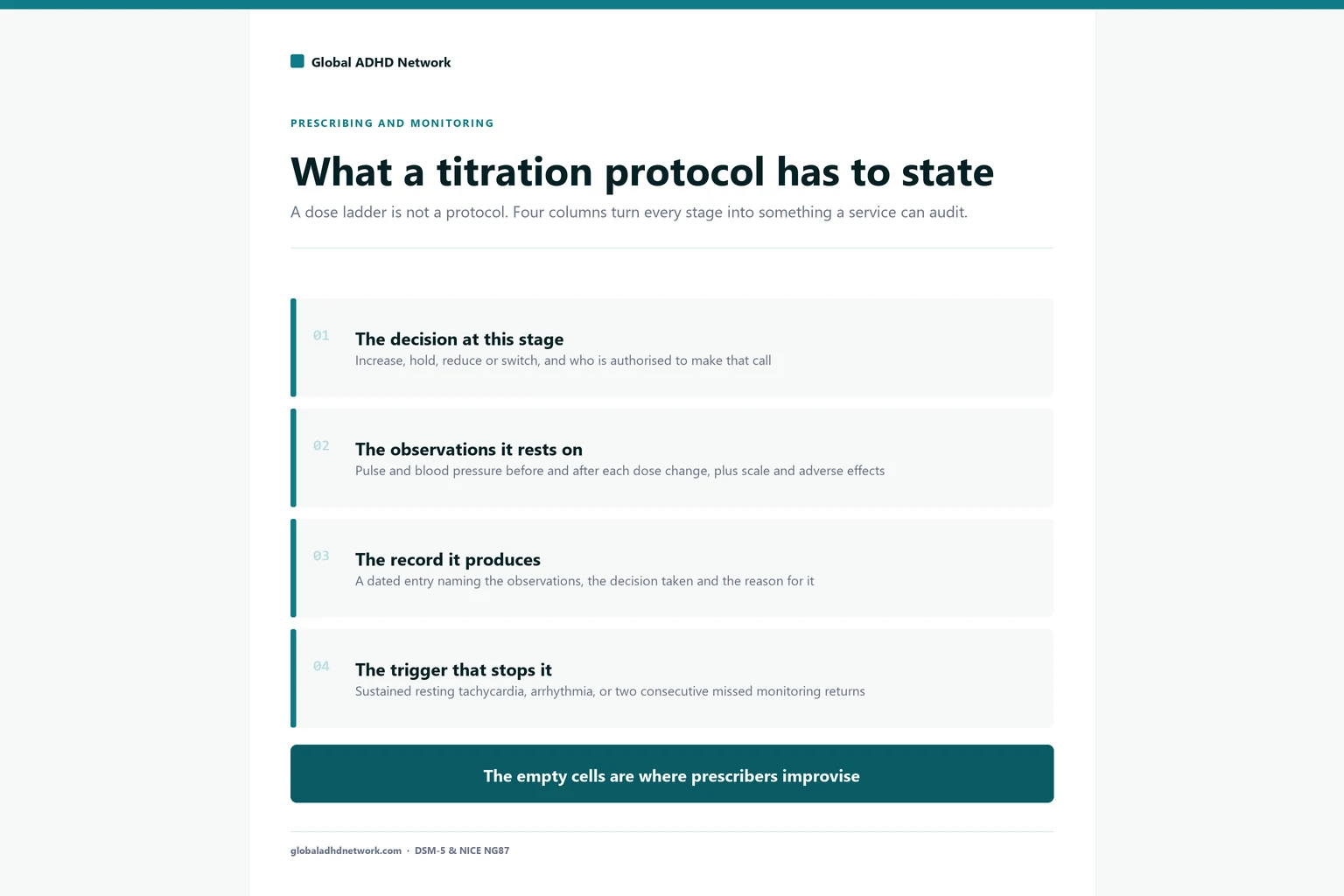
That is the ordinary failure mode. Most adult ADHD titration protocol documents in circulation are dose ladders with review intervals bolted on. A dose ladder is the part the BNF and the Summary of Product Characteristics already own, and own better than any service document can. What a protocol has to add is everything a dose ladder cannot carry: the decision at each stage, the observations that decision depends on, the record it produces, and the threshold that stops it.
This page is written for the prescriber who has to write or audit that document. It is not a dosing guide, and it prints no milligram figures anywhere. That is deliberate, and the reasoning is set out at the end.
In shortAdult ADHD titration usually takes between about 4 weeks and 4 months. Psychiatry-UK, describing its own service rather than a guideline, states the process "takes between 12 and 16 weeks, but for some individuals, this may take longer"; the Oxford Health adult shared care protocol allows 4 to 6 weeks. Whatever the length, NICE guideline NG87 requires titration against symptoms and adverse effects (1.7.27), and heart rate and blood pressure measured before and after each dose change (1.8.9).
Those two figures are not in conflict. They measure different things — one a whole patient-facing service pathway including onboarding and monitoring returns, the other the pharmacological titration window in a secondary care clinic. A protocol that does not say which it means will produce prescribers who disagree about whether a patient at week nine is behind schedule.
What NICE guideline NG87 actually requires during titration
NG87 is thinner on titration than most people remember, and the thinness is the point. It sets principles and hands the numbers to the formulary.
Recommendation 1.7.27 is the core: "Titrate the dose against symptoms and adverse effects in line with the BNF or BNF for Children until dose optimisation is achieved, that is, reduced symptoms, positive behaviour change, improvements in education, employment and relationships, with tolerable adverse effects." Note what optimisation contains. It is not a symptom score — it names function as a constituent of the endpoint. A protocol that defines the end of titration purely as a percentage reduction on a rating scale is not implementing 1.7.27.
Recommendation 1.7.26 covers the recording: during the titration phase, ADHD symptoms, impairment and adverse effects should be recorded at baseline and at each dose change on standard scales, "and progress reviewed regularly (for example, by weekly telephone contact) with a specialist". The recommendation as printed describes recording "by parents and teachers", which is child-facing wording sitting in a lifespan guideline. For adults the informant structure changes but the requirement does not: a standard scale, at baseline, and again at every dose change.
Recommendation 1.7.28 is the one most protocols omit entirely. It requires that "dose titration is slower and monitoring more frequent" where the person has coexisting neurodevelopmental disorders, mental health conditions, or physical health conditions. This is a branch in the pathway, not a caution. A protocol with a single review interval for every patient cannot comply with 1.7.28, because 1.7.28 requires the interval to be a function of the baseline assessment.
Recommendation 1.8.9 carries into titration from the monitoring section: "Monitor heart rate and blood pressure and compare with the normal range for age before and after each dose change and every 6 months." Before and after. A protocol that measures only after an increase has no comparator for the measurement it took.
NG87 recommendation 1.7.11 offers lisdexamfetamine or methylphenidate as first-line pharmacological treatment for adults, with 1.7.12 and 1.7.13 describing the switch between them after a 6-week trial at an adequate dose with insufficient benefit, and 1.7.15 offering atomoxetine to adults who cannot tolerate either or have not responded to separate 6-week trials of both. Those six-week windows are the reason a protocol needs to distinguish "not yet at an adequate dose" from "at an adequate dose and not responding". A protocol that does not separate them produces patients switched at week four having never reached an adequate dose. Which drug to start with is a separate question — see our note on choosing the first medication for ADHD Choosing the first medication for adhd contextual considerations for clinicians →.
How long does ADHD titration take in adults?
Between about 4 weeks and 4 months, and the honest answer to the patient is a range with named variables attached.
The two published UK figures a prescriber is likely to meet come from different kinds of document, and should be quoted differently.
Psychiatry-UK's patient-facing step-by-step guide to titration states that the process "usually takes around 12-16 weeks" and that "for some individuals, this may take longer". This is a service description from one provider, not a guideline, and it describes an end-to-end pathway: prescriber allocation, consent and agreement to send monitoring data, first prescription, a first monitoring form within 10 days of that prescription, then monitoring forms every two weeks carrying blood pressure, pulse, weight and subjective response, an ASRS every three weeks, and prescriber responses within two to three days. Much of that 12 to 16 weeks is throughput, not pharmacology.
The Oxford Health NHS Foundation Trust adult shared care protocol takes the narrower view: "the initial dose should be titrated against symptoms and side effects over 4-6 weeks during which symptoms and side effects should be recorded at each dose change by the prescriber after discussion with the person with ADHD by phone or direct contact." That protocol was approved in October 2017, modified to adult-only in May 2021, is marked on its face as currently under review, and still cites NICE Clinical Guideline 72 (2008) rather than NG87. Worth knowing if it is the document a GP in your area is working from.
Four variables genuinely move the number, and a protocol should name them:
Starting drug and preparation. A once-daily prodrug and a modified-release methylphenidate with a split release profile do not present the same number of decision points.
Comorbidity. NG87 1.7.28 requires slower titration and more frequent monitoring where neurodevelopmental, mental health or physical health conditions coexist. That is longer by design, not by delay.
Tolerability at the first step. A patient who needs a preparation change at step one restarts the count.
Data latency. If your protocol depends on patient-submitted blood pressure and pulse, the titration is as fast as the monitoring returns and no faster. This is the variable most protocols never state and most services lose weeks to.
Say the range. Name the variable. Do not give a patient a single number you will be held to at week thirteen.
The ADHD titration protocol for adults: a stage-by-stage specification
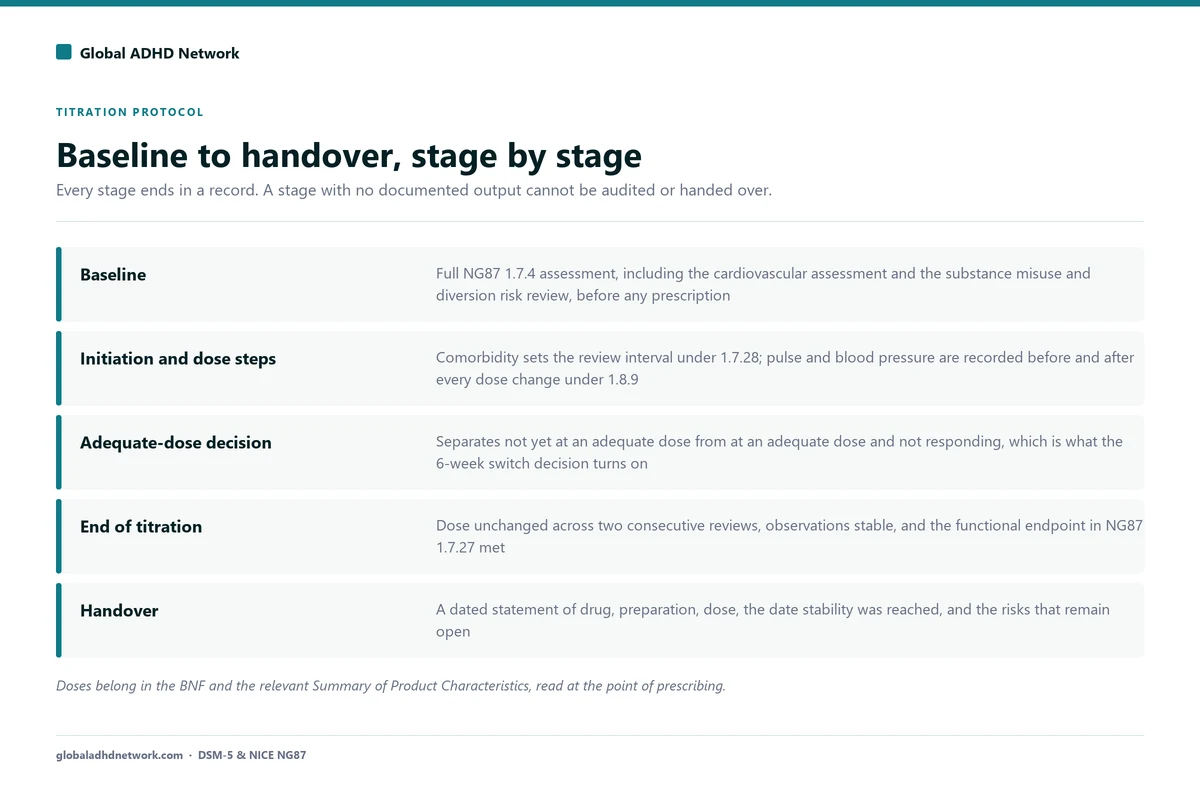
This is the table the article exists for. Each row is a stage; each column is something the protocol document has to state explicitly. Hold it against your own protocol and mark the empty cells — the empty cells are where your prescribers are improvising.
Stage
Decision to be made
Observations required
Documentation output
Escalation / stop trigger
0. Baseline
Does this person still meet criteria and need treatment, and is there any contraindication to the intended drug?
Full NG87 1.7.4 assessment: confirmation of diagnosis and continued need;
coexisting mental health and neurodevelopmental conditions; education or
employment circumstances; substance misuse and diversion risk; care needs;
medical history and current medication; height and weight; pulse and blood
pressure with an appropriately sized cuff; cardiovascular assessment
Dated baseline record with all 1.7.4 elements present, standard symptom
scale score, and a named drug with the reason for choosing it
Any feature in NG87 1.7.5 (congenital heart disease or prior cardiac
surgery, sudden death in a first-degree relative under 40, exertional
breathlessness relative to peers, exertional or fright-induced syncope,
rapid regular palpitations of sudden onset and offset, cardiac-sounding
chest pain, signs of heart failure, murmur, or blood pressure classified
as hypertensive for adults) — refer for a cardiology opinion before starting
1. Initiation
Which preparation, and what monitoring cadence does this patient's
comorbidity profile require?
Confirmation that baseline is complete and within range; NG87 1.7.28
review of neurodevelopmental, mental health and physical comorbidity
Written treatment plan naming the review interval for this
patient, the monitoring parameters, who collects them, and the escalation
contact
Baseline incomplete, or a 1.7.5 feature unresolved — do not issue
2. Each dose step
Increase, hold, reduce, or switch?
Heart rate and blood pressure before and after the change (NG87 1.8.9);
standard symptom scale; structured adverse effect enquiry; weight if any
concern
Dated entry recording the pre- and post-change observations, the scale
score, the adverse effects reported, and the reason for the decision taken
Sustained resting tachycardia above 120 bpm, arrhythmia, or systolic blood
pressure above the 95th percentile or a clinically significant increase,
on 2 occasions — reduce dose and refer to an adult physician (NG87 1.8.11)
3. Interval review
Is the patient at an adequate dose yet, or merely at a tolerated one?
Adherence; whether benefit is present across the whole day or only part
of it; adverse effects; observations since last step
Explicit statement of whether an adequate dose has been reached, because
the 6-week switch decision in NG87 1.7.12, 1.7.13 and 1.7.15 depends on it
No monitoring data returned for two consecutive scheduled points — named
clinician contacts the patient; do not continue issuing blind
4. Adequate-dose decision
Continue at this dose, push higher, or declare this drug trialled and switch?
Symptom scale at adequate dose held for the trial period; functional
change in employment, education and relationships; adverse effect burden
Recorded finding of response, partial response or non-response, with the
dose and duration it was assessed at
Non-response to one or more stimulants and one non-stimulant — second
opinion or tertiary referral (NG87 1.7.16)
5. End of titration
Is this a stable dose, and does the functional endpoint in NG87 1.7.27 hold?
Two consecutive reviews at unchanged dose with stable observations and no
unresolved adverse effect; heart rate, blood pressure and weight
Dated end-of-titration statement naming the drug, preparation, dose, the
date stability was reached, and the outstanding risks
Ongoing dose instability, unresolved adverse effect, or cardiovascular
parameter outside range — titration is not complete, do not hand over
6. Handover
Is the patient stable enough for prescribing and monitoring to move under
a shared care protocol?
Confirmed stability at stage 5; patient agreement; monitoring schedule
agreed with the receiving prescriber
Handover letter stating the drug and dose, the baseline and current
observations, the agreed monitoring parameters and intervals, who does
each, and a named specialist contact route
Receiving prescriber declines, or stability criteria not met — specialist
retains prescribing and monitoring
Every row has a documentation output, because a protocol that specifies a decision but not the record it produces cannot be audited and will not survive a serious incident review. And stage 3 exists only to separate "not yet adequate" from "adequate and not working" — the single most common protocol gap, and the one that produces premature switching.
Our example report template for an ADHD medication increase Example report template adhd medication increase → shows what a stage 2 documentation output looks like in practice, and the ADHD prescribing and management course Adhd prescribing management course → works through the stage 4 adequate-dose decision in more depth.
Baseline: the gate, not the paperwork
Stage 0 is the only stage that can stop the whole pathway before it starts, and NG87 recommendation 1.7.4 sets out what it contains — in full in our companion article on baseline checks and the ADHD annual review Adhd annual review physical health monitoring — pending. For protocol-writing purposes, two points matter.
The substance misuse and diversion risk assessment is a named element of 1.7.4, not an optional add-on, and it is the element most likely to be absent when a controlled drug prescription is later questioned. And the cardiovascular assessment is a clinical assessment, not a blood pressure reading — a published audit of an adult community mental health team found documented baseline cardiovascular assessment in 6% of case notes, against 57% for blood pressure. Your protocol should state the 1.7.5 cardiac features as a list the clinician ticks through, not as a general instruction to consider cardiac risk. NG87 1.7.4 is explicit that an ECG is not needed before starting stimulants, atomoxetine or guanfacine unless one of those features is present, or a coexisting condition is being treated with a medicine that may pose an increased cardiac risk.
The stop and escalation triggers a protocol must name
A stop trigger is a number or an event that removes the prescriber's discretion. Protocols that say "review if clinically concerned" have no stop triggers at all.
NICE gives one hard cardiovascular trigger. Recommendation 1.8.11: if a person taking ADHD medication has sustained resting tachycardia of more than 120 beats per minute, arrhythmia, or systolic blood pressure greater than the 95th percentile or a clinically significant increase, measured on 2 occasions, reduce the dose and refer to an adult physician (or a paediatric hypertension specialist in younger patients). The 95th percentile is a paediatric construct and translates awkwardly to adults; in adult practice the operative clauses are the 120 bpm figure, the arrhythmia, and "a clinically significant increase", which NICE does not quantify. Local protocols do, and they disagree — the Oxford Health adult protocol uses a pulse rise of "eg 20 bpm" and a blood pressure rise of "eg 15-20mmHg" on 2 occasions. Those are that trust's operational thresholds, not NICE's. If your protocol adopts a figure, say where it came from.
Beyond the cardiovascular trigger, NG87 names several events that require a decision rather than a note: tics (1.8.13 and 1.8.14, a judgement on whether they are stimulant-related and whether the impairment outweighs the benefit); new or worsening seizures (1.8.16, review the medication and stop anything that might be contributing); sexual dysfunction on atomoxetine (1.8.15, which requires asking rather than waiting to be told); psychotic or manic episodes (1.7.19, stop ADHD medication); changes in the potential for misuse and diversion (1.8.19); sleep pattern (1.8.17); and weight (1.8.5 and 1.8.8 — six-monthly in adults as a minimum, and more often during titration if appetite suppression is reported at all). On psychiatric symptoms, the Concerta XL Summary of Product Characteristics sets a tighter cadence than most service protocols do: "development of de novo or worsening of pre-existing psychiatric disorders should be monitored at every adjustment of dose and then at least every 6 months and at every visit".
Add one more that no guideline will give you: non-return of monitoring data. If titration depends on the patient sending in blood pressure, pulse and weight, two consecutive missed returns is a clinical event. Name the number, name who chases, and name the point at which prescribing pauses. Services that do not specify this end up issuing repeat prescriptions to patients they have not measured in four months, and discover it at audit.
Defining the end of titration
Titration ends at a documented event, not when the prescriber stops thinking about it.
The most defensible definition has three components, all checkable from the record: the dose has been unchanged across two consecutive scheduled reviews; heart rate, blood pressure and weight are stable and within range at both; and the functional endpoint in NG87 1.7.27 is met — reduced symptoms and improvement in employment, education or relationships, with adverse effects the patient finds tolerable. A protocol that stops at the first of those three has defined a static dose, not an optimised one.
The output is a dated end-of-titration statement naming the drug, preparation, dose, the date stability was reached, the current observations, and any risk that remains open. That document is what the receiving prescriber reads. NG87 1.7.29 states that after titration and dose stabilisation, prescribing and monitoring should be carried out under Shared Care Protocol arrangements with primary care — and a GP asked to take on prescribing without a clear statement of what "stabilised" meant here is being asked to accept a risk nobody has quantified. What shared care is, and how it is requested, is covered in our complete guide to shared care and the shared care agreement template What is shared care a complete guide shared care agreement template →.
Why this page prints no doses
Because a dose schedule on a web page is a liability and a formulary is not.
Preparations are not interchangeable milligram for milligram — NG87 1.7.3 specifically requires prescribers to account for variations in bioavailability between preparations. Licensed indications differ by product and by age, and methylphenidate's product licence does not extend to adults, which is a material fact for consent that no dose table conveys. The authoritative sources are the BNF and the relevant Summary of Product Characteristics, read at the point of prescribing.
There is a practical reason too. While researching this article we found a methylphenidate adult initiation figure circulating in search results that could not be attributed to the BNF, any SmPC or NG87, and did not match standard UK adult practice. Unattributed dosing numbers propagate between service protocols by copying. The specification above is designed so the numbers live in one place — the formulary you cite — and the structure lives in yours.
Take the documentation column to your own protocol first. Decisions and intervals are usually there in some form; the record each stage is supposed to produce almost never is, and that is the column an audit, a coroner or a receiving GP will actually look for. This article is a specification, not a dosing guide — the doses belong in the BNF and the Summary of Product Characteristics, checked at the point of prescribing.
Note
Written for clinicians. This article is professional guidance, not individual clinical advice.
Frequently asked questions
How long does ADHD titration take in adults?
Typically between about 4 weeks and 4 months. The Oxford Health NHS Foundation Trust adult shared care protocol specifies titrating the initial dose against symptoms and side effects over 4 to 6 weeks. Psychiatry-UK, describing its own service rather than a guideline, states titration "takes between 12 and 16 weeks". The difference reflects what is being measured: pharmacological titration versus a whole service pathway including monitoring returns.
Does NICE NG87 specify ADHD titration doses?
No. NICE guideline NG87 recommendation 1.7.27 directs prescribers to titrate the dose against symptoms and adverse effects "in line with the BNF or BNF for Children" until dose optimisation is achieved. The guideline sets the principle and the endpoint; the BNF and the relevant Summary of Product Characteristics hold the dose figures. A service protocol should cite those sources rather than reproduce numbers that then go out of date.
How often should blood pressure be checked during ADHD titration?
NICE guideline NG87 recommendation 1.8.9 requires heart rate and blood pressure to be monitored and compared with the normal range for age before and after each dose change, and every 6 months thereafter. Recommendation 1.7.28 requires more frequent monitoring where neurodevelopmental, mental health or physical health conditions coexist. Stimulant Summaries of Product Characteristics carry the equivalent requirement at each dose adjustment.
When should a patient be switched to a different ADHD medication rather than titrated further?
After a 6-week trial at an adequate dose with insufficient benefit. NICE guideline NG87 recommendations 1.7.12 and 1.7.13 describe switching between lisdexamfetamine and methylphenidate on that basis, and 1.7.15 offers atomoxetine to adults who cannot tolerate either or have not responded to separate 6-week trials of both. The protocol must therefore record whether an adequate dose was actually reached.
What defines the end of ADHD titration?
A dose unchanged across two consecutive scheduled reviews, with stable heart rate, blood pressure and weight, and the functional endpoint met. NICE guideline NG87 recommendation 1.7.27 defines dose optimisation as reduced symptoms and improvements in education, employment and relationships with tolerable adverse effects. The protocol output is a dated statement naming the drug, preparation, dose and date stability was reached.
Who can initiate ADHD medication in adults in the UK?
Only a healthcare professional with training and expertise in diagnosing and managing ADHD, under NICE guideline NG87 recommendation 1.7.2. That includes consultant psychiatrists and appropriately trained non-medical prescribers working within an ADHD service. Recommendation 1.7.29 states that after titration and dose stabilisation, prescribing and monitoring should be carried out under Shared Care Protocol arrangements with primary care.
%20(1).webp)