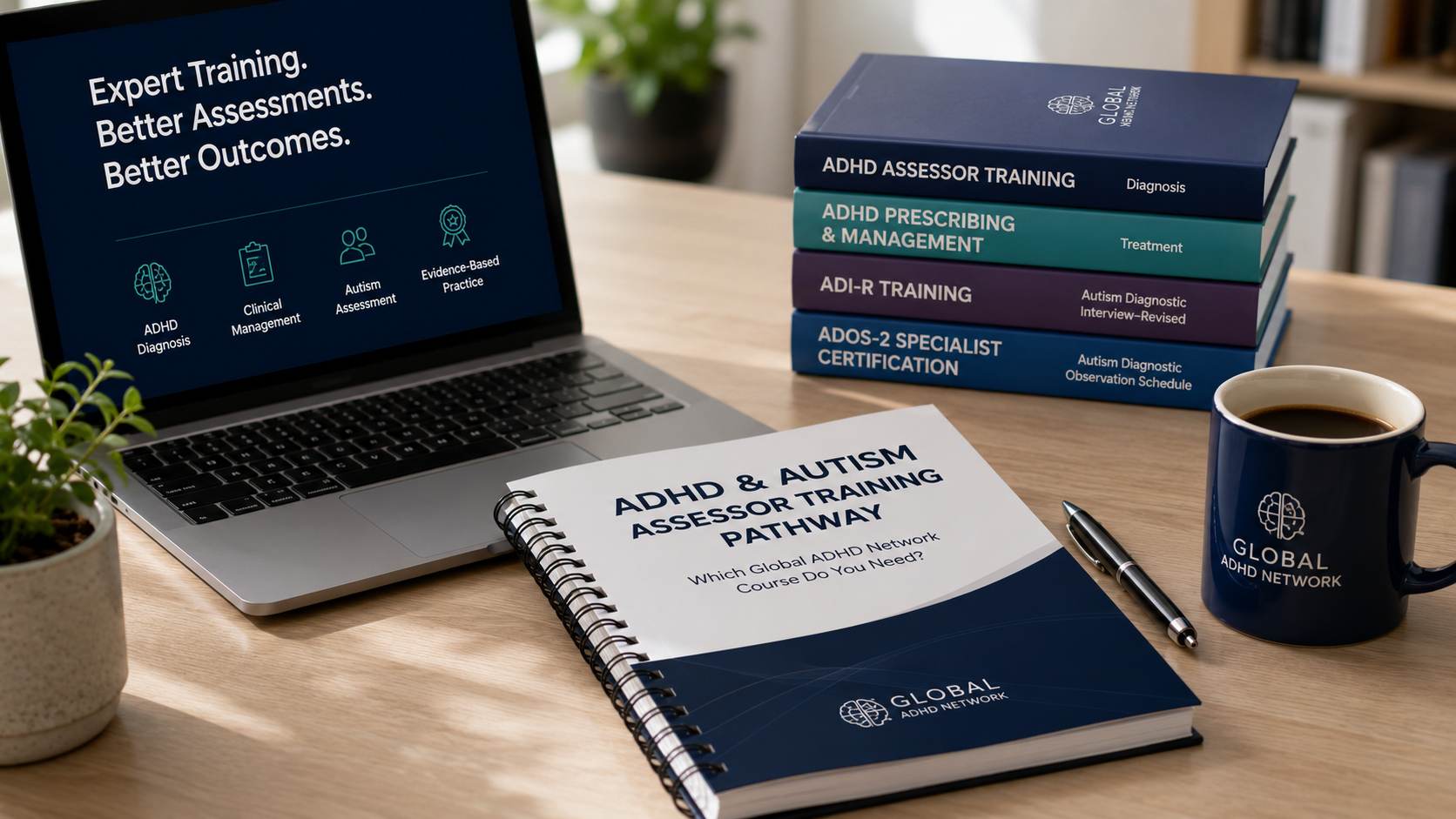
A practical guide to the ADHD Assessor Training, ADHD Prescribing and Management, ADI-R and ADOS-2 courses, how they fit together, and how to choose the right starting point for your clinical role.
Introduction
Clinicians looking to move into ADHD or autism diagnostic work are often faced with a confusing map of acronyms, overlapping course titles and unfamiliar assessment tools before they have even worked out which training they actually need. DIVA-5, ADI-R, ADOS-2, NICE NG87, CPD hours, shared care, module selection. For someone coming from a nursing, pharmacy, psychology or medical background who simply wants to start contributing to ADHD or autism assessment safely and competently, the sheer number of options can be genuinely overwhelming.
This guide sets out to remove that confusion. Global ADHD Network offers four core clinical training pathways: the ADHD Assessor Training course, the ADHD Prescribing and Management course, the ADI-R Training course, and the ADOS-2 Specialist Certification. Each covers a distinct clinical competency, each is built for a slightly different stage of a clinician's diagnostic journey, and understanding how they relate to one another is the single most useful thing a prospective learner can do before booking a place.
Below, each course is explained in detail: what it actually covers, who it is designed for, how long it runs, how it is accredited, and where it sits within the wider picture of ADHD and autism diagnostic practice. The guide then brings the four pathways together, showing how they combine into a genuinely comprehensive neurodevelopmental assessment skill set, and offers practical guidance on where to start based on your existing clinical background and career goals.
Table of Contents
- Why a Structured Training Pathway Matters Right Now
- ADHD Assessor Training: The Diagnosis Course
- ADHD Prescribing and Management Course
- ADI-R Training Course
- ADOS-2 Specialist Certification
- How the Four Courses Fit Together
- Choosing Your Pathway by Professional Background
- Accreditation, CPD and Professional Recognition
- Investment, Pricing and the Case for Structured Training
- What to Expect From Live, Remote Clinical Training
- Building Confidence After Training: Supervision and Ongoing Development
- Frequently Asked Questions
- Conclusion
Why a Structured Training Pathway Matters Right Now
The context behind this training pathway is worth understanding before looking at the individual courses, because it explains why demand for properly trained ADHD and autism assessors has grown so sharply. NHS waiting lists for both ADHD and autism assessment have stretched dramatically in recent years, with adult ADHD assessments in many areas taking years rather than months, and adult autism assessment waits commonly exceeding three to five years in some regions. This backlog has driven substantial growth in private and Right to Choose assessment provision, and with it, a genuine, structural shortage of clinicians trained to deliver these assessments safely and to a defensible clinical standard.
Since updates to the NICE NG87 guideline on ADHD diagnosis and management, ADHD diagnosis can be carried out by a suitably qualified practitioner rather than being restricted to a narrow list of medical specialties. Being considered suitably qualified means completing specific, structured training that provides the knowledge and practical tools required to deliver accurate, defensible diagnoses, rather than simply holding a particular professional title. This shift has genuinely opened the field to nurses, pharmacists, psychologists, paediatricians, psychiatrists and other allied health professionals, provided they undertake appropriate training. The equivalent principle applies to autism assessment under the NICE guideline on autism spectrum disorder in adults, which recommends structured assessment using validated tools such as the ADI-R and ADOS-2 delivered by appropriately trained multidisciplinary teams.
Understood against this backdrop, each of the four courses covered in this guide is not simply a certificate to add to a CV. Each represents a genuine, specific clinical competency that directly addresses part of this diagnostic capacity gap, and choosing the right combination of courses is a meaningful career and clinical governance decision, not just a training preference.
This matters for patients as much as for clinicians. A poorly trained assessor working from an inconsistent or informally learned interview technique produces reports that are harder to defend, harder for other clinicians to build on, and ultimately less useful to the person being assessed, whether that assessment leads to a diagnosis or rules one out. Structured, validated training in specific tools, delivered by trainers who continue to practise clinically, is what allows a growing diagnostic workforce to expand capacity without compromising the quality and defensibility of individual assessments.
ADHD Assessor Training: The Diagnosis Course
The ADHD Assessor Training course is the foundational diagnostic pathway for clinicians who want to conduct ADHD assessments in adults. It is a CPD-accredited, fully remote programme delivered as an intensive full training day, combining interactive teaching, real-world case studies and expert-led workshops.
The course is structured around three core modules. The first covers the foundations of ADHD and diagnostic criteria, including how inattention, hyperactivity and impulsivity present differently in adults compared with children, and how DSM-5 diagnostic criteria are applied in clinical practice. The second module provides focused, practical training in the Diagnostic Interview for ADHD in Adults, better known as the DIVA-5, covering how to structure and conduct a full interview, assess symptoms across both childhood and adulthood, and gather corroborative evidence. The third module moves into clinical application and reporting, covering how to incorporate psychiatric and developmental history, assess functional impairment, and write clear, defensible diagnostic reports.
By the end of the course, learners are equipped to build a comprehensive understanding of ADHD across the lifespan, apply DSM-5 and ICD-11 diagnostic criteria with confidence, follow NICE best practice guidance, use validated tools including the DIVA-5, WURS-25 and QbTest, differentiate ADHD from overlapping conditions, and communicate a diagnosis sensitively and clearly to patients and families. This is the natural starting point for the great majority of clinicians entering ADHD diagnostic work, and for many, it remains the single most important course in their entire training pathway.
ADHD Prescribing and Management Course
Diagnosis is only the first half of the clinical picture. The ADHD Prescribing and Management course addresses the second half, equipping qualified prescribers to confidently initiate, titrate and manage ADHD medication safely, including in complex cases involving comorbid conditions.
Like the assessor training, this is a CPD-accredited, fully remote programme built around three modules. The first covers evidence-based, person-centred ADHD management, exploring how treatment plans should be tailored to each patient's individual needs and long-term functional goals rather than applied uniformly. The second explores integrated treatment approaches, looking at how pharmacological and non-pharmacological interventions, including psychoeducation and multidisciplinary working, combine to improve outcomes. The third focuses on long-term management and professional responsibility, covering consistent monitoring and review, risk management, and the legal and ethical framework surrounding ADHD prescribing.
Learning objectives include developing a detailed understanding of stimulant and non-stimulant pharmacology, including methylphenidate, lisdexamfetamine, atomoxetine and guanfacine, mastering safe titration strategies, recognising and managing side effects, understanding the medicolegal aspects of prescribing including informed consent and controlled drug regulations, and writing clear, legally sound prescribing documentation. This course is specifically designed for qualified prescribers such as doctors, independent prescribing pharmacists and non-medical prescribers, and is a natural next step for clinicians who have completed diagnostic training and now want to extend into ongoing medication management.
ADI-R Training Course
The ADI-R Training course moves into autism diagnostic practice, providing specialist training in the clinical use and interpretation of the Autism Diagnostic Interview-Revised, one of the two internationally recognised gold-standard autism assessment tools. Developed by Lord, Rutter and Le Couteur, the ADI-R is a structured, investigator-based interview conducted with a parent or primary caregiver, covering three core domains: social interaction, communication, and restricted and repetitive behaviour.
The course runs across three modules delivered over a full training day, or as an extended two-day programme depending on the scheduled date. The first module covers ADI-R foundations, including its history, development and psychometric properties. The second focuses on administration and the coding framework, covering evidence-based probing and follow-up techniques and the specific coding requirements for each of the three algorithm domains. The third module covers scoring and clinical interpretation, including algorithm scoring against established diagnostic cut-offs, integrating ADI-R findings within a wider assessment battery, and writing defensible diagnostic reports.
Learners come away able to calculate and interpret ADI-R algorithm scores, apply DSM-5 and ICD-11 autism criteria alongside interview findings, identify masking and late-presenting autism through nuanced interpretation, and apply cultural and contextual considerations when administering the tool across diverse populations. Because the ADI-R is a developmental history tool rather than a direct observation instrument, it is most powerful when combined with an observational assessment, which is precisely where the fourth course in this pathway comes in.
ADOS-2 Specialist Certification
The ADOS-2 Specialist Certification is a rigorous two-day intensive programme covering the Autism Diagnostic Observation Schedule, Second Edition, widely recognised alongside the ADI-R as the gold-standard tool for evaluating social communication and restricted or repetitive behaviours associated with autism. Where the ADI-R draws on caregiver-reported developmental history, the ADOS-2 is a semi-structured, direct observational assessment conducted with the individual being assessed, using standardised activities to elicit and observe relevant behaviours in real time.
This certification is jointly provided with the American Psychiatric Association and carries 7.0 AMA PRA Category 1 Credits alongside CPD credits, reflecting its depth and clinical rigour. The course covers all five ADOS-2 modules, from the Toddler Module through to Module 4, and is delivered live online via Zoom by a WPS registered and approved trainer who continues to conduct ADOS-2 assessments in active clinical practice.
Day one covers foundations and module selection, including the tool's rationale, structure and psychometric properties, its role within a multidisciplinary autism assessment, and the module-selection framework based on age and expressive language level. It also covers live administration and observational targets across all five modules, including the social affect and restricted or repetitive behaviour domains. Day two focuses on coding, scoring and reporting, covering standardised coding principles using codes 0 to 3 and the special codes 7, 8 and 9 in line with the WPS protocol, calculating the Total Algorithm Score and Comparison Score for Modules 1 through 3, avoiding common interpretation pitfalls such as anchoring, ceiling effects and confirmation bias, and writing a person-centred, legally defensible report section. The course concludes with a 30-minute, 20-question final examination requiring an 80 per cent pass mark, leading to a recognised CPD certificate.
How the Four Courses Fit Together
Viewed individually, each of these four courses addresses a distinct clinical competency. Viewed together, they form a genuinely comprehensive neurodevelopmental diagnostic and treatment skill set that reflects how ADHD and autism assessment actually work in real clinical practice, where overlap between the two conditions is common and diagnostic teams increasingly need to assess for both.
The ADHD Assessor Training course establishes the foundational diagnostic competency for adult ADHD, built around structured clinical interviewing using the DIVA-5. The ADHD Prescribing and Management course extends this into safe, ongoing medication management for qualified prescribers, closing the loop between diagnosis and treatment. The ADI-R Training course opens up autism diagnostic capability from the developmental history side, while the ADOS-2 Specialist Certification adds the direct observational component. Used together, the ADI-R and ADOS-2 form the internationally recognised gold-standard combination for autism diagnosis, and both course pages explicitly reference how findings from each tool should be integrated within a single, coherent assessment battery.
For clinicians working in services that assess for AuDHD, the co-occurrence of ADHD and autism, or for those simply looking to build the broadest possible diagnostic skill set, completing all four courses provides genuine end-to-end capability: diagnosing ADHD, managing its treatment, and diagnosing autism using both halves of the gold-standard assessment battery. Not every clinician needs every course, and the right combination depends heavily on individual professional background, registration and career goals, covered in the next section.
Choosing Your Pathway by Professional Background
Clinical psychologists and psychotherapists without prescribing rights typically benefit most from starting with the ADHD Assessor Training course, since diagnostic interviewing and formulation sit squarely within their existing scope of practice. Many go on to add the ADI-R and, where their role involves autism assessment, the ADOS-2, building a strong non-prescribing diagnostic specialism across both conditions.
Doctors, independent prescribing pharmacists and non-medical prescribers such as advanced nurse practitioners are often best served by completing both the ADHD Assessor Training and ADHD Prescribing and Management courses, since their scope of practice allows them to manage the full patient journey from initial assessment through to ongoing medication titration and review. This combination is particularly valuable for clinicians setting up or joining private ADHD assessment and treatment services, where continuity between diagnosis and prescribing is often expected by patients and commissioners alike.
Speech and language therapists, occupational therapists, paediatricians, mental health nurses and other allied professionals working within multidisciplinary autism assessment teams typically prioritise the ADI-R and ADOS-2 courses, since these two tools form the backbone of most NICE-compliant, team-based autism diagnostic pathways. Many clinicians in this group also complete ADHD-specific training given the substantial diagnostic overlap between ADHD and autism in both children and adults.
Clinicians who are entirely new to neurodevelopmental assessment, regardless of background, are generally best advised to start with a single course rather than booking all four at once. The ADHD Assessor Training course is the most common starting point given the volume of adult ADHD assessment demand, though clinicians whose services are specifically oriented towards autism diagnosis may reasonably start with the ADI-R instead. From there, subsequent courses can be added as caseload, service need and confidence develop.
It is also worth thinking about pathway sequencing in terms of career stage rather than purely professional title. Clinicians early in a diagnostic career, regardless of registration, often gain the most from a single, well consolidated course followed by a genuine period of supervised or closely mentored practice before adding further training. Clinicians already established in ADHD or autism services, by contrast, are often better placed to complete a fuller combination of courses relatively close together, since they can draw on existing clinical judgement, team supervision structures and case volume to consolidate new skills quickly.
Service leads and clinical directors planning training across a wider multidisciplinary team should also consider how these four courses map onto team roles rather than training every clinician identically. A well balanced ADHD and autism assessment service typically benefits from a mix of assessor-trained and prescriber-trained clinicians for ADHD, alongside a team holding both ADI-R and ADOS-2 competency for autism, reflecting the genuinely multidisciplinary, tool-specific nature of gold-standard neurodevelopmental assessment recommended by NICE.
Accreditation, CPD and Professional Recognition
All four courses carry CPD certification on completion, and certificates are designed to be submissible to relevant professional bodies and insurance providers as evidence of diagnostic or prescribing competence. The ADI-R Training course specifically states its CPD certificate is submissible to the BPS, HCPC, NMC, GMC and GPhC, reflecting the multidisciplinary nature of autism assessment teams. The ADOS-2 Specialist Certification carries additional weight through its joint provision with the American Psychiatric Association, awarding 7.0 AMA PRA Category 1 Credits alongside standard CPD credits, an accreditation structure more commonly associated with established international medical education providers than typical short courses.
It is worth being clear about what CPD certification does and does not confer. Completing any of these courses provides recognised evidence of structured training in a specific diagnostic or prescribing competency. It does not itself grant a professional licence or override the responsibility of individual practitioners to hold appropriate underlying registration, professional indemnity, and clinical supervision arrangements suited to their scope of practice. Course providers are training providers, not credentialing or regulatory bodies, and each clinician remains individually responsible for ensuring their practice, including any private assessment or prescribing work undertaken following training, is properly covered and appropriately supervised, particularly during the early stages of independent practice.
Investment, Pricing and the Case for Structured Training
Specialist clinical training of this depth represents a genuine financial and time investment, and it is reasonable for clinicians to weigh that investment carefully before committing. Course fees vary by programme, reflecting differences in length and format, from single-day diagnostic and management courses through to the more intensive two-day ADI-R and ADOS-2 certifications, which include additional practical resources, live case-based teaching and, in the case of the ADOS-2 course, a formal examination and joint APA accreditation.
The financial case for this investment is closely tied to the diagnostic capacity gap described earlier in this guide. With private ADHD and autism assessments commanding meaningful fees in most markets, reflecting both the clinical time involved and the sheer weight of unmet demand, structured training of this kind can open a genuinely valuable additional income stream for qualified practitioners, whether integrated into an existing NHS or private role or built into a dedicated private practice. Just as importantly, it allows clinicians to make a direct, measurable difference in reducing the diagnostic backlog affecting so many patients currently facing multi-year waits for assessment.
Beyond the financial dimension, there is a genuine clinical governance case for structured training over informal, self-taught competence. Diagnostic tools such as the DIVA-5, ADI-R and ADOS-2 are validated instruments with specific administration and scoring protocols, and inconsistent or poorly supervised use undermines both diagnostic accuracy and the defensibility of the resulting clinical report. Formal, accredited training, delivered by practising specialists and backed by a recognised certification, gives both the clinician and their patients confidence that assessments are being conducted to a genuinely rigorous, replicable standard.
What to Expect From Live, Remote Clinical Training
All four courses are delivered entirely remotely, typically via Zoom, which reflects a wider shift in specialist clinical training towards accessible, location-independent delivery. This does not mean reduced rigour or interactivity. Course structures consistently combine expert-led teaching with case-based discussion, breakout room practice, mock assessments and live question and answer sessions, and the ADOS-2 certification in particular includes a formal, invigilated final examination as part of its certification process.
Group sizes are generally kept deliberately small, with the ADOS-2 course capped at 20 learners and the ADI-R course capped at 12 in some cohorts, to preserve the quality of case discussion and direct interaction with course trainers. Remote delivery also allows international clinicians to access UK-aligned, NICE-referenced training without travel costs, which has become an increasingly important feature as demand for properly trained ADHD and autism assessors grows across multiple countries facing similar diagnostic backlogs.
For clinicians who want to consolidate classroom learning with direct clinical exposure, additional hands-on experience is available through the Observership Academy, which offers supervised, real-world exposure to live assessment practice alongside experienced clinicians, a valuable complement to any of the four structured courses covered in this guide.
Building Confidence After Training: Supervision and Ongoing Development
Completing a course is the beginning of clinical competence, not the end of it, and the strongest training pathways are explicit about what comes next. Course materials across this pathway consistently point towards a clear post-course plan involving supervised practice, peer coding review where relevant, recording-based reflection, and periodic refresher training, rather than treating a single training day as sufficient preparation for entirely independent, unsupervised assessment work indefinitely.
For newly trained assessors, working alongside a more experienced colleague for an initial period, whether through formal supervision, joint assessments, or structured case discussion, meaningfully accelerates the transition from theoretical competence to confident, independent practice. This is particularly relevant for the observational judgement involved in ADOS-2 administration and the nuanced probing techniques central to both the DIVA-5 and ADI-R, where consistency and calibration genuinely improve with structured feedback over the first several assessments conducted independently.
Clinicians can also strengthen their theoretical foundation before and after training using the Global ADHD Network question bank, a resource designed to reinforce clinical knowledge through structured, self-directed revision, complementing the live, case-based teaching delivered within each course.
Frequently Asked Questions
Do I need to complete the ADHD Assessor Training course before the ADHD Prescribing and Management course?
They are not formally sequential, but most clinicians benefit from completing diagnostic training first, since it establishes the clinical assessment foundation that safe, individualised prescribing decisions rely on. Prescribers who already hold strong ADHD diagnostic experience from elsewhere may reasonably start directly with the management course.
Can I become an autism assessor with only the ADI-R course, without ADOS-2?
In most clinical and NHS-aligned settings, training in both the ADI-R and ADOS-2 is considered best practice for comprehensive autism assessment, since one captures developmental history and the other captures direct observation. Some roles focus on one tool specifically depending on the team structure, but holding both provides the most complete, defensible diagnostic capability.
Are these courses suitable for clinicians outside the UK?
Yes. All four courses are delivered remotely and welcome international delegates, and the diagnostic frameworks covered, including DSM-5 and ICD-11 criteria, have broad international relevance, though clinicians should always confirm how CPD certification is recognised within their own country's regulatory and professional body requirements.
Do I need to already be a prescriber to take the ADHD Assessor Training course?
No. The assessor training course is open to healthcare practitioners more broadly, including those without prescribing rights, since diagnostic assessment and prescribing are distinct competencies. Non-prescribing clinicians who complete the course can conduct diagnostic assessments and work alongside a prescribing colleague for medication decisions.
How do I know which course to book first if I am completely new to this field?
Consider your existing scope of practice and the type of assessment work your service or intended private practice will focus on. Clinicians unsure where to start are encouraged to review the detailed guidance on how to choose an ADHD assessment course or contact the Global ADHD Network team directly for tailored advice based on individual professional background.
Is prior clinical experience with neurodevelopmental assessment required before booking the ADI-R or ADOS-2 courses?
Prior clinical experience with neurodevelopmental assessment is recommended rather than strictly required, since it helps learners contextualise the structured interview and observation techniques covered. Clinicians without this background often benefit from completing foundational ADHD or autism diagnostic training first, before moving into tool-specific certification.
Can I complete more than one course in the same booking cycle?
Yes, many clinicians choose to complete two or more courses within a relatively short period once they have decided on their overall training pathway, particularly where courses run on adjacent or nearby dates. Spacing courses out to allow initial supervised practice between each stage is also a reasonable and common approach, depending on individual workload and confidence.
Conclusion
The ADHD Assessor Training, ADHD Prescribing and Management, ADI-R and ADOS-2 courses each address a distinct, genuinely important part of the neurodevelopmental diagnostic and treatment pathway. Rather than viewing them as four separate, competing options, they are better understood as complementary building blocks that can be combined deliberately to match your professional scope of practice, your service's clinical need, and the specific gap in ADHD and autism diagnostic capacity you want to help address.
Whether you are taking your first step into ADHD diagnostic work, extending into medication management, or building comprehensive autism assessment competency across both the ADI-R and ADOS-2, starting with a clear understanding of how these four pathways relate to one another makes it far easier to choose confidently and build a training plan that genuinely serves your career and your patients. Taking the time to map your own professional registration, current caseload and longer-term ambitions against these four courses, rather than booking the first option that appears, tends to produce a far more coherent and genuinely useful training pathway in the long run. You can review all upcoming course dates and read detailed clinician feedback on verified course reviews before booking your place.
This article provides general information about Global ADHD Network's training courses and does not constitute regulatory or professional advice. Clinicians should confirm how any course accreditation is recognised by their own professional body and country of practice. Further information on ADHD and autism diagnostic guidance is available from NICE guideline NG87 on ADHD and NICE guideline CG142 on autism in adults.
%20(1).webp)