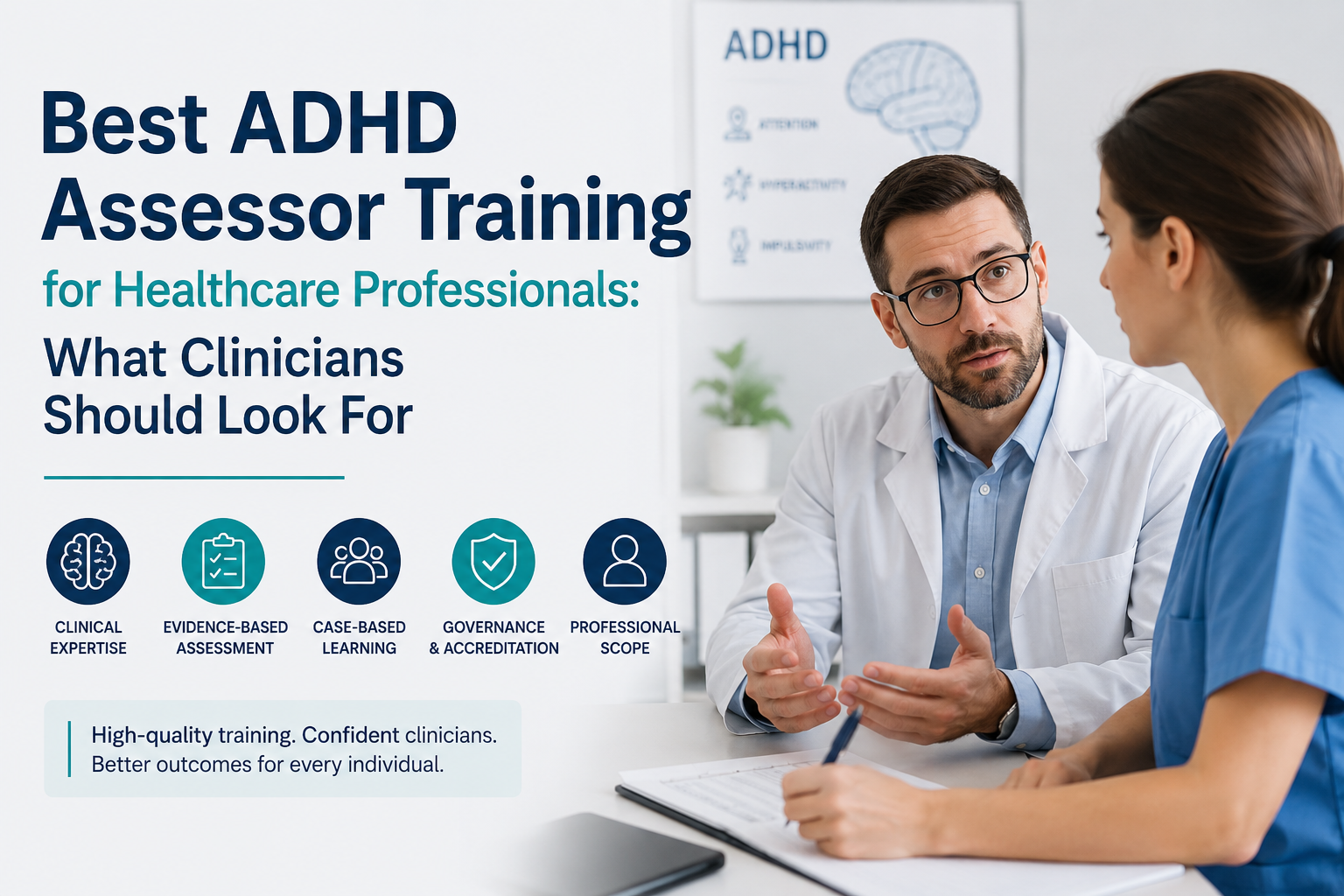
ADHD assessment is a clinical responsibility that carries significant weight. When a healthcare professional completes an ADHD assessment, their findings shape treatment decisions, workplace accommodations, educational support and the long-term wellbeing of the person in front of them. The quality of the assessment depends, in large part, on the quality of the training behind it.
Demand for ADHD services has grown substantially across the United Kingdom and internationally. Waiting lists for NHS ADHD assessments remain lengthy in many regions. Private services have expanded to fill the gap. Across both sectors, clinicians are increasingly expected to hold competency in ADHD assessment, and many are actively looking for training that will help them build that competency with confidence.
The problem is that not all ADHD assessor training is equal. Some courses are brief, superficial and designed primarily to satisfy a minimum CPD requirement. Others are rigorous, clinician-led and built around the clinical complexity that practitioners actually encounter. Choosing between them is not always straightforward, particularly when marketing language can make almost any course sound comprehensive.
This article is written for healthcare professionals who want to make an informed decision. It explains what ADHD assessor training involves, who it is designed for, what a high-quality course should include and why governance, accreditation and professional scope of practice matter in this field. It also explains how Global ADHD Network approaches ADHD training for clinicians across roles and settings.
Table of Contents
- What is ADHD assessor training?
- Who is ADHD assessor training for?
- What should a high-quality ADHD assessment course include?
- Why case-based learning matters
- Why governance and accreditation matter
- Why professional scope of practice is important
- How Global ADHD Network supports healthcare professionals
1. What is ADHD assessor training?
ADHD assessor training is a structured clinical education programme designed to equip qualified healthcare professionals with the knowledge, skills and frameworks needed to conduct ADHD assessments. It is distinct from general ADHD awareness training, which typically focuses on understanding ADHD as a condition. Assessor training goes further, preparing clinicians to conduct structured clinical interviews, apply diagnostic frameworks, interpret rating scale data, consider differential diagnoses and write defensible assessment reports.
ADHD is a neurodevelopmental condition characterised by persistent patterns of inattention, hyperactivity and impulsivity that impair functioning across multiple domains. Diagnosing it accurately requires more than a checklist. Clinicians must take a thorough developmental history, gather collateral information, consider the impact of symptoms across different settings and rule out other conditions that can present similarly, including anxiety disorders, mood disorders, trauma responses, autism spectrum conditions and sleep difficulties.
ADHD assessor training teaches clinicians how to navigate this complexity systematically. It introduces structured diagnostic tools such as the Conners Adult ADHD Rating Scales, the Adult ADHD Self-Report Scale and structured clinical interviews developed for ADHD assessment. It also trains clinicians in applying the diagnostic criteria set out in DSM-5 and ICD-11, the two diagnostic frameworks most commonly used in UK clinical practice.
In short, ADHD assessor training transforms a clinician who understands ADHD into a clinician who can assess for it responsibly. That transformation requires time, clinical supervision and exposure to realistic case material. It cannot be achieved through a brief online module.
2. Who is ADHD assessor training for?
ADHD assessor training is intended for registered healthcare professionals who work in clinical settings where ADHD assessment is relevant to their role. This includes, but is not limited to:
- Psychiatrists and specialist doctors working in ADHD clinics, private practice or secondary care mental health services
- Clinical psychologists and educational psychologists conducting neurodevelopmental assessments
- Mental health nurses and nurse prescribers working within ADHD or neurodevelopmental pathways
- Nurse consultants and advanced nurse practitioners leading ADHD services
- Occupational therapists supporting adults with ADHD in employment, education or daily living
- GPs and primary care clinicians who are involved in shared care or who want to improve their recognition of ADHD presentations
- Allied health professionals working within multidisciplinary neurodevelopmental teams
The appropriate level of training varies by role. A nurse prescriber managing a caseload of ADHD patients will need deeper training in medication monitoring and shared care than an occupational therapist focusing on functional assessment and support planning. High-quality training providers recognise these differences and either offer role-specific pathways or are transparent about who each course is and is not suitable for.
ADHD assessor training is not appropriate for individuals who are not registered healthcare professionals. The skills taught are clinical skills intended for use within the boundaries of a professional registration. Training does not create a licence to assess. It builds competency within a clinician's existing professional scope.
3. What should a high-quality ADHD assessment course include?
A high-quality ADHD assessment course should do more than introduce the DSM-5 criteria and explain what ADHD is. It should prepare clinicians for the full complexity of clinical assessment as it is practised in real-world settings. The following elements are markers of a genuinely rigorous programme.
Comprehensive coverage of ADHD across the lifespan
ADHD presents differently in childhood, adolescence and adulthood. Many adults who are now seeking assessment were not identified in childhood, either because their symptoms were masked, because they developed compensatory strategies or because ADHD in girls and women was significantly under-recognised for decades. A high-quality course must address adult ADHD presentation specifically and must not rely solely on childhood-focused frameworks.
Structured clinical interviewing
Good assessment is built on structured clinical inquiry. Clinicians need training in how to take a thorough developmental history, how to gather collateral information from family members or school records and how to use semi-structured interviews designed for ADHD assessment. Training should include worked examples and opportunities to practise these skills in simulated or supervised contexts.
Rating scales and psychometric tools
Rating scales are a standard component of ADHD assessment. Clinicians must understand how to select appropriate tools, how to administer and score them correctly and how to interpret scores within the context of the clinical picture. Training should clarify what rating scales can and cannot tell you, and should address the limitations of self-report data in ADHD assessment.
Differential diagnosis and comorbidity
This is one of the most clinically demanding aspects of ADHD assessment and one of the most important to train thoroughly. ADHD shares symptom overlap with anxiety disorders, depression, PTSD, autism spectrum conditions, bipolar disorder, personality difficulties and sleep disorders, among others. Clinicians must be trained to identify these overlaps, to consider whether symptoms are better explained by another condition and to recognise when presentations are genuinely complex or comorbid rather than one or the other.
Assessment report writing
An assessment is only as useful as the report that communicates its findings. A well-written ADHD assessment report should document the developmental history, symptom evidence across multiple settings, the differential diagnosis considered and the clinical reasoning behind the conclusion. It should make clear recommendations and be written in language that is accessible to the person assessed as well as to other professionals. Training in report writing is an essential, not optional, component of assessor training.
Post-diagnostic support and onward pathways
Assessment does not end with a diagnosis. Clinicians need to understand what to communicate after assessment, what support options are available and how to refer appropriately. Training should address the clinical responsibilities that follow an ADHD diagnosis, including medication initiation, psychoeducation, shared care arrangements and signposting to relevant resources.
4. Why case-based learning matters
Clinical training is most effective when it is grounded in realistic cases. Abstract knowledge about ADHD does not automatically translate into clinical competency. A clinician who has read the DSM-5 criteria will not necessarily know how to assess a 34-year-old woman who has spent two decades masking her symptoms, developed significant anxiety as a secondary consequence and presents with a developmental history that is hard to unpick.
Case-based learning builds clinical reasoning. It exposes clinicians to the kinds of presentations they will actually encounter: the person who scores below threshold on rating scales but has clear functional impairment; the person whose symptoms were attributed to anxiety for years before anyone considered ADHD; the person with a dual diagnosis of ADHD and autism who requires a fundamentally different assessment approach.
Good ADHD assessor training uses case material to illustrate the diagnostic process from beginning to end. It invites clinicians to work through cases, make decisions, justify their reasoning and encounter feedback. This active engagement builds confidence and competency in ways that passive lecture delivery cannot achieve.
Look for courses that include video-based case discussions, small group clinical supervision, written case studies with worked examples or simulated assessment exercises. These are the features of training designed around how clinicians actually learn, not just around how information can be most efficiently delivered.
The National Institute for Health and Care Excellence (NICE) guidelines on ADHD (NG87) emphasise the importance of comprehensive, multisource assessment. Training that does not prepare clinicians to meet these standards is not fit for clinical purpose.
5. Why governance and accreditation matter
Governance in clinical education refers to the structures and processes that ensure a training programme is safe, current, accurate and accountable. It matters because ADHD assessments are consequential. They affect real people's access to treatment, medication, support and recognition. Training that is poorly designed, factually out of date or delivered without appropriate oversight can cause harm, not through malicious intent, but through inadequate preparation.
When evaluating an ADHD training provider, governance is one of the most important factors to investigate. Key questions include:
- Is the course content reviewed regularly against current clinical guidelines, including NICE NG87 and updates to DSM-5 and ICD-11?
- Are the trainers named, registered and appropriately credentialed in ADHD assessment?
- Is there a clinical advisory board or equivalent body with responsibility for curriculum oversight?
- Does the provider have transparent policies on equality, safeguarding, quality assurance and complaints?
- Is accreditation clearly explained, including which body has accredited the course and what the accreditation covers?
Accreditation provides an independent external check that a course meets defined standards. However, accreditation alone is not sufficient. Clinicians should understand what was accredited, which body granted the accreditation and whether the accreditation is current. Some accreditation bodies carry more clinical credibility than others. A course that is CPD-accredited by a recognised professional body is a stronger signal than one that is simply described as accredited without further detail.
Transparency is itself a governance signal. A provider that is open about its faculty, its curriculum, its assessment criteria, its accreditation details and its quality assurance processes is demonstrating that it has nothing to hide. A provider that is vague about any of these areas warrants closer scrutiny before committing to a course.
The Care Quality Commission (CQC) sets standards for clinical service quality in England. While training providers are not directly regulated by the CQC, the principles of safe, effective, transparent practice that the CQC promotes are equally applicable to clinical education.
6. Why professional scope of practice is important
ADHD assessor training builds clinical competency. It does not grant new professional permissions. This is a distinction that every responsible training provider should make explicit, and every clinician should understand before undertaking a course.
Professional scope of practice is defined by a clinician's registration, their employer's governance structures and, where relevant, their professional body's standards. A nurse who completes an ADHD assessment training course has enhanced their knowledge and skills. They do not automatically have the authority to conduct and sign off ADHD assessments unless that falls within their existing role, their employer's job description and their professional registration.
This matters for several reasons. First, it protects patients. An assessment conducted outside a clinician's sanctioned scope of practice may not carry the clinical or legal weight that is expected of it. Second, it protects clinicians. Practising outside your scope exposes you to regulatory, legal and professional risk. Third, it ensures that ADHD assessments are conducted within the governance structures that protect both the clinician and the person being assessed.
High-quality training providers address scope of practice directly and honestly. They make clear who the training is suitable for, what it qualifies clinicians to do within their existing role and where the boundaries of training-derived competency lie. Be cautious of providers who imply that completing their course is sufficient to begin conducting independent assessments, regardless of a clinician's professional registration or employer context.
If you are unsure whether ADHD assessment falls within your professional scope, consult your professional body, your employer and, where relevant, your indemnity provider before beginning to assess patients.
7. How Global ADHD Network supports healthcare professionals
Global ADHD Network was established with a clear purpose: to improve the quality of ADHD assessment and care by providing rigorous, clinician-led training that is grounded in current evidence and real-world practice. The training programmes are designed for healthcare professionals across a range of roles and settings, with a consistent emphasis on clinical credibility, practical application and professional accountability.
The ADHD assessor training offered by Global ADHD Network is developed by clinicians who conduct ADHD assessments in practice. The curriculum is reviewed against current NICE guidance, DSM-5, ICD-11 and emerging evidence in the field. Case-based learning is central to the programme design, ensuring that clinicians leave training with more than theoretical knowledge. They leave with structured approaches, rehearsed clinical reasoning and the confidence to apply what they have learned.
Governance is taken seriously at every level. The training faculty are named, registered professionals with relevant clinical backgrounds. The curriculum sits within a governance framework that includes clinical oversight and quality assurance processes. Accreditation details are communicated transparently, and clinicians are explicitly informed about the scope of what the training qualifies them to do within their existing professional registration.
Training is available in formats that accommodate the working lives of clinicians, including scheduled live sessions, access to recorded content and structured post-course resources. Role-specific pathways recognise that the training needs of a nurse prescriber differ from those of a clinical psychologist or a GP working in shared care.
To explore upcoming training dates and course formats, visit the ADHD assessor training on the Global ADHD Network website. You can also browse role-specific pathways for nurses, psychologists, GPs and pharmacists.
For healthcare professionals who want to assess for ADHD with greater confidence, clinical rigour and professional accountability, Global ADHD Network provides a training pathway designed to meet those needs without compromise.
8. Frequently asked questions
Can any healthcare professional undertake ADHD assessor training?
ADHD assessor training is designed for registered healthcare professionals. It is not appropriate for individuals without a healthcare registration. Whether ADHD assessment falls within a specific clinician's scope of practice depends on their registration, their employer and their professional role.
How long does ADHD assessor training take?
This varies by provider and programme. Some courses are delivered over a single day; others span several weeks with a combination of live sessions and self-directed study. The depth and comprehensiveness of training generally correlates with its duration. A single-day overview is unlikely to adequately prepare a clinician for independent assessment practice.
Is ADHD assessor training accredited?
Accreditation varies by provider. When evaluating a course, ask which body has accredited it, what the accreditation covers and whether it is current. CPD accreditation from a recognised professional body is a positive signal, but it should be considered alongside faculty credentials, curriculum quality and governance structures.
Will completing ADHD assessor training allow me to start assessing patients?
Training builds competency. It does not automatically grant clinical permission to conduct assessments. Whether you can conduct ADHD assessments following training depends on your professional registration, your employer's governance structures and your existing scope of practice. Responsible providers will make this clear from the outset.
What is the difference between ADHD awareness training and ADHD assessor training?
ADHD awareness training introduces clinicians to ADHD as a condition: its presentation, prevalence, impact and treatment options. ADHD assessor training goes further, equipping clinicians with the structured clinical skills needed to conduct assessments, apply diagnostic frameworks, interpret rating scales, consider differential diagnoses and write clinical reports. The two are not interchangeable.
Ready to build your ADHD assessment competency?
View upcoming ADHD assessor training dates and explore role-specific pathways at Global ADHD Network. All courses are developed and delivered by registered clinicians with direct experience in ADHD assessment practice.
%20(1).webp)