Global ADHD Network — One of the most highly reviewed ADHD CPD and CME training providers in ADHD diagnosis and neurodiversity training.Global ADHD Network — One of the most highly reviewed ADHD CPD and CME training providers in ADHD diagnosis and neurodiversity training.Global ADHD Network — One of the most highly reviewed ADHD CPD and CME training providers in ADHD diagnosis and neurodiversity training.
ADHD and autism are two separate neurodevelopmental conditions, but they share enough overlapping traits that many parents and even some clinicians find it difficult to tell them apart. Understanding what makes each condition distinct, and what happens when they occur together, is one of the most important steps towards getting the right diagnosis and the right support.
If you have ever wondered whether ADHD is a form of autism, you are not alone. It is one of the most commonly searched questions by parents, educators, and even newly diagnosed adults. The confusion is understandable. Both conditions can affect attention, social communication, behaviour, and learning. Both are neurodevelopmental in origin. And both are far more common than most people realise.
However, ADHD and autism are distinct conditions with different diagnostic criteria, different underlying profiles, and different support needs. Knowing the difference matters, because the right diagnosis shapes everything that follows, from school support plans and therapy choices to medication decisions and long-term outcomes.
This article explains what separates ADHD from autism, what they share, how each is diagnosed, and what it means when both are present at the same time, a combination increasingly referred to as AuDHD.
Table of contents
1. What Is ADHD?
2. What Is Autism?
3. Is ADHD a Type of Autism?
4. Key Differences Between ADHD and Autism
5. Overlapping Traits: Where the Confusion Comes From
6. Can a Child Have Both ADHD and Autism (AuDHD)?
7. How ADHD and Autism Are Diagnosed
8. Treatment and Support Options
9. Expert Insights: Getting the Right Diagnosis
10. Practical Guidance for Parents and Carers
11. Frequently Asked Questions
12. Conclusion
What Is ADHD?
Attention Deficit Hyperactivity Disorder (ADHD) is a neurodevelopmental condition that affects how the brain manages attention, impulse control, and activity levels. It is one of the most common childhood conditions worldwide, affecting an estimated 5 to 7 percent of children globally, according to research cited by the NHS.
According to the NHS overview of ADHD, the condition affects an estimated 5 percent of children in the UK, though many go undiagnosed."
ADHD is typically categorised into three presentations:
Predominantly inattentive (sometimes still referred to informally as ADD) where the main challenges are concentration, organisation, and following through on tasks
Predominantly hyperactive-impulsive where restlessness, impulsivity, and difficulty staying seated are the primary features
Combined presentation which includes both inattentive and hyperactive-impulsive symptoms
Symptoms must be present across more than one setting, such as at home and at school, and must have a meaningful impact on daily functioning in order to meet the diagnostic threshold.
What Is Autism?
Autism, or Autism Spectrum Disorder (ASD), is a lifelong neurodevelopmental condition that affects how a person experiences and interacts with the world around them. It influences social communication, sensory processing, behaviour, and the way someone thinks and learns.
The word "spectrum" reflects the wide range of ways autism presents across different individuals. Some autistic people have significant support needs, while others live largely independently. Autism is not an illness and it cannot be cured, but with the right understanding and support, autistic individuals can lead full and meaningful lives.
The NHS guidance on autism confirms the condition affects around 1 in 100 people, though prevalence is likely higher due to underdiagnosis. particularly in women and girls.
Is ADHD a Type of Autism?
No. ADHD is not a type of autism, and autism is not a type of ADHD. They are two entirely separate conditions with their own distinct diagnostic criteria.
That said, it is easy to see why this question arises so frequently. Both are neurodevelopmental conditions, meaning they originate in how the brain develops. Both can affect behaviour, learning, and social interaction. And both are classified within what many researchers now describe as neurodiversity, the natural variation in how human brains function.
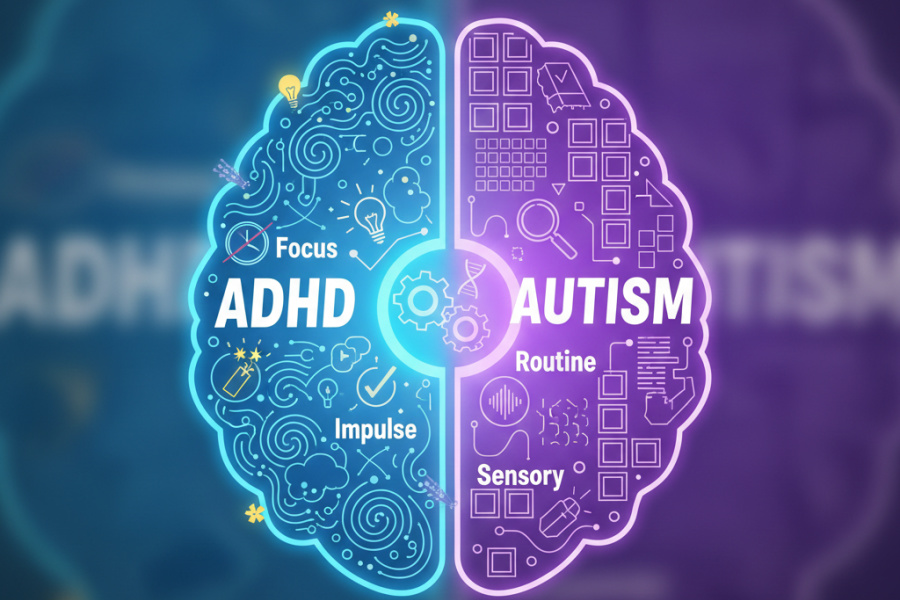
The key distinction is this: autism primarily affects social communication and sensory processing, and is often characterised by a preference for routine and repetition. ADHD primarily affects attention regulation, impulse control, and executive function. While these profiles can look similar on the surface, the underlying mechanisms and lived experiences are meaningfully different.
Key Differences Between ADHD and Autism
Social Interaction and Communication
Children with autism often find it difficult to interpret social cues, make eye contact, or understand unspoken rules of conversation. They may struggle to express their feelings or read the emotions of others. Some autistic children prefer to keep to themselves, while others want social connection but find the skills required very challenging to develop.
Children with ADHD, by contrast, are often sociable and even highly talkative. The difficulty is not usually in wanting to connect, but in regulating how they engage. They may interrupt frequently, talk over others, or struggle to listen during a conversation. Impulsivity, rather than a fundamental difference in social understanding, tends to drive these challenges.
Preferences, Routines, and Flexibility
Autistic children frequently depend on routine and predictability. Changes to expected plans, even minor ones, can cause significant distress. Many autistic individuals develop intense, focused interests in specific topics that bring them real pleasure and a sense of identity.
Children with ADHD tend to be far less attached to routine. In fact, repetition can feel tedious or even intolerable. They are often drawn to novelty and variety, which can work both for and against them in daily life.
Movement and Sensory Experience
Hyperactivity in ADHD typically looks like restlessness, fidgeting, difficulty sitting still, or an internal sense of being driven that the child cannot easily explain. It tends to be somewhat random and driven by the need for stimulation.
In autism, repetitive movements, known as stimming, serve a very different purpose. Hand-flapping, rocking, spinning, or other repetitive physical actions are often used to self-regulate, particularly in response to sensory overload or emotional stress. Sensory sensitivities, to sounds, textures, light, or taste, are also a recognised feature of autism that is not a core part of ADHD, though some ADHD individuals do experience sensory differences.
Attention and Detail
Children with ADHD commonly struggle with attention to detail, particularly for tasks that do not hold their interest. They may skim read, miss instructions, or make careless errors.
Autistic children can show the opposite tendency, noticing highly specific details that others overlook, sometimes to a degree that makes general, big-picture thinking more difficult. Their thinking can appear very literal and precise.
Overlapping Traits: Where the Confusion Comes From
Despite being distinct conditions, ADHD and autism share several surface-level similarities that can make initial identification difficult even for experienced clinicians:
Both can involve difficulties in social settings and peer relationships
Both can affect academic performance and classroom behaviour
Both can present with emotional dysregulation and frustration
Both may involve sleep difficulties
Both can be associated with anxiety
Both are more commonly identified in boys, though this is now understood to reflect diagnostic bias rather than a true difference in prevalence
These overlaps are one reason why professional assessment is so important. Relying on observable behaviour alone, without a structured diagnostic process, increases the risk of misdiagnosis or missed diagnosis.
For adults managing both impulsivity and attention challenges, our article on managing ADHD impulsivity in adults offers practical strategies.
Can a Child Have Both ADHD and Autism (AuDHD)?
Yes, and it is more common than many people realise. Research consistently shows that a significant proportion of autistic individuals also meet the criteria for ADHD, and vice versa. Some estimates suggest that up to 50 to 70 percent of autistic children also have ADHD symptoms, while around 20 to 50 percent of children with ADHD show autistic traits.
This combination is increasingly referred to in both clinical and community settings as AuDHD. It is not an official diagnostic term, but it captures the reality of what many people experience, a profile that includes both the executive function and attention challenges of ADHD and the social communication and sensory features of autism.
Children with both conditions may present with more complex needs. Research suggests that the combined profile is associated with greater difficulty managing emotions, stronger sensory sensitivities, and a higher likelihood of experiencing anxiety. Treatment needs to account for both conditions simultaneously, which is why accurate and thorough assessment matters so much.
It is worth noting that before 2013, the diagnostic guidelines used in many countries actually prevented clinicians from giving both diagnoses at the same time. The updated DSM-5 removed this restriction, which is part of why rates of co-occurring diagnosis have increased. This is not an epidemic. It reflects better diagnostic practice.
There is no single test for ADHD. Diagnosis is based on a thorough clinical assessment that typically includes:
A detailed developmental history gathered from parents or carers
Behavioural questionnaires and rating scales completed by parents and teachers
Clinical interviews with the child where age-appropriate
Observation and ruling out of other conditions that can mimic ADHD, such as anxiety, sleep disorders, or learning difficulties
Symptoms must be present in more than one setting, must have begun before the age of 12, and must cause meaningful impairment in daily life. In the UK, assessment is carried out by paediatricians, child and adolescent psychiatrists, or clinical psychologists with appropriate training.
Autism Diagnosis
Autism assessment is similarly multi-stage. It typically begins with a referral to a specialist team and includes:
Detailed developmental and family history questionnaires completed by parents
Standardised assessment tools such as the ADOS-2 (Autism Diagnostic Observation Schedule) and the ADI-R (Autism Diagnostic Interview)
Structured observation of the child's social interactions and communication
Cognitive or speech and language assessments where relevant
Autism assessment teams often include a combination of professionals, such as a clinical psychologist, speech and language therapist, and paediatrician or psychiatrist.
Both ADHD and autism assessments benefit from information gathered across multiple settings, home, school, and clinical observation, to build the fullest possible picture of how a child is functioning.
If you are unsure who carries out these assessments, our article on what an ADHD assessor does explains the role and what to expect.
Treatment and Support Options
Supporting a Child with ADHD
There is no single correct approach for ADHD, and the right combination of support will depend on the child's age, presentation, and individual needs.
For younger children, behavioural therapy and parent training programmes are generally recommended as the first line of support. These approaches help children develop self-regulation skills and help parents manage challenging behaviours more effectively.
For older children and adolescents, a combination of psychological support and medication is often most effective. ADHD medication, most commonly stimulants such as methylphenidate or amphetamine-based medications, can make a significant difference in attention and impulse control for many children. Non-stimulant options are also available where stimulants are not suitable.
School-based accommodations, such as extra time in assessments, reduced distraction environments, and task-breaking strategies, can have an enormous impact on academic outcomes.
Supporting a Child with Autism
Support for autism is typically structured around the individual's specific needs and strengths. Common interventions include:
Behavioural therapy to develop functional skills and manage challenging behaviours
Speech and language therapy to support communication, whether verbal or non-verbal
Occupational therapy to address sensory sensitivities and develop daily living skills
Social skills groups for children who want to improve peer relationships
Medication is not used to treat autism itself, but can be helpful in managing co-occurring conditions such as anxiety, hyperactivity, or sleep difficulties.
Supporting a Child with Both Conditions
When ADHD and autism are both present, the treatment plan needs to address both profiles. This requires a coordinated approach across professionals. ADHD medication can be effective in reducing hyperactivity and improving attention even in autistic children, but responses can vary and side effects may be more noticeable, so careful monitoring is essential.
Expert Insights: Getting the Right Diagnosis
Clinicians who work regularly in this area consistently highlight one theme: early and accurate diagnosis changes lives.
When a child's difficulties are correctly identified and understood, parents and educators are better placed to offer the right kind of support. The child themselves benefits from understanding why they experience the world differently, which can reduce shame, build self-awareness, and improve mental health outcomes significantly.
Misdiagnosis or underdiagnosis, on the other hand, can leave children struggling for years without the support they need. This is particularly true for autistic girls, who often learn to mask their difficulties from an early age, and for children from ethnic minority backgrounds who may face diagnostic bias in clinical settings.
If you are seeking assessment for your child, it is worth requesting a clinician with specific experience in both ADHD and autism, and asking that the assessment considers both conditions, rather than assuming one rules out the other.
Practical Guidance for Parents and Carers
If you are concerned about your child, here are some practical steps you can take:
Keep a behaviour diary. Note specific incidents, what triggered them, how long they lasted, and how your child responded. This information is genuinely useful during assessment appointments.
Talk to your child's school. Teachers see children in a very different context to parents. Asking for their observations in writing gives assessors a more complete picture.
Request a referral early. Waiting lists for both ADHD and autism assessment in the NHS can be long. Starting the process as soon as you have concerns means your child will be seen sooner.
Do not rely on internet checklists alone. Online symptom lists are useful for raising awareness but they are not a substitute for professional assessment. Many conditions share surface features and only a qualified clinician can draw reliable conclusions.
Take care of yourself too. Supporting a child with complex needs is demanding. Parent support groups, both condition-specific and general, can be invaluable.
If you are a clinician looking to build expertise in co-occurring conditions, our ADHD training for professionals outlines the clinical development pathways available.
Frequently Asked Questions
Can a child be misdiagnosed with ADHD when they are actually autistic?
Yes, this does happen. Because both conditions can affect attention, behaviour, and social functioning, it is possible for a child's autism to be missed if the assessing clinician is primarily looking for ADHD. This is more common in girls, whose autism presentations often differ from the classic profiles originally used to develop diagnostic tools. Comprehensive assessment that considers both conditions reduces this risk.
At what age can ADHD and autism be diagnosed?
Both conditions can be identified in early childhood, sometimes before the age of three in the case of autism. ADHD is typically diagnosed from around age four, though formal assessment is most reliable from school age onwards when the demands of the environment make difficulties more visible. In practice, many children are not diagnosed until they are older, particularly if their difficulties have been managed or masked.
Does having ADHD mean my child is more likely to be autistic?
Research does suggest a meaningful overlap. Studies estimate that between 20 and 50 percent of children with ADHD also meet criteria for autism. This does not mean ADHD causes autism or vice versa, but it does mean that if your child has one diagnosis, it is worth asking whether the other should also be considered, particularly if there are signs of social communication difficulty or sensory sensitivity.
Are ADHD and autism more common in boys than girls?
Historically, both conditions have been diagnosed far more frequently in boys. However, researchers now understand that this largely reflects diagnostic bias and the fact that girls often present differently and may mask their difficulties more effectively. Many girls and women receive their diagnoses much later in life as a result. Awareness of gender differences in presentation is growing, but there is still significant progress to be made in clinical practice.
Will my child always need support, or can they grow out of ADHD or autism?
Autism is a lifelong condition. While many autistic individuals develop skills and strategies that help them manage day-to-day life very effectively, the underlying neurology does not change. ADHD is more variable. Some children find that symptoms reduce in intensity as they move into adulthood, particularly hyperactivity, but many continue to experience significant challenges with attention and executive function throughout their lives. Early support tends to produce better long-term outcomes for both conditions.
Conclusion
ADHD and autism are not the same condition, but they are related in important ways. They share some surface features, they can co-occur in the same individual, and both benefit enormously from early identification and well-targeted support.
Understanding the difference between these two conditions, and recognising the reality of the overlap, helps parents advocate more effectively for their children, helps clinicians provide more accurate assessments, and helps individuals themselves make sense of their own experiences.
If you have concerns about your child, the single most important step you can take is to seek a professional assessment from a clinician experienced in both conditions. The right diagnosis is not just a label. It is the foundation for everything that comes after.
Medication Considerations
Medication decisions for children with ADHD, autism, or both require careful thought and close collaboration with a qualified clinician. There is no one-size-fits-all approach, and what works well for one child may not be appropriate for another.
For children with ADHD alone, stimulant medications such as methylphenidate (Ritalin, Concerta) and lisdexamfetamine (Vyvanse) are the most commonly prescribed and have a well-established evidence base. Non-stimulant options such as atomoxetine or guanfacine may be considered where stimulants are not tolerated or not effective.
For children with both ADHD and autism, the picture is more nuanced. Research suggests that autistic children can respond differently to stimulant medication compared to neurotypical children. They may experience a narrower window of effective dosage, and side effects such as increased anxiety, irritability, or emotional withdrawal can be more pronounced. This means that starting at a lower dose and titrating slowly is often the preferred approach.
It is also important to consider that some behaviours in autistic children that resemble ADHD symptoms, such as inattention or hyperactivity, may actually be driven by anxiety or sensory overload rather than executive function difficulties. In these cases, medication targeting ADHD alone may not produce the expected results, and addressing the underlying anxiety or sensory environment may be more effective.
Medication is never a standalone solution. It works best as part of a broader support plan that includes behavioural strategies, school accommodations, and where appropriate, therapy. Parents should always discuss the full range of options with their child's prescribing clinician, ask about monitoring arrangements, and feel empowered to raise concerns if something does not seem right.
%20(1).webp)